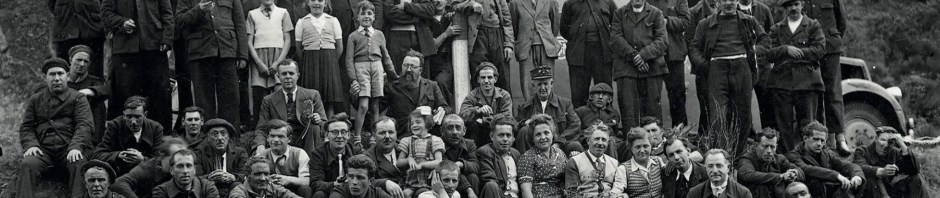

Hospital staff members, children and patients during a day trip near the Saint-Alban Psychiatric Hospital, circa 1950. Credit… Baldran Collection, Saint-Alban-sur-Limagnole. [New York Times caption and illustration]
“Gathering, touching, connecting — these are Tosquelles’s methods.”
This article highlights an exhibition at the American Folk Art Museum in Manhattan that will end on August 18, 2024:
Francesc Tosquelles: Avant-Garde Psychiatry and the Birth of Art Brut.
The Catalan doctor Francesc Tosquelles was “a psychiatrist who spent decades dismantling the hard bars between illness and health, pathology and normalcy, artists and everyone else. He drew on Freud and Marx, and also on his experience as a refugee, in exile from Franco’s fascist Spain.”
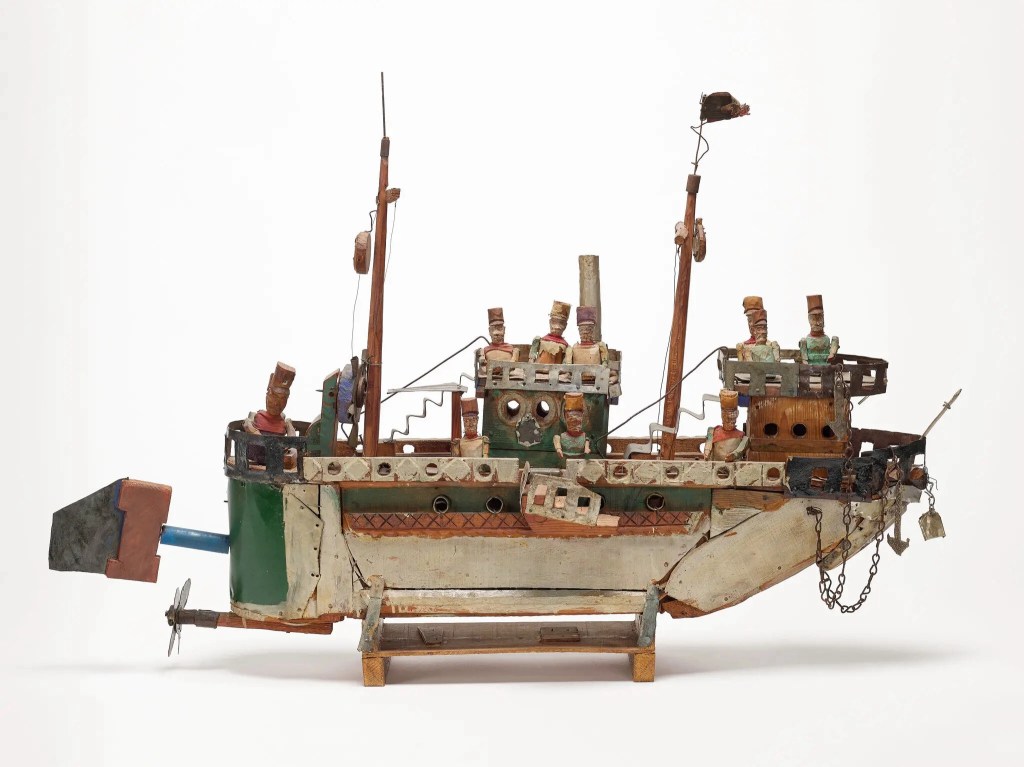
Auguste Forestier’s sculpture “Untitled (Boat),” 1935-1949, opens the exhibition at the American Folk Art Museum. Credit… CNAC/MNAM, via RMN-Grand Palais/Art Resource, NY. [New York Times caption and illustration]
Against the historical trauma of fascism, war and displacement, Tosquelles built radical psychiatric practices around non-hierarchical relations between patients, doctors and their neighbors… He also encouraged his patients’ creativity, which put him at the confluence of Modernist avant-gardes and Art Brut. All these ideas converged at a psychiatric hospital in Saint-Alban, a small village in southern France, where Tosquelles worked from 1940 to 1962.
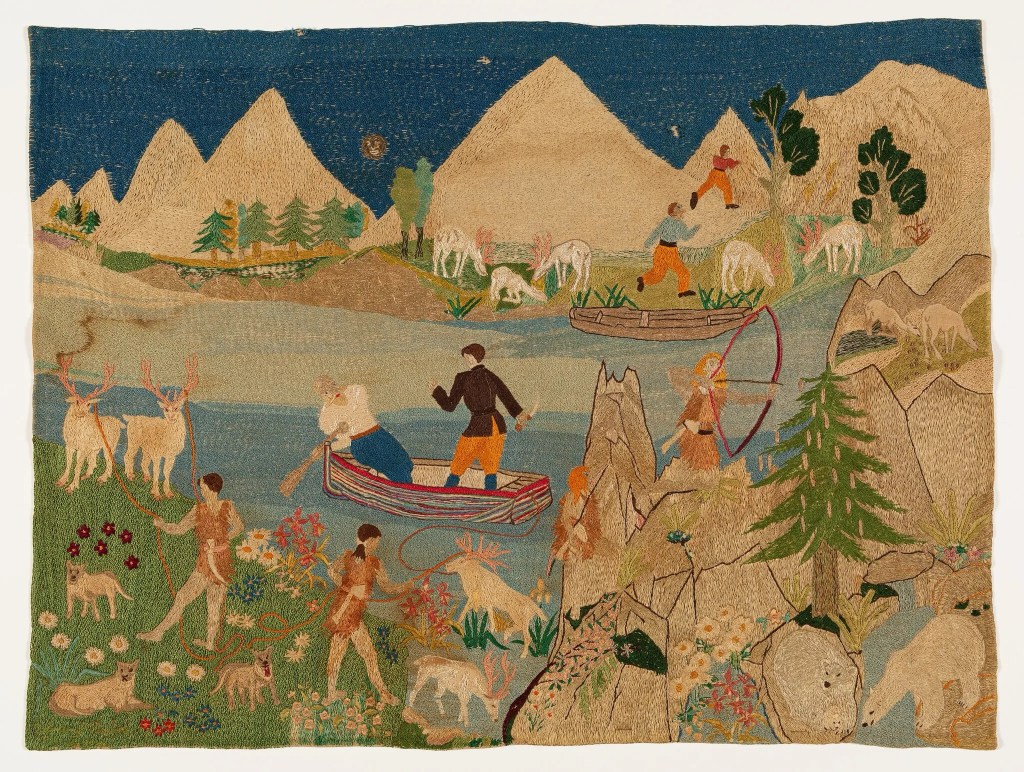
Marguerite Sirvins, “Landscape With Boats, Hunters, and Animals,” circa 1944-1955, rayon thread embroidered on fabric. Credit… Musée LaM. [New York Times caption and illustration]
Tosquelles also instructed his colleagues in psychoanalytic concepts and trained local people in basic psychiatry. With fascists on the march and decades of unthinkably brutal war, it seemed clear to Tosquelles that just about everyone needed therapy. If the affliction is social, he reasoned, the treatment must be too. [My emphasis — JMN]

”Untitled (Known as ‘Myrllen’s Coat’),” circa 1948-1955, a cloak covered in pale blue curls, heart-shaped groups of figures and illegible letters, made by a woman named Myrllen. Credit… Tennessee State Museum, Nashville. [New York Times caption and illustration]
The story behind “Myrllen’s Coat” is poignant:
Its maker, a woman named Myrllen, reportedly experienced symptoms of schizophrenia, and was one of the first Americans prescribed Thorazine. Her harrowing hallucinations subsided, but so did her desire to sew.
(Travis Diehl, “The Avant-Garde Psychiatrist Who Built an Artistic Refuge,” New York Times, 7-22-24)
(c) 2024 JMN — EthicalDative. All rights reserved

 EthicalDative
What an interesting post Jim!
LikeLiked by 1 person
Thank you, Sue!
LikeLiked by 1 person
https://trinkhall.museum/ This might be of interest to you, JMN. Trinkhall in Liège, Belgium, is a museum that exhibits artists that are different from the average man. I just love the place and the art ! Not brut at all. Very sensitive instead !
Many thanks and a great day to you.
LikeLiked by 1 person
“Qu’est-ce que la justesse des formes, des matières, des volumes ? […] Où en sommes-nous avec la dissimulation, le mensonge ou la vérité ? […] Juillet s’étale dans l’imprécision des devenirs.” I love the statements implied in such questions, and the questions implied in such statements. Poetry! The link to the Liège Trinkhall Museum that you’ve furnished is extremely interesting. You’re very kind and intuitive to provide it. I must explore and find out more about this space. I’ve subscribed to its newsletter. Your work leads to such worlds. Daily contact with you, along with Doonesbury, Gary Larson and The New Yorker, is a ritual for me. Best regards — Jim
LikeLiked by 1 person
Next to Gary Larson and Garry Trudeau ! I bend in unlimited thanks, Jim ! Have a super great day !
LikeLiked by 1 person