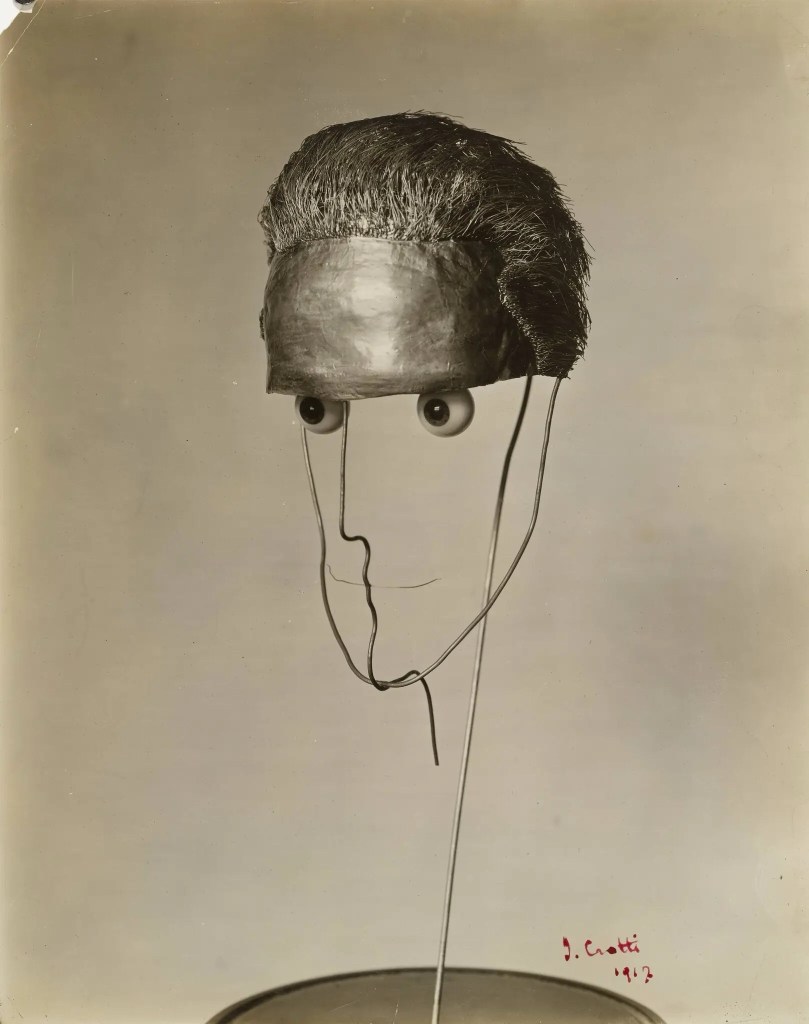
Jean Crotti’s wire sculpture of Duchamp. Credit… Artists Rights Society (ARS), New York/ADAGP, Paris; via The Museum of Modern Art, New York [New York Times caption and illustration]
“When functioning as art, an object asks its viewers to ‘look harder, look longer, ask questions, interrogate, try to make something of it.’”
Alva Noë, philosopher at the University of California, Berkeley)
Duchamp helps us understand that “art” shouldn’t be thought of as a noun that picks out certain kinds of objects, but as a verb: We “art” absolutely any object at all by using it to trigger thoughts and conversation.
Marcel Duchamp was chairman of the “hanging committee” for the First Annual Exhibition of the Society of Independent Artists in April 1917. It showed 2,400 works by 1,300 makers. At Duchamp’s behest, the works were displayed alphabetically by the 1,300 makers’ names. This caused much heartburn in art circles. Robert Henri, dean of the Ashcan School (my favorite “school” of painters) wrote:
“Should order and relationship not be sought in the presentation of pictures?… We would not care for a musical program where Beethoven’s Seventh Symphony would be followed by a fox-trot, nor would it be possible to enjoy eating in sequence mustard, ice-cream, pickles and pastry.”
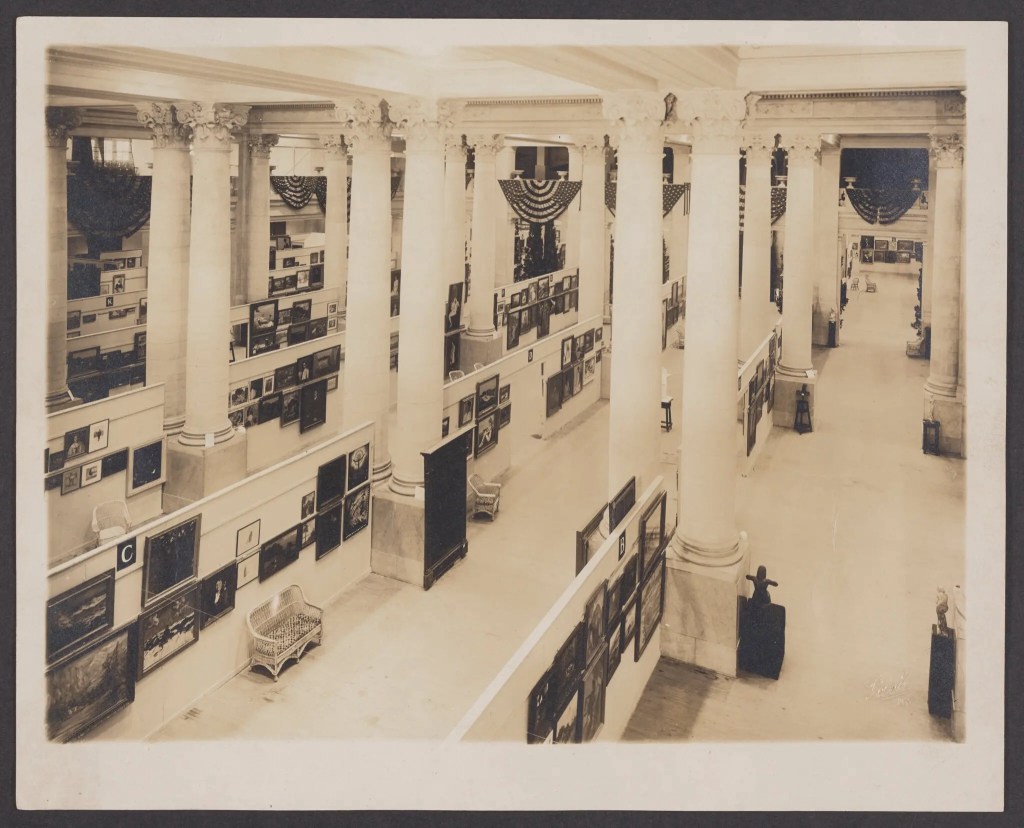
An April 1917 view of the Exhibition of the Society of Independent Artists at the Grand Central Palace. Credit… via Philadelphia Museum of Art Library and Archives: Arensberg Archives. [New York Times caption and illustration]
(Blake Gopnik, “Duchamp Made a Urinal Into Art in 1917. We’re Still Discussing it.” New York Times, 4-7-26)
(c) 2026 JMN — EthicalDative. All rights reserved

 EthicalDative