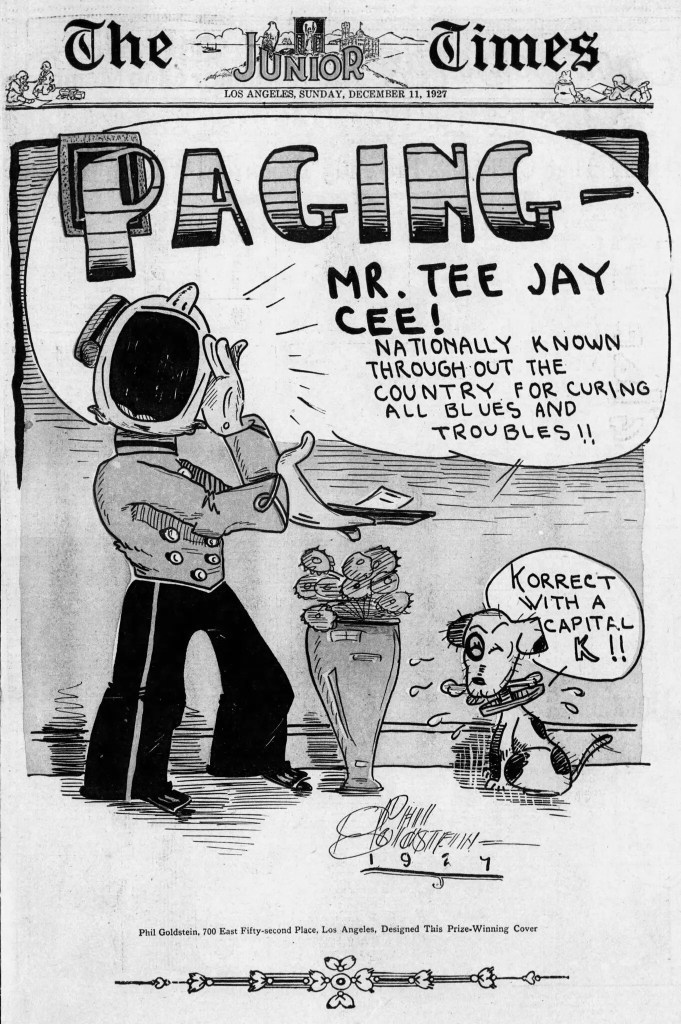
For me the skills of cartoon and caricature are from on high, which is why I relished this article about Philip Guston. It told me much I didn’t know. He was the son of Ukrainian Jewish immigrants in Montreal who moved to Los Angeles. In adulthood he changed his surname from Goldstein. As a student at Manual Arts High School in the 1920’s, he was friends with a young Jackson Pollock.
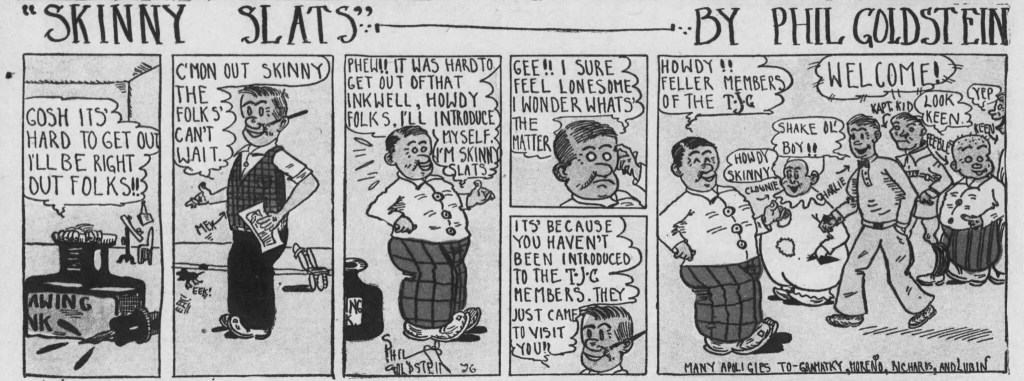
[Guston] joined a youth organization that produced The Junior Times, a Sunday supplement in The Los Angeles Times for essays, poems, puzzles and illustrations by kids, for kids. From 1925 to 1929, in these pages, Guston honed his pen for an audience of the West Coast’s largest home delivery.
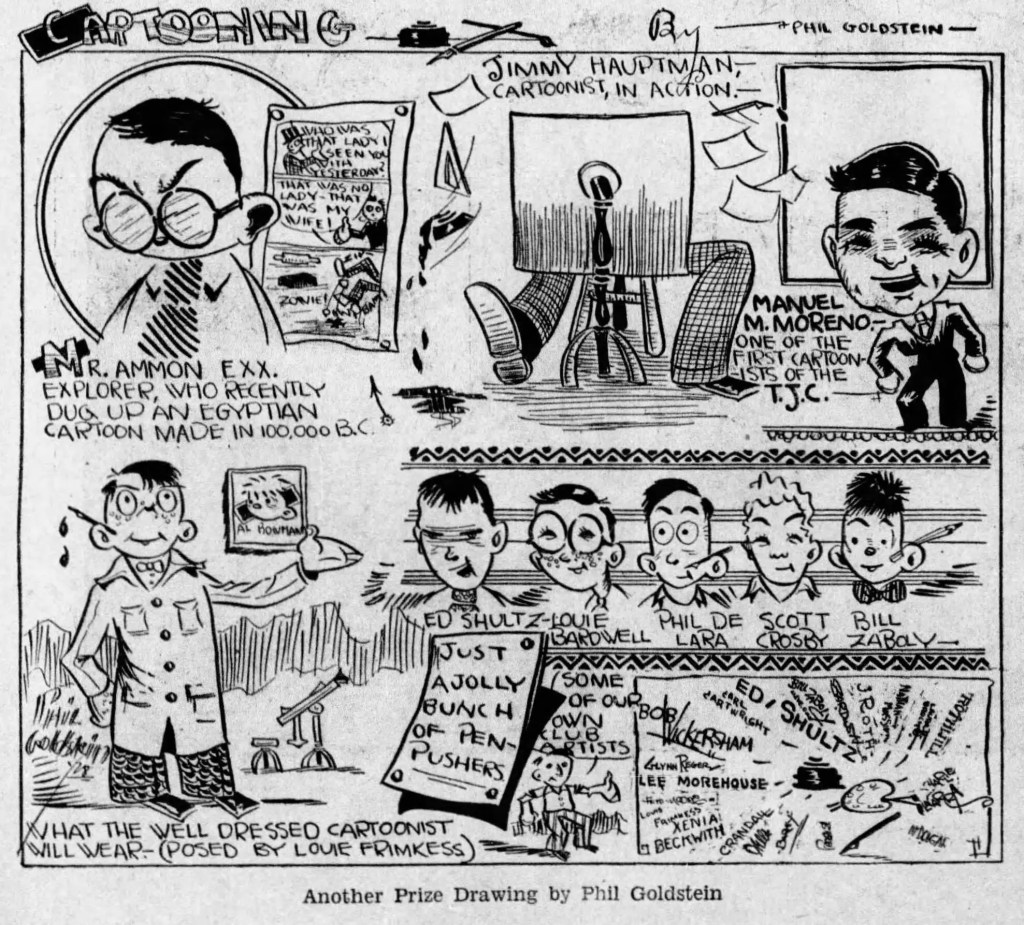
The “jolly bunch of pen-pushers,” as Guston described the teenage illustrators in a sleekly drawn, George Herriman-esque panel of July 1928, would go on to arts careers themselves: Louie Frimkess founded the firm Advertising Designers, Philip Delara joined Warner Brothers; Bill Zaboly, a Minnesotan, inherited the design of Popeye after E.C. Segar’s death, while Manuel Moreno, the brightest face in Guston’s group, established a short-lived studio in Mexico after animating for Walter Lantz, the creator of Woody Woodpecker.
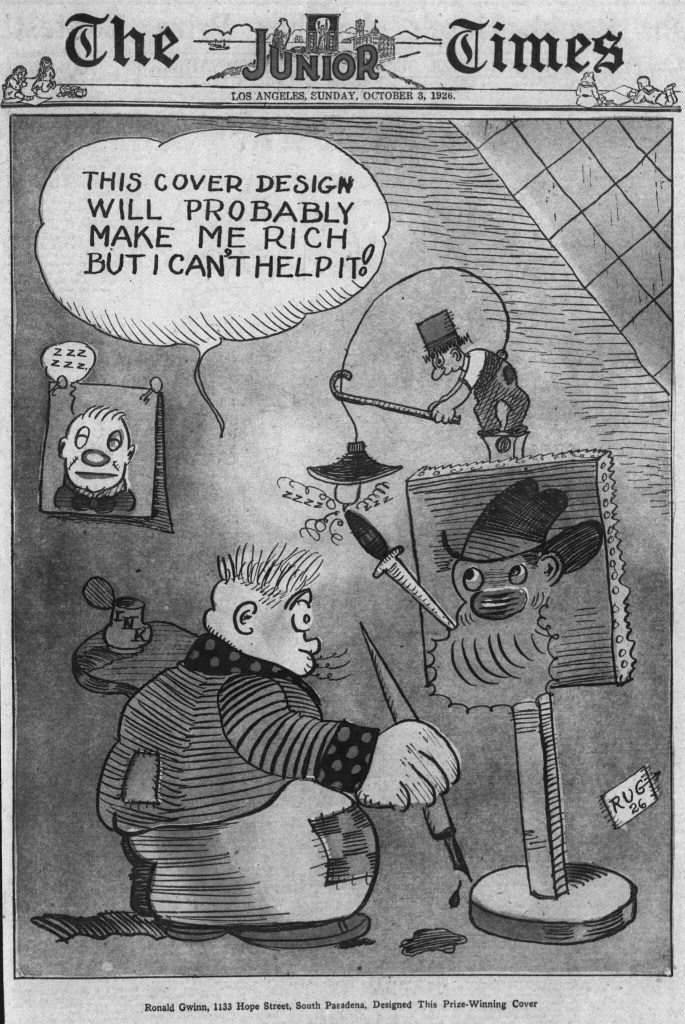
Art history is aware of Guston’s loftier influences — his mentor in West Coast Surrealism, Lorser Feitelson, or the Hollywood collectors of Duchamps and Brancusis, the Arensbergs — but these homegrown funny pages, with their collaborations and callbacks, were a laboratory for him and for budding artists of all predilections.
Controversy surrounds Guston’s figurative painting later in life, and critics speculate that he may have regretted racial stereotypes that appeared in his youthful cartoons. To quote the article: “Guston left no record beyond the comics themselves.”
(Walker Mimms, “Are Philip Guston’s Teenage Cartoons the Key to His Klan Images?” New York Times, 6-14-24)
(c) 2024 JMN — EthicalDative. All rights reserved

 EthicalDative
Thanks for that Jim. I couldn’t see anything in his (late) paintings but now it all makes sense.
LikeLiked by 1 person