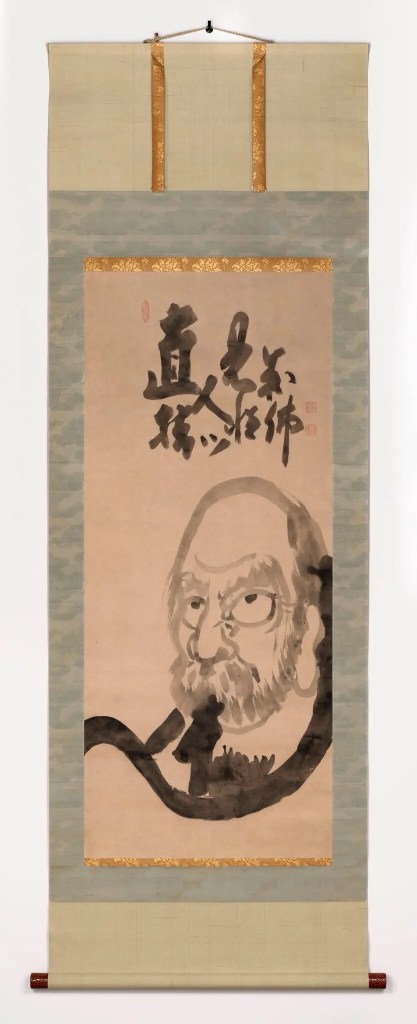
The thin, gray quality of the old man’s face suggest [sic] that even a Zen master’s identity is evanescent, while the dark intensity of his eyes captures the timeless persistence of his understanding. A series of feathery, beautiful strokes come together at the bottom to form a beard, making the off-white paper look whiter where it flashes between them. Daruma just appears out of nowhere, as if he were always there.
(Will Heinrich, “In Zen Painting, It Takes Years of Practice to Do Almost Nothing,” New York Times, 4-6-24)
Think what you will about copyedit lapses, the article is interesting in what it says about Zen painting. It points out how “letting go of the impulse to fill in interesting details” contributes to making pictures that aren’t fussy and overwrought. Be still, my bumbling brush.
(c) 2024 JMN — EthicalDative. All rights reserved

 EthicalDative
Hakuin Ekaku avoids almost anything that could trigger “likes” in the traditional sense. Even his calligraphy can hardly be surpassed in terms of modesty. For me personally, such works are particularly interesting because they raise the question: how much can you leave out and still show the essence.
LikeLiked by 2 people
Well said, Mr. Zettl. Will Heinrich opens his discussion with the following: “Two longtime painters recently told me how joyful their studio practices had become in their 40s once they took their minds off their ambitions, stopped trying to impress anyone, and just let the paintings paint themselves.”
LikeLiked by 2 people
Yes, exactly! Give up ambitions if they don’t follow the natural flow, don’t want to impress anyone, let the image come, be absorbed in the creation process. But everything is easier said than done 🙂
LikeLiked by 1 person
True as to the difficulty. Contingent, needful man that I am, I’ll tread the surface of Neptune sooner than reach the first waystation on the Zen path! Nevertheless, a mere taste of the way’s deep lore is bracing.
LikeLiked by 1 person
Ha 🙂 Under no circumstances should you be put off or confused. Zen is a principle, a philosophy that encompasses EVERYTHING. So why not complete beginners like us?
LikeLiked by 1 person
You give me hope, Mr. Zettl.
LikeLiked by 1 person
Your post (and the comments) are excellent advice Jim. (Now I need to try to follow it!)
LikeLiked by 1 person
Greetings, Sue! Good to hear your voice.
LikeLike