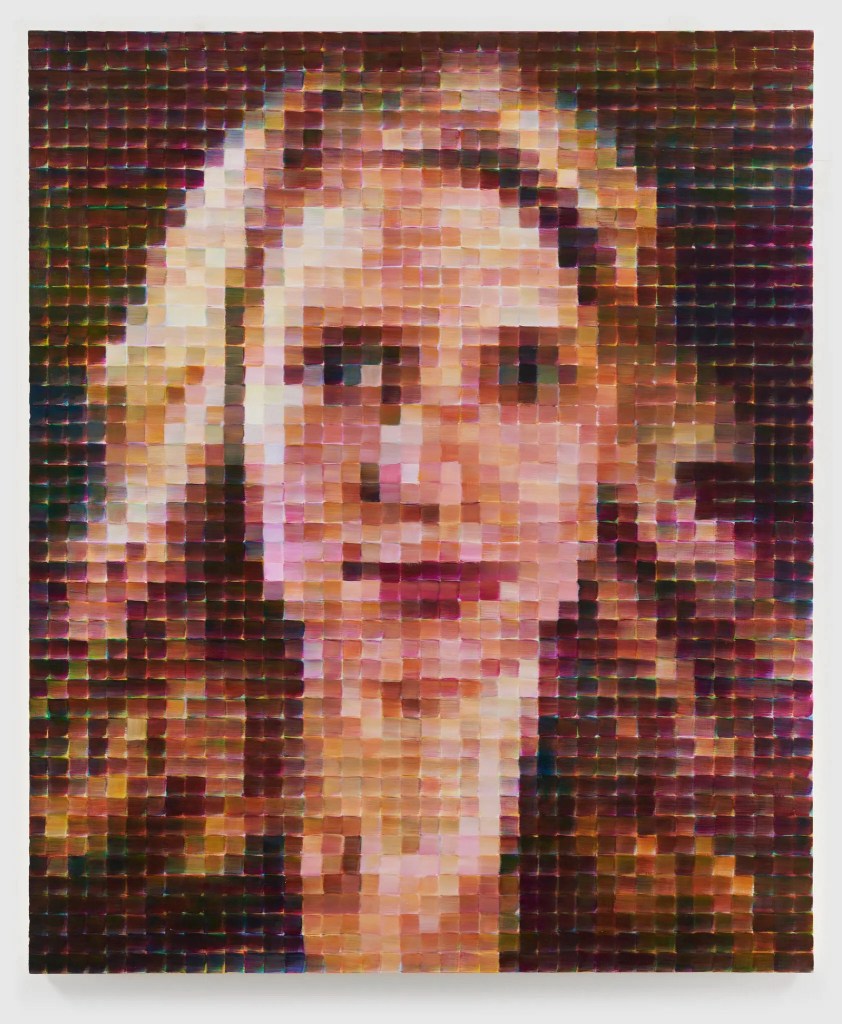
Chuck Close, “Michael Ovitz (Unfinished),” 2020-2021, oil on canvas, 72-1/2” × 61-1/2” × 2.” Credit… Chuck Close, via Pace Gallery. [New York Times caption and illustration]
Chuck Close’s approach to painting is intriguing. It’s as if he invented pixellation avant la lettre.
“This new body of work is more abstract, and quieter than any previous ones,” Close told the artist Cindy Sherman in a 2018 interview. “The brushstrokes don’t make shapes or stand for any particular information per se, they just exist as layers of transparent washes of oil colors that I’m trying to treat as watercolors, as I did decades ago.”
Chuck Close, “Claire,” 2020, oil on canvas, 72” × 60.” According to Pace, Close would take a photograph and break it down into single color grids. When making paintings, he translated the color onto the canvas through thin layers of semi-transparent paint in red, yellow, and blue. The grid was created in stages using these three colors individually. Credit… Chuck Close, via Pace Gallery. [New York Times caption and illustration]
(Robin Pogrebin, “Gallery Shows Last Works by Chuck Close. Will It Repair a Reputation,” New York Times, 2-17-24)
I live in Texas and devote much of my time to easel painting on an amateur basis. I stream a lot of music, mostly jazz, throughout the day. I like to read and memorize poetry.
When I was young… yes, did Chuck Close, I mean, was Chuck Close, inspired by halftone illustrations? by commercial art? by printed media? I remember once seeing an oil painting that appeared to be nothing but a collection of black dots on a white ground, when viewed from a few feet away, but when one moved a good distance away from it the seemingly random dots resolved themselves into an image of Jesus Christ! Was halftone I wonder the beginning of digital imagery? Again, was Chuck Close’s inspiration / motif halftone imagery? Certainly Roy Lichtenstein and Andy Warhol were using techniques / motifs taken from commercial art sources. I don’t know. I never really cared for that style of painting. It just seems so laboured. And boring to do. Mind you, Cezanne, after the period of his early frenzied work was over, also went in for measured work, so to speak, using thinned colour, dabbed on cautiously and carefully, to build up the pictorial image of whatever it was he was looking at.
Interesting thoughts, Peter. I note your terms “laboured” and “boring.” In my boots, I’m intrigued by painters who may be perceived to be cheating or impure in some respect or other. What possesses them to flout received practices?
I can’t answer that Jim. The world, even the so-called “art world,” perhaps, especially the art world, in recent times, the last couple of centuries, that is, has been “infected” as t’were by deliberate subversiveness and destructiveness. I think art parallels what’s going on socially and politically; not overtly, not in-your-face propaganda, not in any obvious way. So, for example, we see Picasso the self-confessed Marxist, doing his damnedest to ruin and raze the great art of Western Civilisation to the ground! Lol!


 EthicalDative
Interesting works! Thanks for the post Jim.
LikeLiked by 1 person
Thank you, Sue!
LikeLike
Intriguing how the colours and the pictures are built up. So disciplined!
LikeLiked by 1 person
Well observed, so true! I’ve marveled at how laboriously he must have worked.
LikeLike
When I was young… yes, did Chuck Close, I mean, was Chuck Close, inspired by halftone illustrations? by commercial art? by printed media? I remember once seeing an oil painting that appeared to be nothing but a collection of black dots on a white ground, when viewed from a few feet away, but when one moved a good distance away from it the seemingly random dots resolved themselves into an image of Jesus Christ! Was halftone I wonder the beginning of digital imagery? Again, was Chuck Close’s inspiration / motif halftone imagery? Certainly Roy Lichtenstein and Andy Warhol were using techniques / motifs taken from commercial art sources. I don’t know. I never really cared for that style of painting. It just seems so laboured. And boring to do. Mind you, Cezanne, after the period of his early frenzied work was over, also went in for measured work, so to speak, using thinned colour, dabbed on cautiously and carefully, to build up the pictorial image of whatever it was he was looking at.
LikeLiked by 1 person
Interesting thoughts, Peter. I note your terms “laboured” and “boring.” In my boots, I’m intrigued by painters who may be perceived to be cheating or impure in some respect or other. What possesses them to flout received practices?
LikeLiked by 1 person
I can’t answer that Jim. The world, even the so-called “art world,” perhaps, especially the art world, in recent times, the last couple of centuries, that is, has been “infected” as t’were by deliberate subversiveness and destructiveness. I think art parallels what’s going on socially and politically; not overtly, not in-your-face propaganda, not in any obvious way. So, for example, we see Picasso the self-confessed Marxist, doing his damnedest to ruin and raze the great art of Western Civilisation to the ground! Lol!
LikeLiked by 1 person