
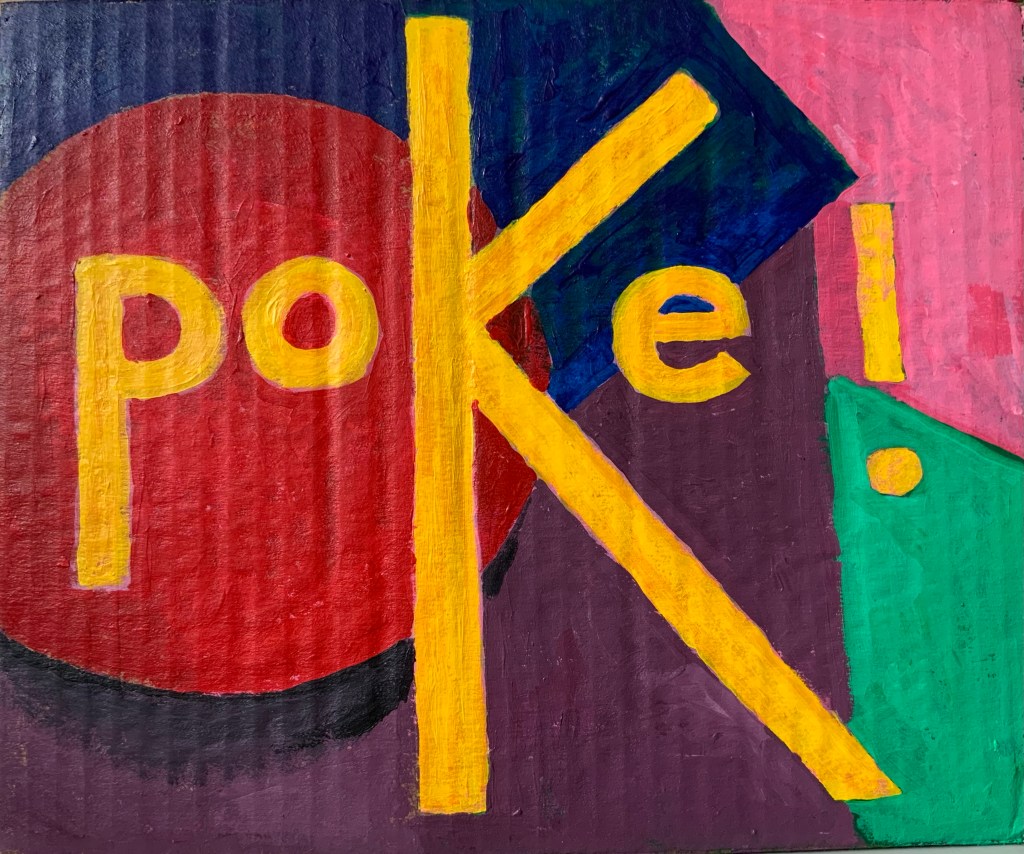
The ditches at the edge of the field were thick with poke, which I did like, even loved. The poison root of the poke grows down deep and snaggled like a mandrake.
(Kathryn Nuernberger, from “A Sense of Belonging,” Poetry, May 2023)
There’s video on YouTube of a young Tony Joe White singing his immortal song. For some reason it’s tagged “Polk Salad Annie” everywhere on the platform. Polk?
A guy on mudcat.org vaguely hinted at the following back in ‘99:
Just to add that bit of unneeded fluff…..the “polk” as opposed to “poke” and I don’t know that you can accurately reproduce in print the way the word is spoken in the deep south. Somewhere between the two in a way, but there IS the vaguest hint of the “L” aand [sic] is quite similar to the way you’d say “Pork” in the region, with the vaguest hint of the “R” instead. Clear as mud huh? In the final analysis….Who cares?
I care. The Swamp Fox makes a point of articulating it very deliberately early in the song:
Po…kuh — full stop, allowing the voiceless velar plosive to let out its full acoustic kick on his dorsum — Sellid.
That’s how he says it: Poke Sellid. Maybe he wanted to make sure it didn’t get confused with “polk” or “pork” in the future. Further along Tony Joe says:
Cuz that’s about all they had to eat. (Pause) But they did all right.
There it is, easy to miss, the strongest line in the song: But they did all right. Defiant understatement. Bottom-up glorification of the kick-ass, cussèd intransigence, the scrappy survivalism, the righteous ruggedness of the rural populace rooting and rutting in its canebrakes and truck patches, eternally scratching a living from the dirt and bragging on itself. Suck it up. Embrace hardship. Don’t bellyache about your deprivation. Sing it.
(c) 2023 JMN — EthicalDative. All rights reserved

 EthicalDative
♥️
LikeLiked by 1 person
Poetry, music, linguistics, opinion, your posts have it all.
LikeLiked by 2 people
Thank you, OA. You’re more than generous. I’m thinking of this blog as a compost pile. If I throw enough stuff on it, maybe it will decay into something fertile! 🙂
LikeLiked by 1 person
Eat bitterness (吃苦) is a term that has traditionally existed in Chinese thought for ages. Mao Zedong made it a central concept in his time. It is to be understood in such a way that one tackles something and kneels down without being unsettled by every little obstacle. 麦头苦干 (to bury one’s head down and work hard) is a similar term. Complaining about trifles has always been frowned upon in Chinese thinking and is a sign of weakness.
LikeLiked by 1 person
Thank you for this informative comment. The English rendering “eat bitterness” has a baleful luminosity to it, like “drink tears,” that caught my eye. I picked up the quote from this article in the New York Times: https://www.nytimes.com/2023/05/30/business/china-youth-unemployment.html. I hope my extension of the spirit of the ancient Chinese axiom to what the song by Tony Joe White expresses isn’t entirely misconceived. Best regards.
LikeLiked by 1 person
No, it was not misleading! I just wanted to add a little background information. Yes, youth unemployment is one of the sad and pressing problems in China, and the unfortunate youth are going through a bitter time. It doesn’t seem like that’s going to change anytime soon either. Xi did a lot of things wrong and it’s not just young people who are disappointed and anger is growing.
LikeLiked by 1 person
Delighted always to have your background, Mr. Zettl. I can sympathize with what the young of China are confronting. I hope there as elsewhere things evolve in a positive direction. Best regards. — Jim
LikeLiked by 1 person
Thanks very much! Yes, let’s hope for the best! The last time China had such a big problem with youth unemployment was at the time of the Cultural Revolution. Mao Zedong sent more than 16 million young people to the countryside then to keep them busy and out of trouble. The more Xi tries to copy Mao, the greater the concern that this will happen again.
LikeLiked by 1 person