In this complicated, ancient poem* I glimpse the life of squalid intrigue and dependency that was ever the courtier’s lot. At the mercy of the tyrant’s whim and the plots of competitors, his is a routine of flattery, complaint and cunning self-promotion. Skill with panegyric is a tool for survival.
A brute comparison of the Arabic text’s word count to that of my paraphrase highlights Arabic’s extraordinary facility for compression.
As a matter of style, consider verse 6. The English speaker yearns for active voice, yet the Arabic verbs are passive, as if to underscore the speaker’s lack of agency in the matter of his own welfare.
At the end, verses 11 and 12 twist fulsome praise of the patron, self-abasement and special pleading into a tight weave of indirection.

2 fa-bittu ka-‘anna-l-^ā’id(āti) farašna-nī | hirās(ān) bi-hi yu^lā firāš(ī) wa-yuqšabu
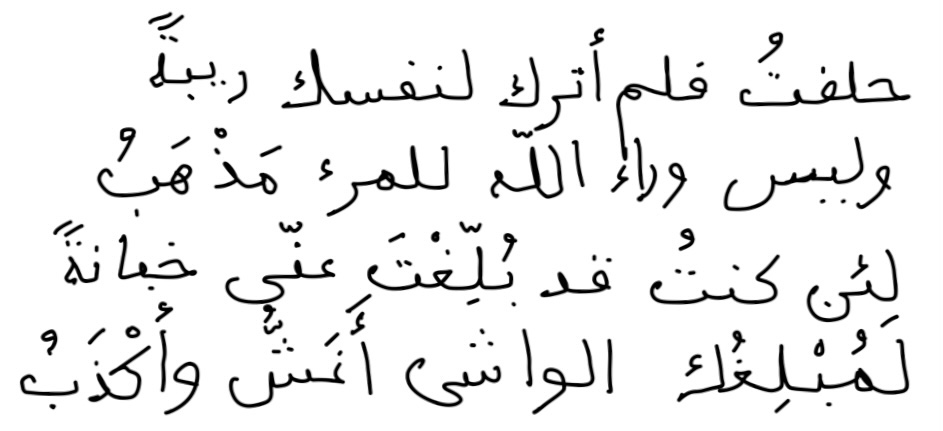
1 Word reached me — may you shun cursed behavior! — that you blamed me and things over which I am vexed and exhausted.
2 So I spent the night nagged by thoughts that seemed to spread a spiny bush for me, by which my bed was tossed and poisoned.
4 la-‘in kuntu qad bulliḡta ^an-nī ẖiyānaẗ(an) | la-mubliḡ(u)-ka-l-wāšī ‘aḡašš(u) wa-‘akḏab(u)
3 I swore, leaving no doubt in your mind — and beyond God there is no escape for a person.
4 If you’ve been whispered to about treachery on my part, your slandering informant is a conniving liar,

6 mulūk(un) wa-iẖwān(un) ‘iḏā mā ‘ataitu-hum | ‘uḥakkamu fī ‘amwāli-him wa-‘uqarrabu
5 Whereas I am a man with a tract of land on which to wander and find retreat.
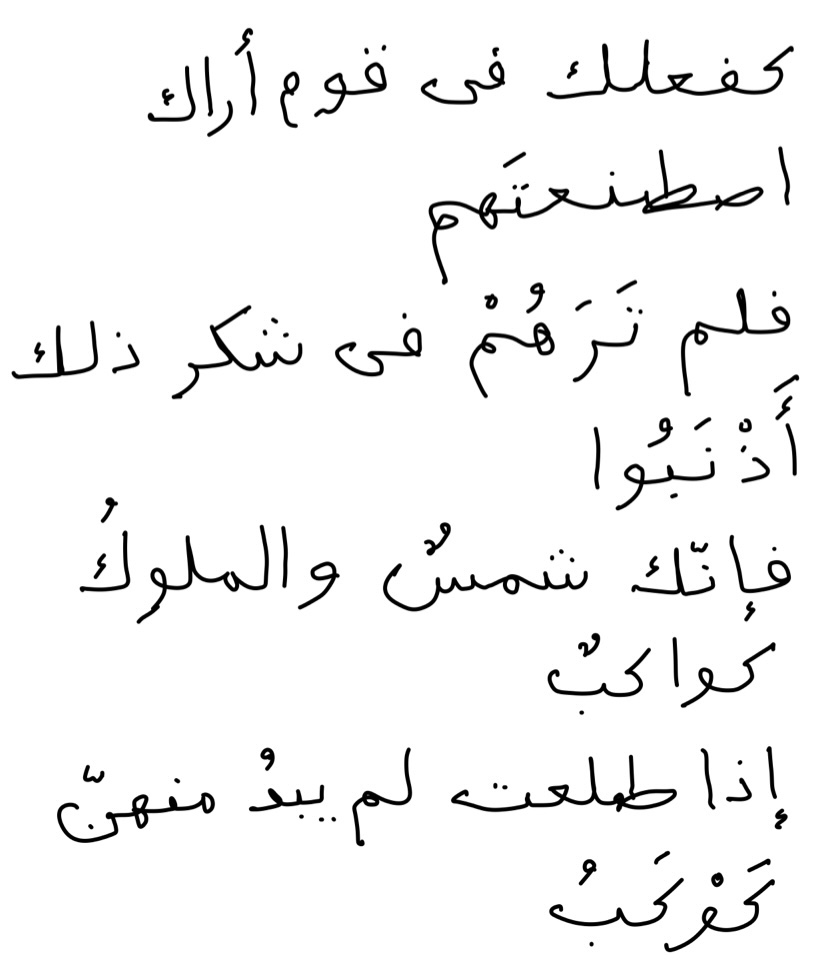
6 With kings and brothers, when I’ve come to them, I’ve been made responsible for their possessions and treated as an intimate,
8 fa-‘inna-ka šams(un) wa-l-mulūk(u) kawākib(un) | ‘iḏā ṭala^at lam yabdu min-hunna kaukab(u)
7 Just as you’ve done with persons I’ve seen you favor, and yet not consider to have sinned from lack of gratitude.
8 For you are a sun, and other kings are stars; when (your sun) rises, not one of those stars appears.

10 ‘a-lam tara ‘ana-l-lāh(a) ‘a^ṭā-ka sauraẗ(an) | tarā kull(a) malk(in) dūna-hā yataḏabḏabu
9 Don’t leave me with the threat as though I were, to the people, smeared with tar, covered in scabs.
10 Don’t you see how God has given you power, and how every monarch quakes before it?

12 fa-‘in [‘ak] maẓlūm(ān) fa-^abd(un) ẓalamta-hu | wa-‘in [tk] ḏā ^utbā fa-miṯl(u)-ka yu^tibu
11 You are not one to spare a brother whom you have not straightened out. What man is the refined one?
12 If I am wronged, I’m a slave you have treated badly; and if you are disposed to restore me to your good graces, a man like you grants favor.
Notes
*The text I use is A.J. Arberry’s Arabic Poetry, A Primer for Students, Cambridge University Press, 1965.
1 may you shun cursed behavior: Lane: (A greeting addressed to kings): “Mayest thou refuse… to do a thing that would occasion thy being cursed…”
2 tossed: the Arabic says “lifted” or “raised.”
3 I swore: Presumably an oath of innocence invoking God’s name.
4 slandering: the Arabic says “embroidering” or “embellishing.”
5 I am a man: I.e., man of substance.
11 Which man…etc. I.e. “Which man can claim to be truly refined?”
12 Key words are verb yu^tibu and its derivative ^utbā. Of the latter, Lane says: “Its primary signification is the returning of one whose good will, or favour, has been solicited, or desired, to the love of his companion.” As an example of the former, Lane translates ‘a^taba-hu as: “He granted him his good will, or favour; regarded him with good will, or favour; became well pleased, content, or satisfied, with him.”
(c) 2023 JMN — EthicalDative. All rights reserved

 EthicalDative
🖤
LikeLiked by 1 person