In this telling, art is a global and porous affair. And far-flung provinces serve as entrepôts to and from the vanguard — not just detours to be “represented” like Nashville hot chicken in the flavor portfolio of Pringles.
(Walker Mimms)
I clipped this article on November 30, 2023, and only now have absorbed it thoroughly. It’s more engrossing even than I had anticipated, which has me echoing its illustrations with greater abandon than usual. The article is by Walker Mimms, ‘Southern/Modern’: Rediscovering the Radical Art Below the Mason-Dixon Line,” New York Times, 11-30-23. Here are the particulars about the exhibition it references:
Southern/Modern
Through Dec. 10 [2023], Georgia Museum of Art, 90 Carlton Street, Athens, Ga., (706) 542-4662; georgiamuseum.org. The show will travel to the Frist Art Museum (Jan. 26, 2024, through April 28), 919 Broadway, Nashville, Tenn., (615) 244-3340; fristartmuseum.org.
***
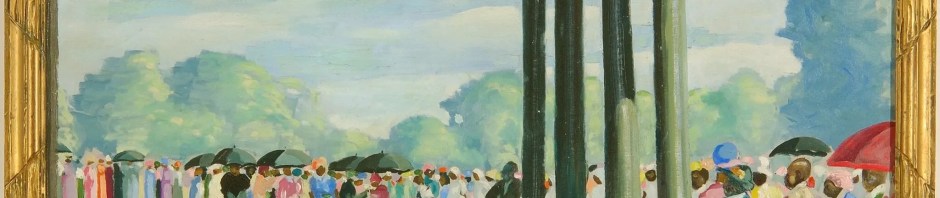
On John Kelly Fitzpatrick’s “Negro Baptising”:
The lobes of cyan and mud-green… jelly into a sunny riverbend. Two parishioners are about to be dunked […] A tall bridge traces the inner margins of the canvas […] It’s a framing device George Bellows and other urbans employed to remind us where we, the viewers, stand — that is, outside the action.

On Hale Woodruff’s “Southland”:
[…] Woodruff renders the actual painted earth in tones of salmon and sherbet — singing, iridescent hues that negate all the death. It’s a Rorschach test: do you see a wasteland, or a vibrant painterly possibility?

On the “watercolor satire” of Homer Ellertson:
In his suavely executed [painting] a Goodyear service station has set up shop in the front yard of a plantation home. The sepia tone of this work feels retrofuturist, as if we’re glimpsing some coming destiny from an even later date.

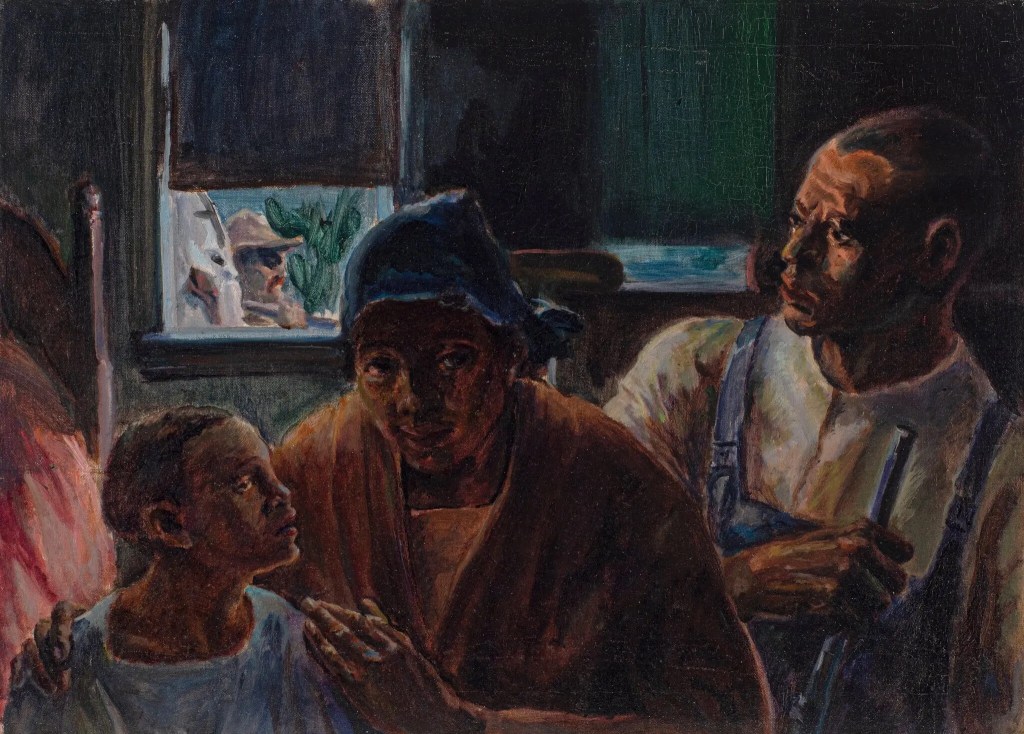
On James A. Porter’s “When the Klan Passes By”:
[Porter] uses dark but thin brushloads to convey, through the averted eyes of the Black family in the foreground, the private consequences of race terrorism.
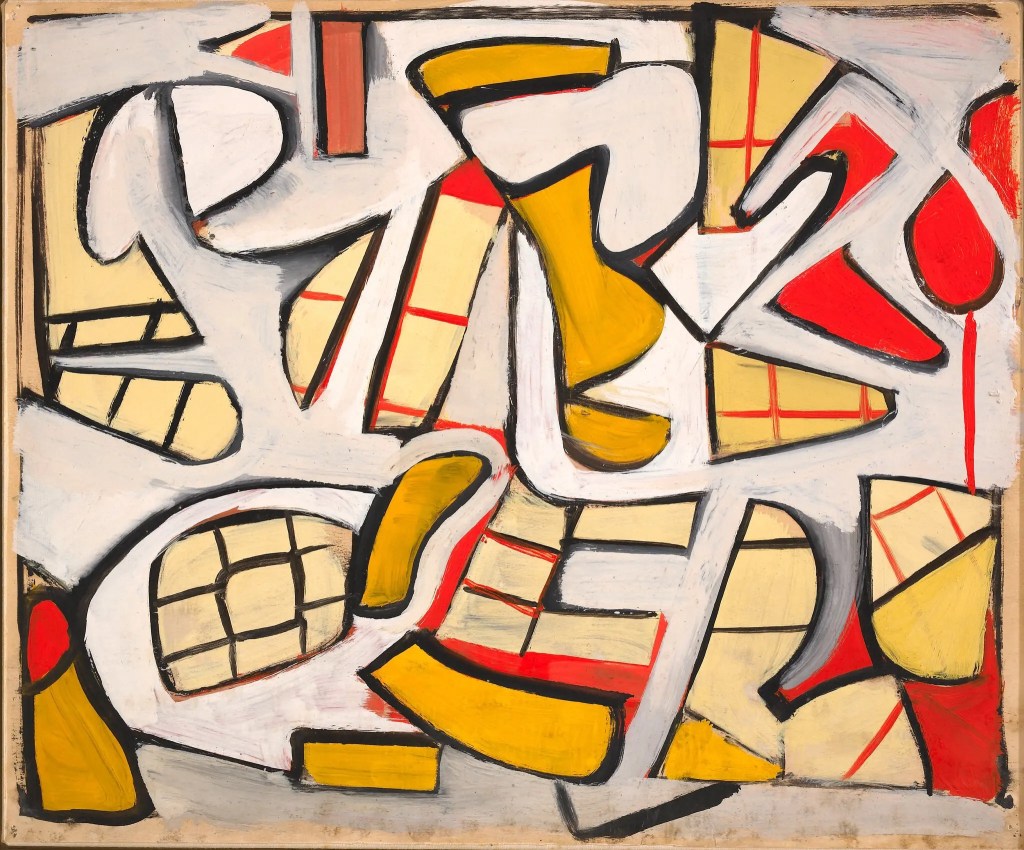
On Elaine de Kooning’s “Black Mountain #6”:
To the Big Apple, graduates of Black Mountain College, in North Carolina, returned like winged pollinators to a hive. (Representing the Black Mountain contingent here is an early jigsaw-paned composition by one graduate, Elaine de Kooning. […])
Here’s Mimms’s memorable summation:
More than Agrarian conservatism, […] the painters in this show echo what the historian C. Vann Woodward later called the “irony of Southern history”: the fact that, as America dominated the global stage from the Monroe Doctrine [1823] to World War II, the southeastern quadrant of the country persisted in a long line of self-destructive, embarrassing regressions, from a feudal regime to a secession attempt to an apartheid state.
(c) 2024 JMN — EthicalDative. All rights reserved


This is fascinating Jim. There’s so much to think about and absorb. Thank you for another excellent post. Sue
LikeLiked by 1 person
Delighted, Sue. Cheers.
LikeLike
🎨🖼️🖌️
LikeLiked by 1 person
Très gentille.
LikeLike