
Art is something scrappy and strange; it may hiss rather than purr. How it redeems, presumably, is at the heart of the critic’s project, but also the lay consumer’s. That’s me. In doodling my readings of <clears throat> lineated discourse, I’m at pains, inconsistently, to speak of the “verse-object” as I ponder a given text. I must feel the art before calling it a poem. It’s a high-horse presumption. No it’s not. It’s risible. It’s a stab at bootstrapping an expansive sensibility. Yes it is.
It isn’t clear. The non-ordinary object provokes, disquiets, taunts. An opportunity lies in paying it enough attention so it has a chance to impinge, and you come under its sway. Good critics are people who look, read, listen more closely than we chickens who scurry around “liking” stuff.
The phrase in my title is Roberta Smith’s assessment of painter Henry Taylor’s “excursions into three dimensional works.” It’s dismissive but indulgent, because she really likes his painting. “Taylor’s best impulses,” she writes, “are the ones he answers in two dimensions.” I’ve been swayed by his work before. His paintings are odd and engrossing; raunchy and raw; scrappy and strange.

… Taylor’s paint handling… tends to be startlingly tough and direct. It proceeds in slabs of untempered color and skirmishes of brushwork, sidestepping traditional notions of finish and beauty… Taylor’s paint also makes his figures very present. As do their staring, often dissimilar eyes.
I relish the reference to staring, “often dissimilar” eyes, but what does Smith mean when she says they “make his figures very present”? Her answer may be in the observation that you “can keep pondering their expressions — and the feelings behind them.” Fair enough. I stumbled upon this uncanny feeling of “presence” recently in contemplating Frans Hals’s smiling lute player.
A painting titled “the [sic] dress, ain’t me” has an excitingly faceless figure — who needs one anyway? As if the painter said to himself, “I’ve done enough,” and washed his brushes.
The body language is superb. With her hands gently clenched, the older woman inspects the dress. The work’s palette of browns, ochers, white and light blue is an exemplar of Taylor’s odd, frugal color.
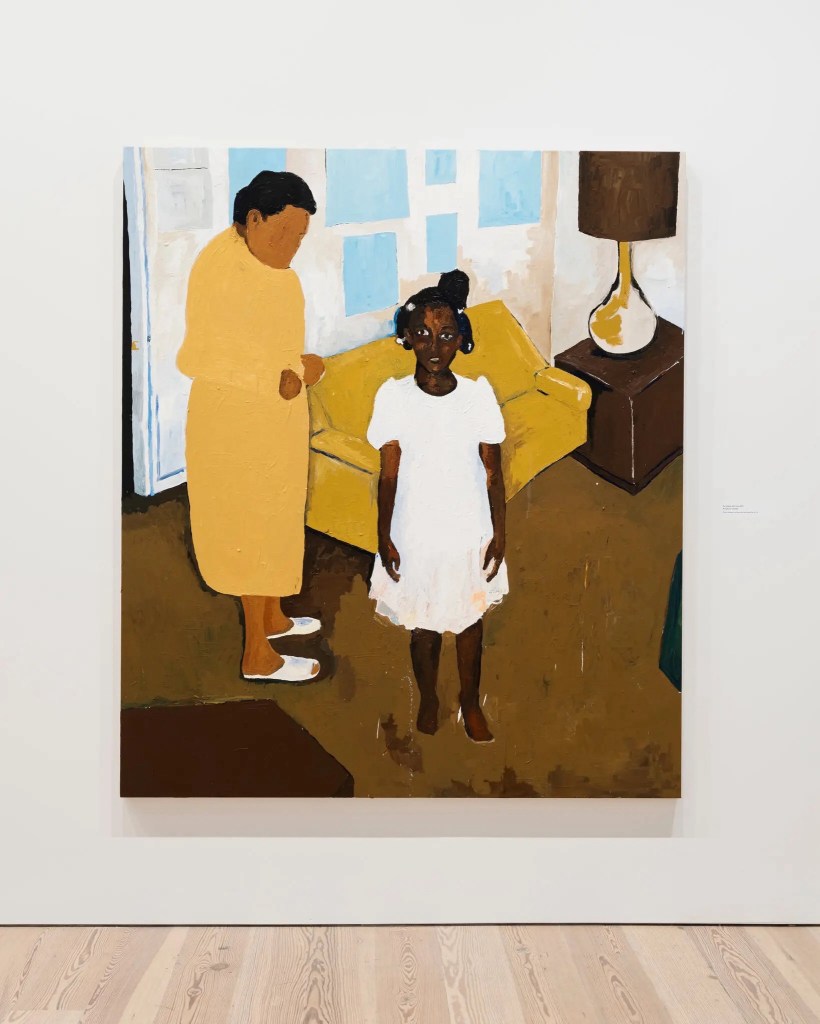
(Roberta Smith, “Henry Taylor’s ‘B Side’ Is Full of Grade-A Paintings,” New York Times, 10-17-23)
(c) 2024 JMN — EthicalDative. All rights reserved

 EthicalDative
Very interesting – you keep me thinking Jim! Thank you! Sue
LikeLiked by 1 person
Thanks for your attention and kind words, Sue! — Jim
LikeLike