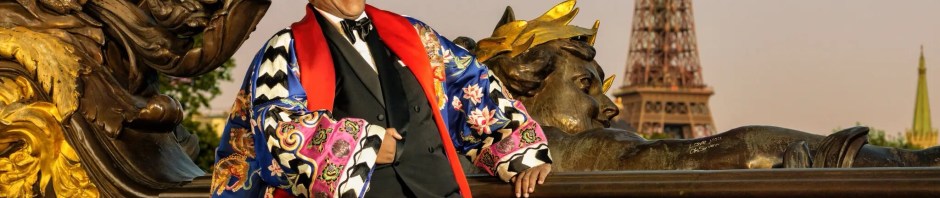
André Leon Talley on the Pont Alexandre III in Paris in 2013. Jonathan Becker/Contour, via Getty Images. [New York Times caption and illustration]
Poetry doesn’t need music. All of its music is contained in print on the page. (PJ Harvey)
People try to tell me I’m a poet and I say, No, I have music and rhythm to help me get my point across but real poets do it all just with the language and the lines. (Melissa Etheridge)
The language and the lines: Melissa Etheridge’s phrase sticks with me. I can’t think of an analogy to draw between music and poetry that doesn’t smack of overreach. Music has tone and beat. Poetry has word and line. Absent measured foot-fall, does sheer lineation mark rhythm in poems? Music has a certain existence on the page, but hardly completes its mission there. It wants to vibrate in a soprano’s or trombone’s voice. Poetry is happy to stay in print, to be read silently and aloud.
The lines of Derrick Austin’s eulogy of André Leon Talley are honed to within an inch of formal life (“dear to” goes no further!), yet they make statements celebrating the “lordly lantern”:
Notes Amanda Petrusich, “Feeling the Sting of Time With PJ Harvey,” The New Yorker, 7-23-23. By the Book, “Melissa Etheridge’s ‘First Love’ as a Reader Was Poetry,” New York Times, 2023, but no other date). Maureen Dowd, “Farewell, André the Glorious,” New York Times, 1-22-22). The poem is “André Leon Talley” by Derrick Austin, published in Poetry, September 2023.
I live in Texas and devote much of my time to easel painting on an amateur basis. I stream a lot of music, mostly jazz, throughout the day. I like to read and memorize poetry.
 EthicalDative
‘Poetry Doesn’t Need Music’
Poetry doesn’t need music. All of its music is contained in print on the page.
(PJ Harvey)
People try to tell me I’m a poet and I say, No, I have music and rhythm to help me get my point across but real poets do it all just with the language and the lines.
(Melissa Etheridge)
The language and the lines: Melissa Etheridge’s phrase sticks with me. I can’t think of an analogy to draw between music and poetry that doesn’t smack of overreach. Music has tone and beat. Poetry has word and line. Absent measured foot-fall, does sheer lineation mark rhythm in poems? Music has a certain existence on the page, but hardly completes its mission there. It wants to vibrate in a soprano’s or trombone’s voice. Poetry is happy to stay in print, to be read silently and aloud.
The lines of Derrick Austin’s eulogy of André Leon Talley are honed to within an inch of formal life (“dear to” goes no further!), yet they make statements celebrating the “lordly lantern”:
André Leon Talley
lordly lantern
tall neon doyen
dear to
orated tenderly on art or a trend
learned (Eden Tyndale Lear Eeyore Yoda Erato Leander Leda Troy Dante Donatella Leontyne)
ornately
real
annealed oleander
lonely eye
Notes
Amanda Petrusich, “Feeling the Sting of Time With PJ Harvey,” The New Yorker, 7-23-23.
By the Book, “Melissa Etheridge’s ‘First Love’ as a Reader Was Poetry,” New York Times, 2023, but no other date).
Maureen Dowd, “Farewell, André the Glorious,” New York Times, 1-22-22).
The poem is “André Leon Talley” by Derrick Austin, published in Poetry, September 2023.
(c) 2024 JMN — EthicalDative. All rights reserved
Share this:
About JMN
I live in Texas and devote much of my time to easel painting on an amateur basis. I stream a lot of music, mostly jazz, throughout the day. I like to read and memorize poetry.