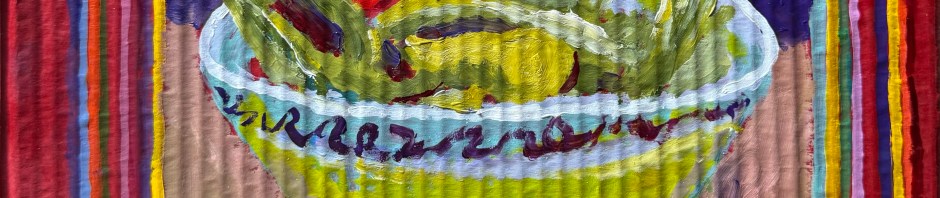

“Okra in a Bowl,” oil on cardboard, 6 x 12 in. (JMN 2024).
In a single poem Gwendolyn Brooks wraps up in a big bow the harrowing, goofy joy, the confused exultation salted with brow-knitting angst, that enters into raising yourself with children. “Life for my child is simple, and is good” is the title line of a Brooks poem published in Poetry, September 2024.
Life for my child is simple, and is good.
He knows his wish. Yes, but that is not all.
Because I know mine too.
And we both want joy of undeep and unabiding things, […]
What comes next flouts expectation. Brooks has prepared us for something with her curious adjectives “undeep” and “unabiding.” What are those un-usual things she shares a wish for with her child?
Like kicking over a chair or throwing blocks out of a window
Or tipping over an ice box pan
Or snatching down curtains or fingering an electric outlet
Or a journey or a friend or an illegal kiss.
There it is — the flash of mischievous toleration residing in Brooks’s persona. She enlarges on it with that rhythmic forward gear of hers:
No. There is more to it than that.
It is that he has never been afraid.
Rather, he reaches out and lo the chair falls with a beautiful crash,
And the blocks fall, down on the people’s heads,
And the water comes slooshing sloppily out across the kitchen floor.
And so forth.
And lo the chair falls. The mock epic tone supports the whimsy. The falling of the blocks is artfully comma-paused, heightening a child’s delight in their downward trajectory to the people’s heads. An apt coinage — “slooshing” — augments the sloppiness of an emergent escapade. And so forth — the dry summation clinches the riff’s gentle irony with a note of resignation coupled with acknowledgement of the blithe ways in which tykes slither through and slam into their world.
A hallmark of well-oiled English is contraction in many contexts, formal and informal: “that’s” (“that is”), “he’s” (“he has”), etc. Brooks’s avoidance of such forms in this poem conveys weight to what poses as casual speech. It’s a subtle elevator of tone.
The poem ends with a swoop into profundity that I stretch for a word to describe. What I come up with is diamantine.
Not that success, for him, is sure, infallible.
But never has he been afraid to reach.
His lesions are legion.
But reaching is his rule.
I’ve quoted the entire poem! I’ll have to live with the shame of unraveling it when it says all it needs to without me. Every poem of Gwendolyn Brooks’s in the September magazine — there are several — has me in thrall. That issue is archival now — the October one has since arrived. But a good poem is what Ezra Pound said it is: news that keeps on being news.
(c) 2024 JMN — EthicalDative. All rights reserved

 EthicalDative
What a wonderful poem – beautifully analysed by you with a delightful still-life to add to the pleasure! I particularly enjoy seeing the corrugations of the cardboard. Bravo Jim!
LikeLiked by 1 person
Glowing words and deeply appreciated, Sue. It seems like daubing on cardboard frees me up to risk ruining things, which are the likeliest outcomes! Those corrugations didn’t seem so obvious when I was brushing on the paint, but I like ’em too!
LikeLiked by 1 person