
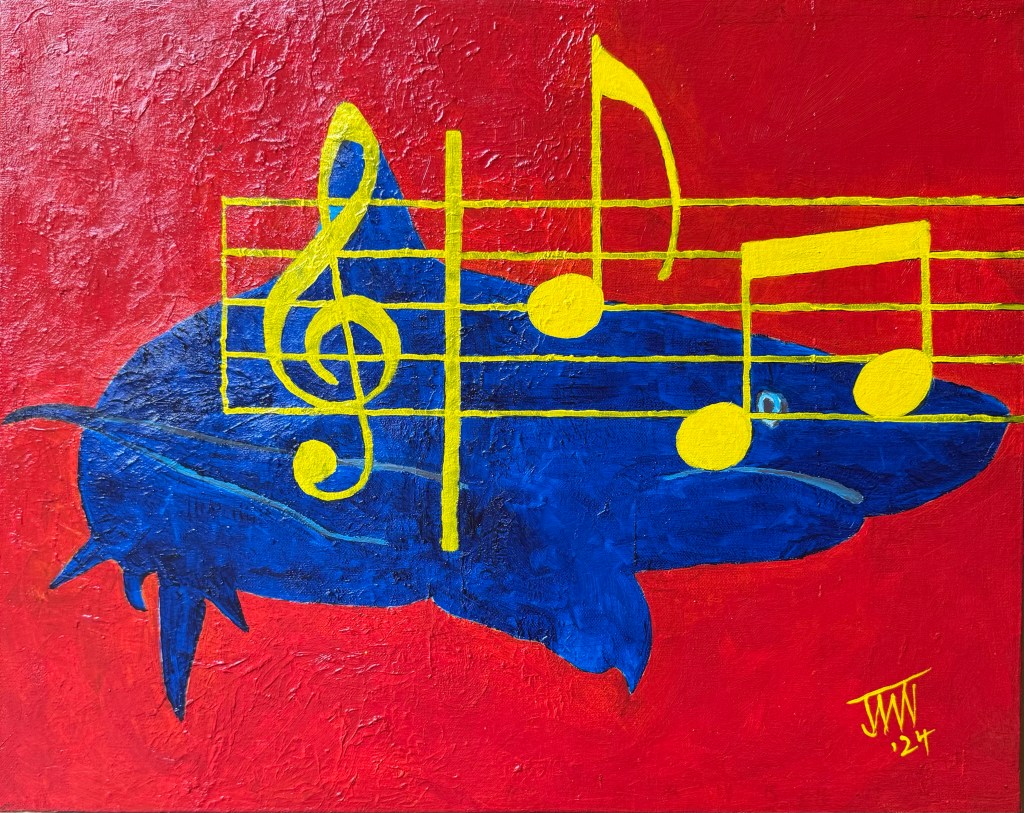
“Song in a Shark Suit,” oil on canvas on top of oil on canvas, 16×20 in. (JMN 2024).
Economy and directness are said to be paramount traits of poetry. “Directness” does heavy lifting in that statement. The poem by Alafia Nicole Sessions titled “Immature Animals” (Poetry, October 2024) stumps, like something glimpsed that you can’t identify, but so interesting you stare after it hoping it’ll reappear, or slow down, or become recognizable. Consider these phrases vivisected from the poem:
… should’ve set my quiver for meat,…
… spare my palms for prayer, from reaching…
… their hard parts barely bridled…
… cleaning my teeth with their bones…
… make sounds that seem like want with your trachea…
How can you not dig into language so deucedly vigorous and convincingly irrational? It creates intellectual friction on top of fascination. The poem reads like a riddle, cleanly indited down to the very punctuation level, save for this run-on sentence: I sniffed all manner of immature // animals, most, with their hard parts barely bridled, / met my eye, were willing to spill themselves. Does “poetic license” make my avowedly fastidious longing for a semicolon after “animals” irrelevant? Of course. I would say the poem articulates with striking indirection the experience of transitioning from a state of muddle — the natural condition of callow youth — to a state of clarity in matters of physical love. It’s only a hunch.
This commentary runs to excessive length, worth my time to write, possibly not yours to read. I want to see in “Immature Animals” an erotic journey told… how? Parabolically? But have I fallen into the trap of dithering over what a poem “really means”? Isn’t that called exegesis or something? Books say poetry doesn’t traffic in “narrative,” or doesn’t have to. Images (configured by words tethered to significances) are poetry’s building blocks, they say. If you attend not to the words’ denotation, but rather to their connotation — the associations they trigger — your message center will be set alight with receptivity and feeling, they say. Hmm. That has brought haiku to mind. If a haiku is its own thing, a syllabic crystal beaming its little signal, “Immature Animals” is a walled garden wafting lush sounds and aromas over ten feet of masonry. Those waftings tease and arouse the construing faculty. You want to find an entryway and get to the sensory source. Or compare it to a drawing of pure lines doing what lines do, going somewhere under their own unapparent steam, changing direction at the unspoken behest of an unapparent hand, resolutely evading conventional figuration.
Every three-line stanza bleeds enjambedly into the next. This armors the poem against piecemeal citation. You go whole hog (like below), or not at all. Also, you quote phrases with elision of line breaks, like this: I never thought I’d be the hunter. That’s what the “I” of the poem reproaches themself for not knowing at its beginning — the fact that they are the hunter, not the hunted. The poem makes you the hunter by reading tactically. You’re looking for clues. Blood running pink can be a sign of undercooked meat. A “meat” setting on the thing that holds arrows (a quiver) was called for, says “I.” An arrow meant for killing is tipped differently than one tipped for butts. “I” also regrets not having devoured the dandelion greens, a healthful salad. So what? Here, the first domino of a sequence stood on edge sets off the train of toppling “nonsense.” Instead of the quiver-setting and dandelion-eating that should’ve occurred, pronominal “I” climbed into / a pot, added salt, became a handful / of small bells. We’re definitely not in Kansas, never were.
Let’s work through it. “I” cooks themself up into something different, a self-transformation involving bells, and undulation like waves of the sea, where sirens whose telltale gaze (violet eyes) betrays them on land can cry safely under water. It’s a state of affairs that’s unsatisfactory to “I.” They wanted their thoughts to be drowned; to pray, not reach, with their hands. They’ve had varieties of interaction with partners (?) who were tempestuous (hard parts barely bridled), who held up to reasonable scrutiny character-wise (met my eye), and who had animal momentum (were willing to spill themselves). Following a climax (after the branch snapped), however, “I” holds their breath! Why? Let down by what was “sniffed”? “I” expresses wonderment at former guises and modulations (the crown I knit from bluebells, soft waves I cultivated in the pool of my throat) now discarded. Also maybe, wonderment at the advent of sexual maturity: Was the bush of my belly just a dream?
The answer is “No.” The poem turns to what feels like affirmation. A second person pronoun, a “you,” materializes. In three days “you” will return with your bluebeard and your new scent. (“I” counts the days.) If the allusion is to Bluebeard the serial wife murderer, its import eludes me. But what seems more pertinent is that new scent attaching to “you.” The sounds coming from “you”’s trachea have “I”’s attention. I confess that for a while I kept reading the next phrase as “Obedient to the bassline,” a musical reference. The poem’s actual word, baseline, means a benchmark for comparison purposes. Maybe it’s a new standard brought to the table by the bearer of the new scent, which leads to the quivering ankle bells.
Immature Animals
When the blood turned pink I should’ve known,
should’ve set my quiver for meat, downed
the dandelion greens. Instead I climbed into
a pot, added salt, became a handful
of small bells. Undulated to recall myself
as sea. Underwater the siren’s cry is safe —
on land, my violet eyes undeniable. I wanted the alarm
to drown my thoughts, to spare my palms for prayer,
from reaching. I sniffed all manner of immature
animals, most, with their hard parts barely bridled,
met my eye, were willing to spill themselves.
Holding my breath after the branch snapped,
cleaning my teeth with their bones, I never thought
I’d be the hunter. What happened to the crown
I knit from bluebells, the soft waves I cultivated
in the pool of my throat. Was the bush of my belly
just a dream? In three days you’ll return with your
bluebeard and your new scent, make sounds
that seem like want with your trachea. Obedient
to the baseline, I’ll string a thin strand of brass bells
around my ankle, watch them quiver.
(c) 2024 JMN — EthicalDative. All rights reserved

 EthicalDative