
Volcanic ash from Mount Tambora’s eruption, as well as coal pollution, gave Turner glowing atmospheres to paint in his day. So did the toxic air enveloping the city of London which Monet responded to in some of his paintings a century later. A recent article by Emily LaBarge in The Times treats of the two artists.
Here’s one of several Monets reproduced in the article:
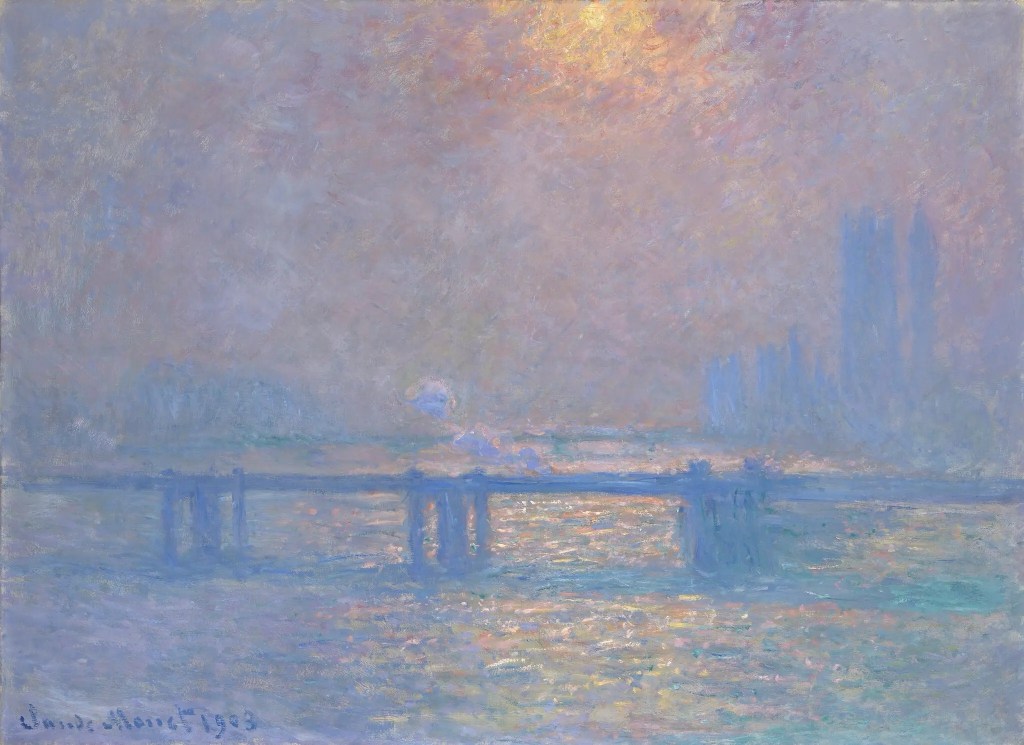
Monet’s “Charing Cross Bridge, The Thames” (1903). Credit… Alain Basset/Lyon Mba. [New York Times caption and illustration]
It’s interesting that Monet started his canvases en plein air in London, but finished them at his studio in Giverny, France where, as the article says, “they took on new life. As much as they are representations of a city and its unearthly fog, they also show how art best captures nature when it transforms it.” The part of that statement I’ve bolded provokes thought. “Transformation” is a large word. I wonder what relevance it may have to the workaday strivings of the painter back in his studio? I hear you say, But Oscar-Claude Monet wasn’t the average painter! Granted. But did he know that then?
Here’s the sole Turner reproduced in the article:
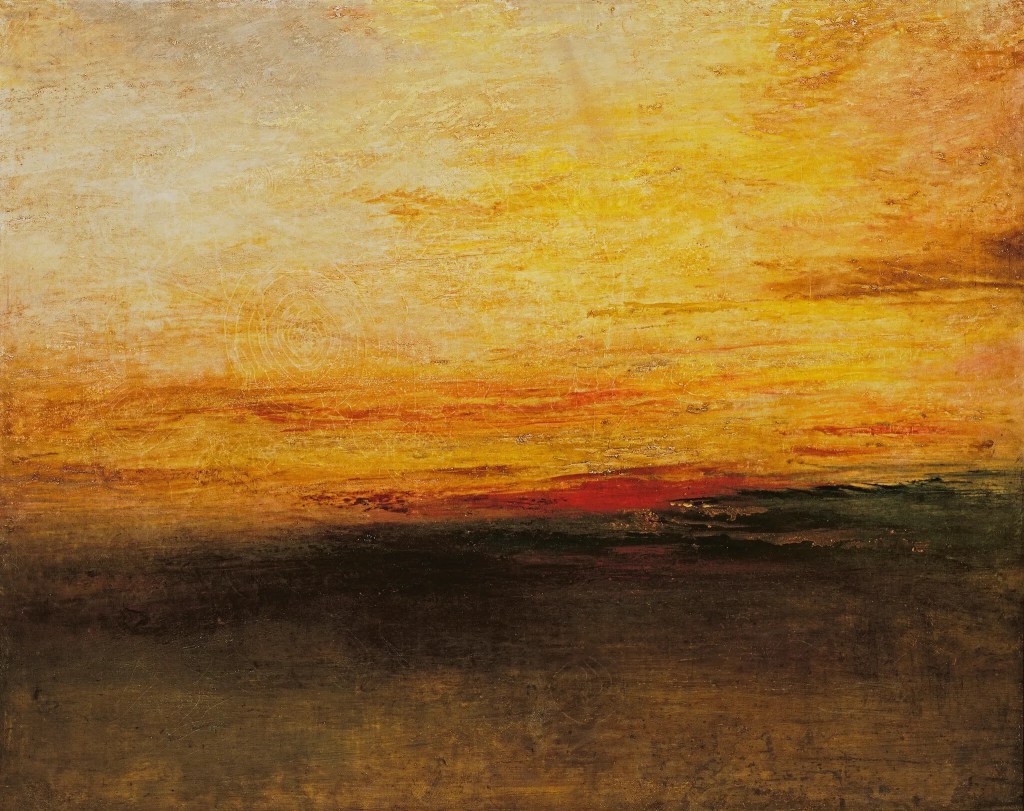
“Sunset” (1830-35), by J.M.W. Turner, is on display at Turner’s House in London as part of the exhibition “A World of Care: Turner and the Environment.” Credit… Tate. [New York Times caption and illustration]
The Turner painting has a starkness and severity — a primeval glow depicting almost nothing. It steers clear of prettiness, feels more modern than Monet’s.
Here’s how I would apostrophize Monsieur Monet: Kind sir, beautiful man, brush genius, color maestro, your oeuvre is deathless, but I’ve seen an awful lot of it in many unlikely places (dorm room posters, sides of buses, etc.).
In a second article, stunning and lavishly illustrated, Jason Farago usefully emphasizes how, familiar as they are now, the painters whom we know as “impressionists” (originally a term of derision) were innovators going rogue and poking a finger in the eye of an Olympically hidebound and snooty French art establishment. He writes this:
And if you find Monet, Renoir, Degas too pretty and popular — if you think Impressionism is the artistic equivalent of a pumpkin spice latte — I want you to taste the espresso beneath the foam.
I’m particularly fond of a painting by Berthe Morisot and what Farago says about it.

[No caption. Referenced in the article as “… Picture No. 107 in the exhibition of 1874: another of Morisot’s lugubrious bourgeois bachelorettes.”]
But her dress is an open tangle of white, as opaque as the brushy harbor, and between her black hat and violet choker is a face dissolving into vapor. No gatekeepers remain to decree how to picture her. Art, from 1874 onward, means freedom: so sad, so beautiful.

[No caption. Detail, “… Picture No. 107.”]
(Emily LaBarge, “When Artists Found Beauty in London’s Toxic Fog,” New York Times, 10-7-24; Jason Farago, “How the Impressionists Became the World’s Favorite Painters, and the Most Misunderstood,” New York Times, 9-10-24).
(c) 2024 JMN — EthicalDative. All rights reserved


So interesting! I especially like the Turner which, as you say, feels so modern. Thanks for the great post Jim.
LikeLiked by 3 people
Thank you, Sue.
LikeLike
Morisot, Turner, and Monet – all brilliant. Love the connections with atmospheric conditions. The impact of the London particular on art (and literature) is always such a trove.
LikeLiked by 3 people
Love your comment. Thanks for reading.
LikeLiked by 1 person