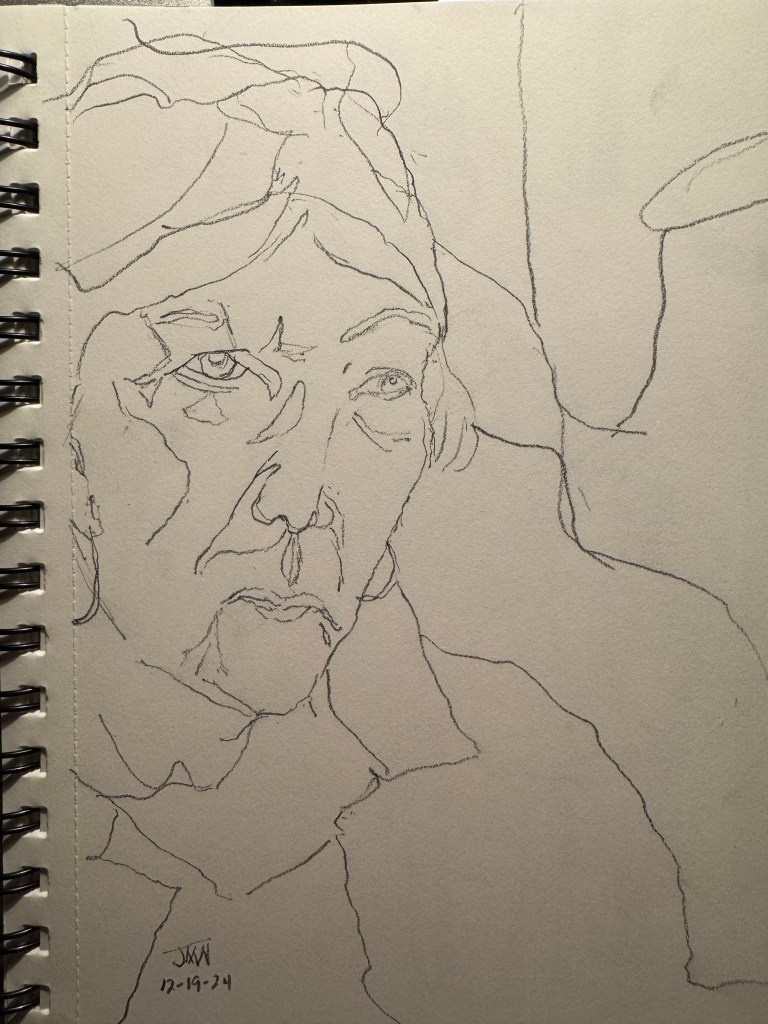
The planet is bursting with verse. A reader of poetry has to be arbitrary to stay afloat. In this post I’ve done something impudent, which is to apply strikeout formatting to text which I think would have been better omitted. My emendations aren’t knowledge-signaling; they’re just a symptom of constructive engagement with interesting texts. I’m sure I didn’t invent this thought — a poet must have said it: Starting a poem is (relatively) easy; ending it is the trick. Music is between the rests; poetry between the silences.
The folio feature of Poetry, December 2024, is titled “The Chorus These Poems Create: Twenty Years of Letras Latinas.” I was braced for a “Latinx” experience. What I found is a sequence of high-performing poems that evade x-ing. I long to take more than piecemeal account of such feats, but see my above remark about the planet.
“Carnivore,” by Rigoberto González, has an italicized preamble referencing multiple sclerosis. The poem calls on the moose for a familiar emblem of sturdiness, but falls back on the gazelle: […] I’m supposed to be / upright and sturdy as a moose. / Better yet, a gazelle. I / used to walk so gracefully, / so elegantly in that animal / me. […] The speaker is prey to a wasting illness, but what’s central in the poem is loneliness over lost love: How my antelope nose soothed my buck’s / neck before he stotted away, / stomping out my heart […]. The poem’s conclusion is disarmingly specific:
He chewed it off just like
I’m gnawing at the dead
gazelle of me. At night I detect
thumping. Heartbeat or
hoofbeat, I can’t say. It creeps
further away, memory of
a man who once loved me,
hungering for the whole of me.
Oh I used to be more edible
than this. And so mealy.
“Searching,” by Jordan Pérez, instantiates a vegetable garden at the end of its productive life. The drama is captured perfectly by the tomatoes: […] The tomatoes, / believing they were near death, rushed to birth / fruit, and the very production took / the last life from them. The poem pivots on a query somewhat misaligned along a “body” semantic: Can you show me a body that is itself / whole? The ensuing turtle anecdote picks the poem up and carries it to a soulful ending:
[…] I think daily about the spotted turtle,who I found trapped under the boardwalk[,]and carried back to the water, only to later
read that, if she’s moved too far, will spend
the rest of her life searching for her eggs.How is it possible to define yourself by waiting
for someone you have never met?
“As Capitalism Gasps for Breath I Watch the Knicks Game,” by Yesenia Montilla, is a snappy fan paean to the New York Knicks basketball franchise: […] The ruckus of these players, the desire they / have to come in first. They rebound & strip like stickup / kids. […] The poem also reflects wryly on the anomaly captured in its title: […] Don’t get it twisted, capitalism is dying // & yet here I am rooting for boys bred to burn out their bodies / to make billionaires more billions. […]
Here are the poem’s last 3 couplets:
What happens to the heart of a city when its people survive
on air; that space between the flick of the wrist & the swish
of a three-point buzzer beater? We fight for a win to fill
the ache of losing: Palestine, Congo, Sudan, Ayiti. We take
what we can, celebrate small victories until we win everything
we thought we never could—
(c) 2024 JMN — EthicalDative. All rights reserved

 EthicalDative
Lovely drawing Jim. And I like the idea of editing out redundant text – you can use the same principal in drawing and painting too, I think. Sometimes an artwork loses it when it’s overworked. Sue
LikeLiked by 1 person
Thank you, Sue. I agree, the dilemma of when to stop is big in art work as well. Are we close enough to Christmas for me to wish you a merry one?
LikeLiked by 1 person
Yes close enough here – we are ahead of you in time zones! Best wishes to you for Christmas and the New Year – let’s keep up the stimulating posts in 2025!! Sue
LikeLiked by 1 person
Returning your wish for a Good New Year, Sue. Yours in blogging, Jim!
LikeLiked by 1 person