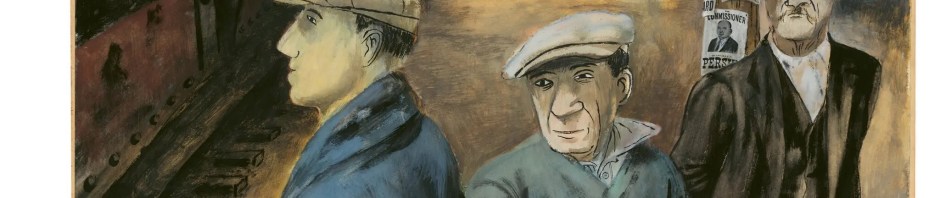
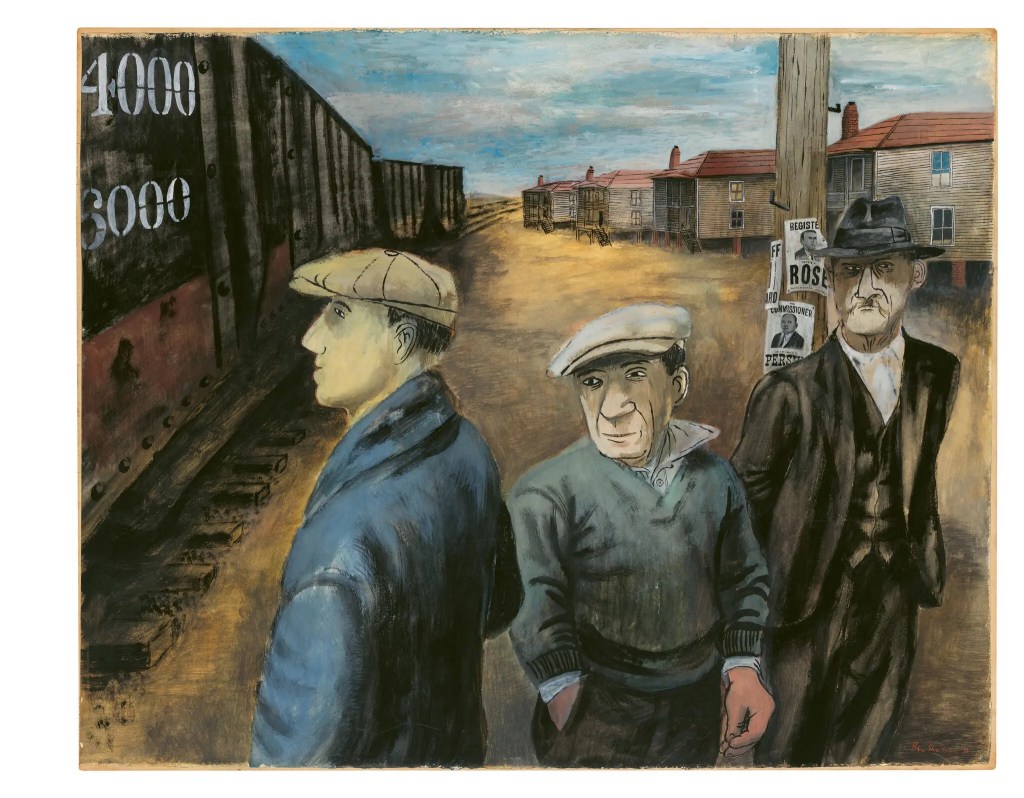
Ben Shahn, “Scotts Run, West Virginia,” 1937. During the Great Depression, Shahn felt sympathy for Americans suffering the deprivations he grew up with. (This painting was based on a photograph he took.) Credit… Estate of Ben Shahn/Licensed by VAGA at Artists Rights Society (ARS), NY; via The Jewish Museum. [New York Times caption and illustration]
If the images in the survey feel more like news than comment, that’s partly because we can sense the press photos Shahn used as his sources. Though his paintings themselves aren’t close to photorealistic — his technique can be potently slapdash — their subjects have the verve of seeming caught on the fly.
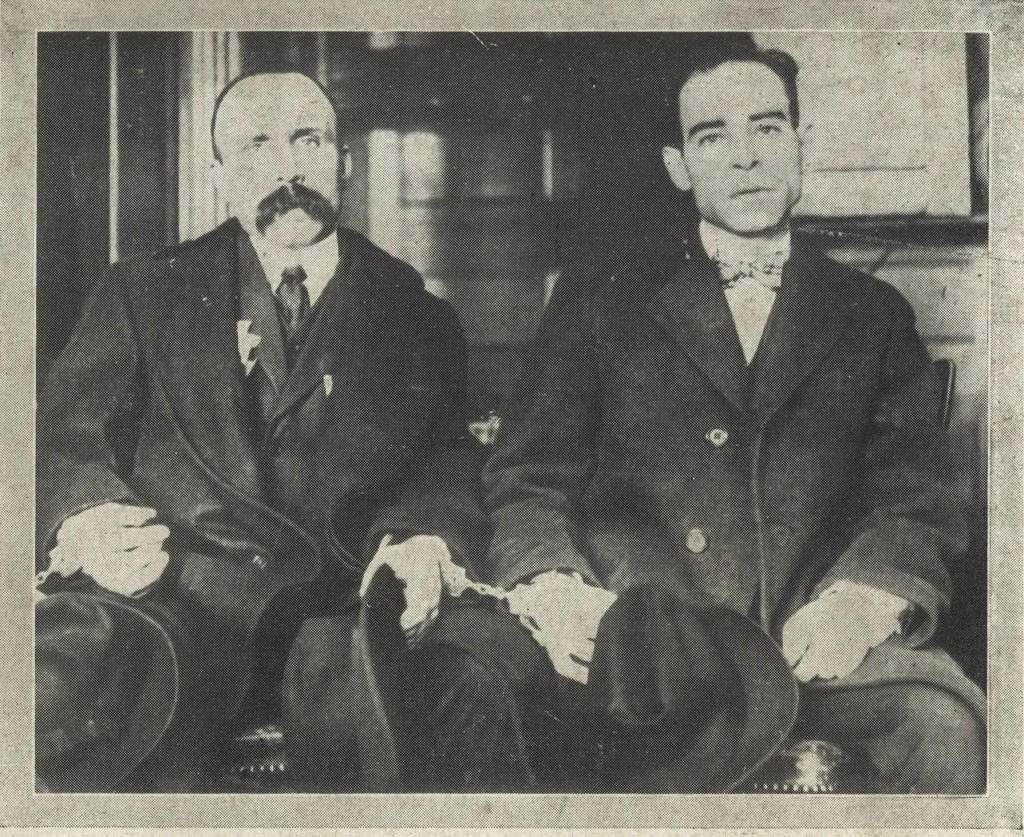
A 1923 news photograph showing Bartolomeo Vanzetti (left) handcuffed to Nicola Sacco, in a courthouse in Dedham, Mass. Shahn used it as his source for a painting in the Jewish Museum show. Credit… via Boston Public Library. [New York Times caption and illustration]
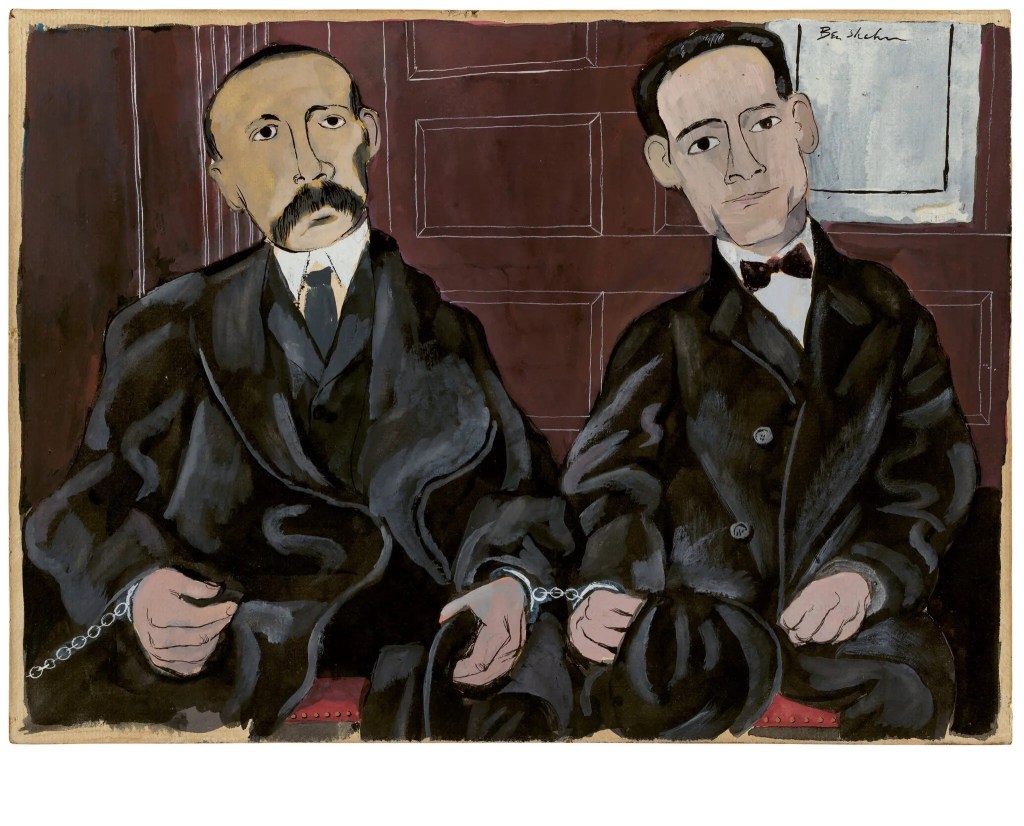
The exhibition includes an earlier series on the controversial 1921 trial of Nicola Sacco and Bartolomeo Vanzetti, Italian immigrants executed for murder despite flimsy evidence. Shahn’s painting of the two handcuffed men is cropped weirdly tight; we see that it echoes a source photo that had been cropped the same way, to save space on the printed page. Shahn borrows the feel of a photograph’s direct observation to make his painted subjects seem more directly observed by us.
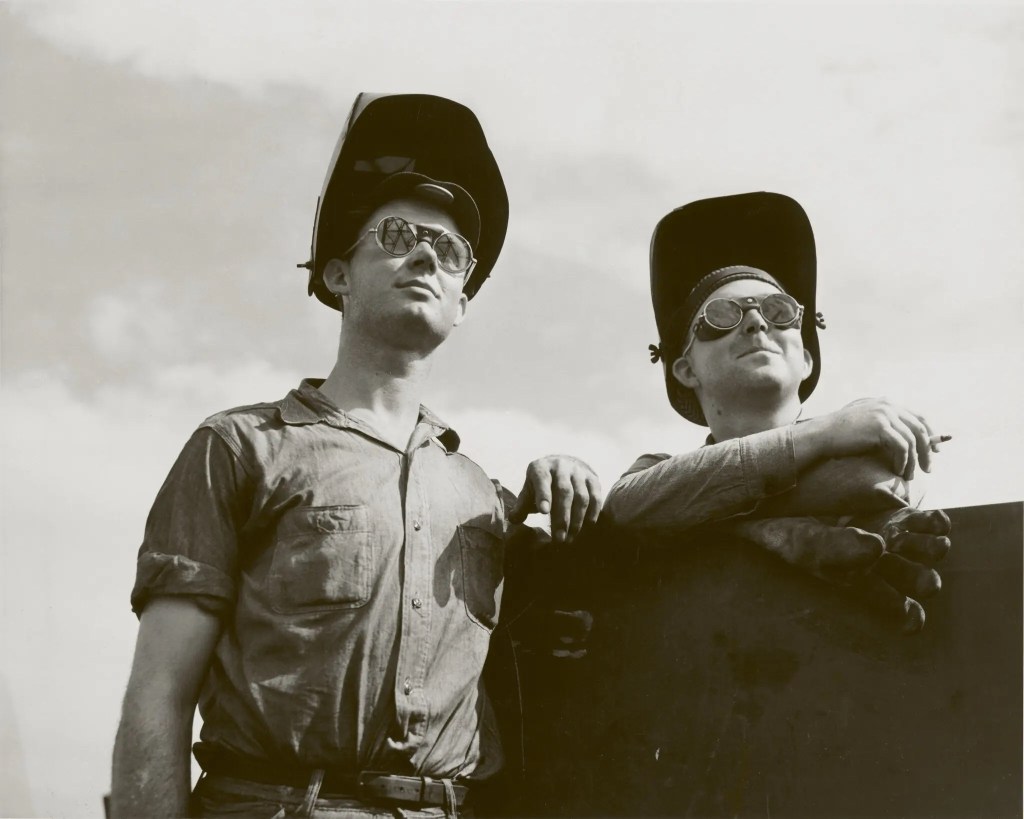
A photograph by Alfred T. Palmer, showing two welders, October 1941. Shahn used this photograph as the source of a poster, changing the race of one of the welders to Black. Credit… The Jewish Museum. [New York Times caption and illustration]
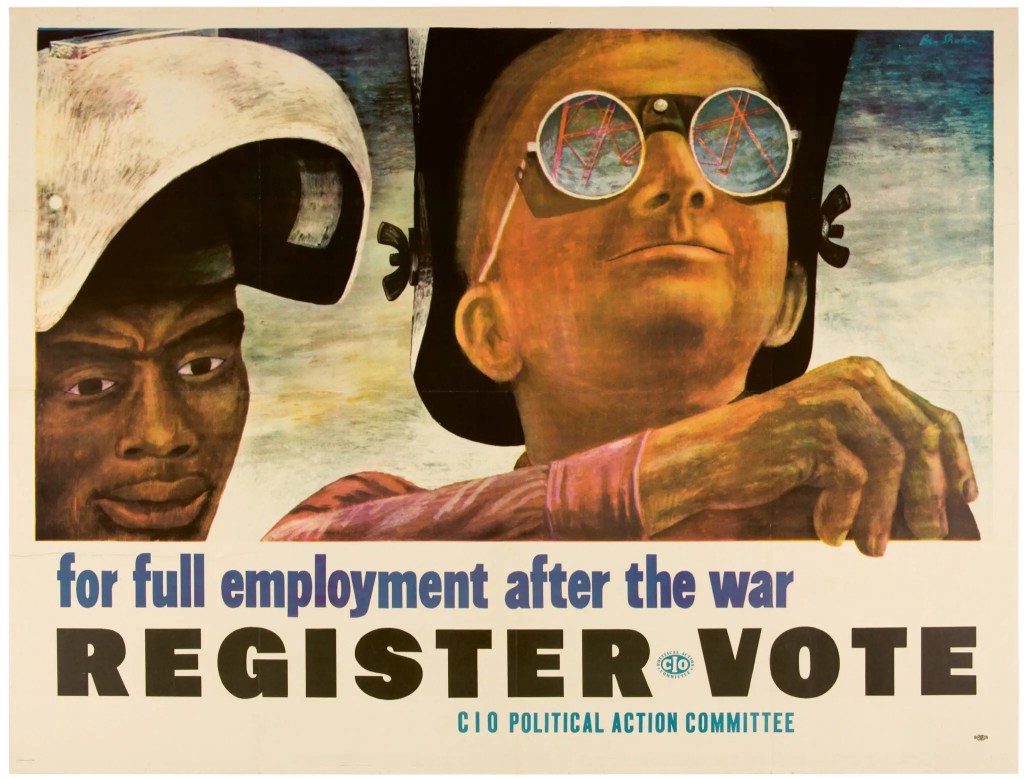
Ben Shahn, “For Full Employment After the War, Register, Vote,” 1944. Credit… Estate of Ben Shahn/Licensed by VAGA at Artists Rights Society (ARS), NY; via The Jewish Museum. [New York Times caption and illustration]
… And prosecutions that can seem to serve politics, not justice.
… In the decade or so before his death in 1969, Shahn could seem more interested in modern aesthetics than in modern people and their plights. His pictures became palimpsests of allusive symbols, reheating modern styles from Paul Klee and Pablo Picasso… We miss the immediacy of Shahn’s earlier pictures, with their close ties to an observed world… What Shahn couldn’t have realized, as he turned away from his potent visions of the 1930s and 40s, was that they would find new purchase almost a century later, when once again we face issues of racial injustice, and what our nation might do about it, and prosecutions that can seem to serve politics, not justice.
(Blake Gopnik, “Ben Shahn’s Social Realist Art Feels Relevant Again in Landmark Survey,” New York Times, 5-29-25)
(c) 2025 JMN — EthicalDative. All rights reserved

 EthicalDative