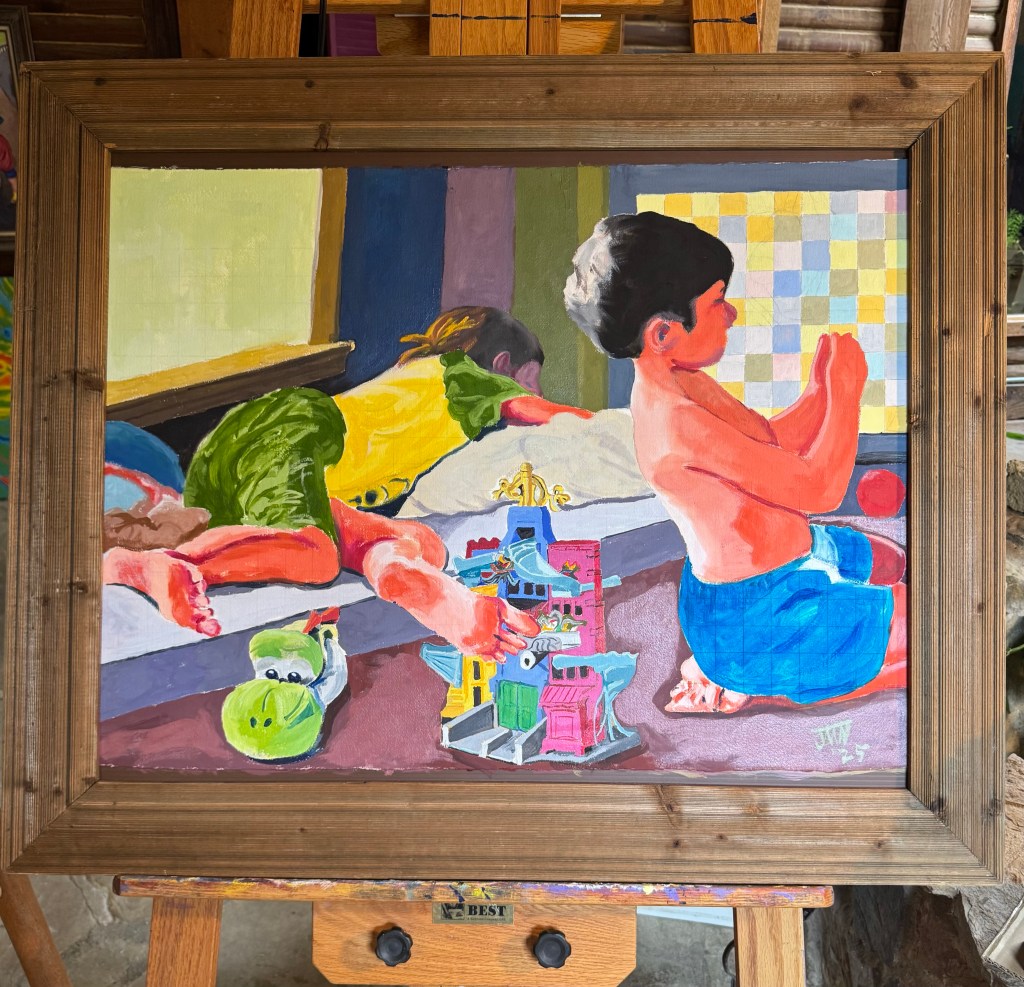
“Time Out,” oil on watercolor paper, 24×30 in. (JMN 2025).
Afterthought foregrounded: This will go down as a wildly utopian, presumptuous, naive, impractical proposition. Imagine a world in which the devout were schooled from an early age to read the foundational scriptures of their respective creeds in the original languages rather than translations. Talk about a conversation of adepts. Would there be fewer arguments over religion? Not likely. But they’d be better ones.
I make my way through the Quran’s Arabic à grands coups de dictionnaire. Why resort to the dictionary when there are translations available? Because translations can diverge considerably, besides often being overly interpretive for the literal-minded language student who wants to hear the plain text talk. I do lookup to pinpoint unvarnished word meanings. It’s an exhilarating sojourn on multiple levels. Here’s an instance from today’s stint of reading (September 24, 2025).
Abraham (14:49)
وَتَرَى ٱلْمُجْرِمِينَ يَوْمَئِذٍۢ مُّقَرَّنِينَ فِى ٱلْأَصْفَادِ ٤٩
On that Day you shall see the guilty ones secured in chains;
— A. Maududi (Tafhim commentary)
Et le jour (viendra) où tu verras les criminels enchaînés les uns aux autres (en couples semblables).
— Montada Islamic Foundation
https://quran.com/14/49
The above are two translations I monitor as I go. They assist me in construing the Arabic. I also consult the Spanish translation of Julio Cortés, who was my teacher. Here’s his version:
49 Ese día verás a los culpables encadenados juntos,
The pivotal word is muqarrab(īna). It’s the past participle in masculine, accusative plural of a Form II verb having causal force with a range of meanings tightly or loosely connected to making or letting someone or something get close. It can include the taking of someone as associate or companion; also, the sheathing, or putting into its scabbard, of a sword. How does this sheathing relate to the “base” meaning, you may wonder. Good question having no immediate answer. Relationships across a semantic range can be untraceable. As with all languages, eons of usage have caused metaphorical, practical, maybe even accidental, drift. This driftiness undoubtedly accounts for some of the variations observable in translations of texts captured from oral transmission in ancient times.
Muqarrab(īna) modifies a nominal present participle, mujrim(īna), “criminals,” describing their condition of being fī-l-‘aṣfād, “in the bonds.” Wehr lists equivalents of ṣafad (pl. ‘aṣfād) as bond, tie or fetter. Why not also chain, shackle, manacle? Who knows? A bilingual dictionary can’t be a thesaurus, though Wehr often comes close. The above translations happen to agree on “chains.”
For muqarrab(īna), the French and Spanish versions key vaguely on its “companion” aspect: “chained together” in Spanish; “chained one to another (in similar couples)” in French. The English reduces it to “secured,” which isn’t exactly accounted for in Wehr’s listing. Or is it? Perhaps “secured” is akin to “sheathed,” though less literal. The putting away of a weapon brings it in companionable proximity to its owner’s waist while neutralizing it. I rather like “sheathed in fetters” for muqarrab(īna) fī-l-‘aṣfād(i). The sinners are rendered harmless in their chains, like a blade in its scabbard. Or, to modernize the simile, like a gun in its holster.
I’d love to know the thing least knowable, which is what exactly any given expression brings to the mind of a native Arabic speaker not tasked with phrasing it in any other tongue. The fantasy analogy that occurs to me is that of a psychic MRI which would show on a screen the image present in the speaker’s mind arising from reading or thinking the expression.
(c) 2025 JMN — EthicalDative. All rights reserved

 EthicalDative
Ah you have a clever mind and impressive intellect Jim …. and your painting is delightful!
best regards Sue
LikeLiked by 2 people
You say more than I deserve, Sue, but I revel in your kind assessment. A sympathetic ear is a blessing. Cheers from here — JIm
LikeLiked by 2 people
Excellent painting and excellent post, JMN. A peek into the many-lingual brain and its thoughts.
LikeLiked by 4 people
Thanks so much, OA, on both counts. Great to have such feedback from someone whose work I admire. Best regards!
LikeLiked by 2 people