Body Language

merce cunningham 2

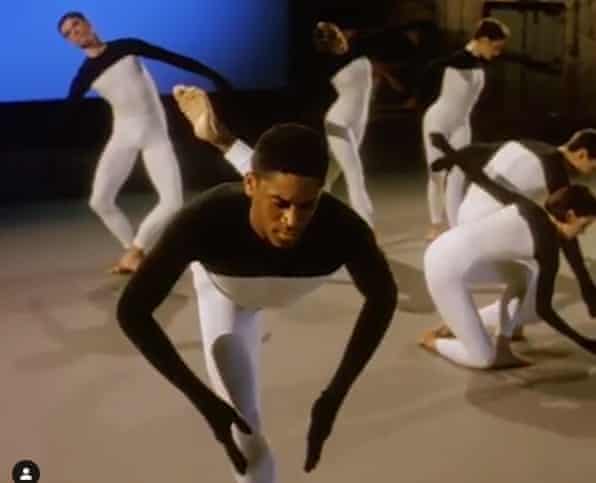
‘I’d never encountered anything like it’ … Michael Cole in Cunningham’s Beach Birds for Camera, with music by John Cage, 1991. Photograph: Merce Cunningham Trust.

I’ve had little opportunity to enjoy the spectacle of dance except vicariously through the writing of Joan Acocella in The New Yorker. I admire the discipline and athleticism that dance demands of its performers. The passage cited here charms me for how it expresses dance movements as “phrases,” as well as for its glimpse through the eyes of a dancer into the creative process. (Michael Cole, dancer)

[Merce Cunningham] would make a phrase just for the legs, say, then he would teach a completely different phrase for the arms, and then another for the torso and the head. It was up to us to put it all together and make sense of it. That’s where it really started to get crazy. (Michael Cole, dancer)

(Lindsey Winship [Interviewer], “’He said two things to me in five years. And one was thanks for the cheese’ – Merce Cunningham,” The Guardian, 4-15-19)

(c) 2019 JMN.

Posted in Quotations | Tagged , | Leave a comment

Not Ready for Answers

merce cunningham 1

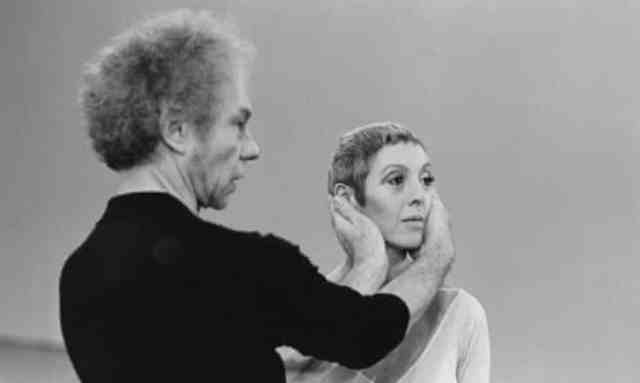
‘My new life began’ … Valda Setterfield with Merce Cunningham. Photograph: Babette Mangolte, courtesy of the WAC.

Merce Cunningham comes across in these recollections of his dancers as a man who spoke volumes in few words. “Don’t make everything so pretty” and the terse statement that answers demand questions cover about ninety percent of art and life, in my opinion.

My mother always said I should smile more, and my teachers said I’d get a job if I was more personable. But at one point Merce said to me: “Don’t make everything so pretty.” And I suddenly thought: “Thank God I can drop all that stuff.” I was lucky – Merce and I found ways to really talk to each other, and that wasn’t true for everyone. He always said: “I don’t tell people what to do. If they don’t ask me questions, they’re not ready to hear the answer.” (Valda Setterfield, dancer)

(Lindsey Winship [Interviewer], “’He said two things to me in five years. And one was thanks for the cheese’ – Merce Cunningham,” The Guardian, 4-15-19)

(c) 2019 JMN.

Posted in Anthology, Quotations | Tagged , | Leave a comment

The Heart Is a Pump

daelan 4-10-19

Daelan, March 31, 2019 —

I like what Terence McNally says about creating character through dialogue. His “heart” trope further in the interview, however, is hackneyed. I hope writers who survive this “age of calamity” find a new way to talk about courage, tolerance, empathy, affection, and zest for life — something that for me is glimpsed in this newborn’s face.

I realized very early that my descriptive powers — what a room looked like, what a person looked like — were scant. But I could write credible dialogue. And my characters sounded different from one another. I could define them better by how they spoke than by telling you how they looked… I decided if I really wanted to be a writer, I’d better focus on theater.

I’m working in an age of calamity, but also in an age of great progressive things happening, too… I think what’s required is an openness to them… These are tumultuous, rich times for a writer. All you need is ears and a heart.

My advice to artists is the same as I’d give to someone who wanted to be a better dentist or a better lawyer. Show up, listen, let your heart expand.

(Philip Galanes, “A Conversation With Terence McNally, the Bard of American Theater,” NYTimes, 4-10-19)

(c) 2019 JMN.

Posted in Quotations | Tagged | 2 Comments

Warholiana Keeps On Keeping On

warhol cows

The Guardian.

Sprayed with silver and decorated with tinfoil, Andy Warhol’s Factory was not only his studio, but a hangout for collaborators and muses like the Velvet Underground and Edie Sedgwick. Photojournalist Nat Finkelstein spent three years documenting it all

(“All tomorrow’s parties: Warhol’s Factory — in pictures,” The Guardian)

Caption:

Warhol at the Factory, 1965. Warhol poses with a piece from his series Cow Wallpapers, produced between the 1960s and 80s. Reportedly, Warhol got the idea from art dealer Ivan Karp, who once suggested, ‘Why don’t you paint some cows? They’re so wonderfully pastoral and such a durable image in the history of the arts.’ When Karp saw what Warhol had produced, he exclaimed, ‘They’re super-pastoral! They’re ridiculous! They’re blazingly bright and vulgar!’ For his next show, Warhol papered every wall in the gallery with them.

(c) 2019 JMN.

Posted in Quotations | Tagged | Leave a comment

On Clarity

punctuation colorful BBC

BBC.

As a first-year law student I, along with my peers, had to read and sort out a seeming infinitude of cases written by appellate judges whose writing skills varied widely. Navigating the dense prose of the tomes we lugged around in outsize briefcases seemed at times like slogging through a trough of fudge. I was once grilled unforgettably in class by my contracts professor for having reached the wrong conclusion about the law established by a historic case. My reading had led me to deduce the opposite of what the judge had actually decided.

I appreciate the work of Linda Greenhouse, who writes a regular column for The NYTimes about the Supreme Court and the law. Her profession is to parse what judges write, tease significance from it, and write clearly about it. In such a writer I learn from a rare stylistic slip as well as from her customary excellence.

Item (the emphasis is mine):

The cases I’ve discussed here that were not, as they reached the court, on many people’s radar — not the high-profile cases like the [T****] administration’s defense of adding a citizenship question to the 2020 census, in a case to be argued this month, or the immigration, abortion and Affordable Care Act cases now filling the pipeline to the Supreme Court. Looking ahead, is there any chance the court will avoid mirroring the country’s cavernous polarization — and any way we won’t all be the poorer if that proves to be the case?

(Linda Greenhouse, “A Supreme Court Do-Over,” NYTimes, 4-11-19)

In general, an opinion piece demands a strong, clear wind-up. Nuance can be appropriate in the body of the article, but the reader expects no puzzles at the end. The concluding paragraph cited above strikes me as flawed.

The “that” in the first line introduces a dangling subordinate clause; it’s never completed with its own verb. The verbose interpolation introduced by the first double dash encourages this lapse. The writer loses her beginning.

The second double dash introduces a question that derailed me because of how I wanted to understand “any way”; I read the phrase initially as an equivalent of “nevertheless”; however, that reading asks for the inversion “won’t we”: “— and any way won’t we all be the poorer if that proves to be the case?” Then I realized that it also requires “any way” to be written as one word: “anyway.”

Upon another re-reading I concluded that what is meant would become clearer if it were put like this: “— and is there any way we won’t all be the poorer if that proves to be the case?”

In this manner, then, I have furnished a wooly elucidation to a wooly conclusion in the best tradition of appellate judges.

(c) 2019 JMN.
Posted in Commentary | Tagged | Leave a comment

Wrestling With Darkness

ben monder guitarist

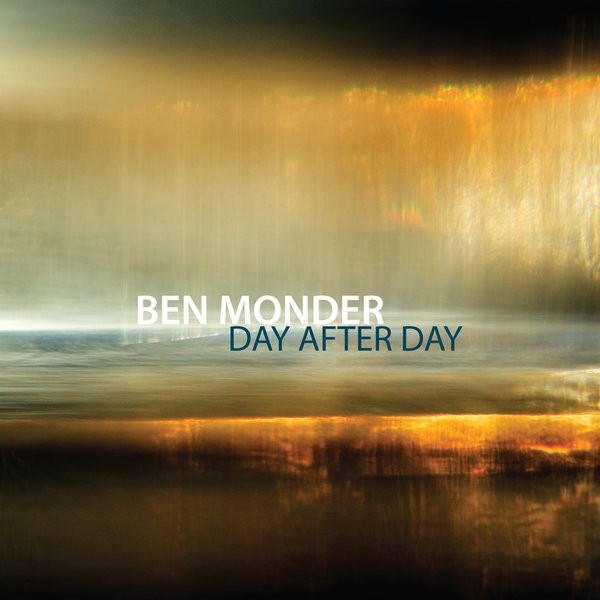
“Day After Day,” Mr. Monder’s latest album.

I wish the article quoted here had reproduced the De Chirico painting it mentions. I like to see evidence of how painting and music can interact for an artist. I’m only now becoming acquainted with Monder’s music. His recurring dream suggests that even an accomplished musician can’t always play how or what he would like to play. That somehow inspires me to keep playing.

Mr. Monder has a print of a small, phosphorescent De Chirico painting on the wall in his practice room at home in south Brooklyn. “There are paintings that seem to convey what I’m trying to sound like,” he said… He described a recurring dream that he said the painting always reminds him of. “I’m in a room, which is flooded with light, and I’m practicing, and I’m able to play just, anything,” he said. “It’s super inspiring, and I always wake up and I’m like, ‘Where did that go?’”

(Giovanni Russonello, “Ben Monder and David Torn: Jazz Guitarists Unafraid to Wrestle With Darkness,” NYTimes, 4-9-19)

(c) 2019 JMN.

Posted in Quotations | Tagged | Leave a comment

“The End of Satire”

charlie hebdo

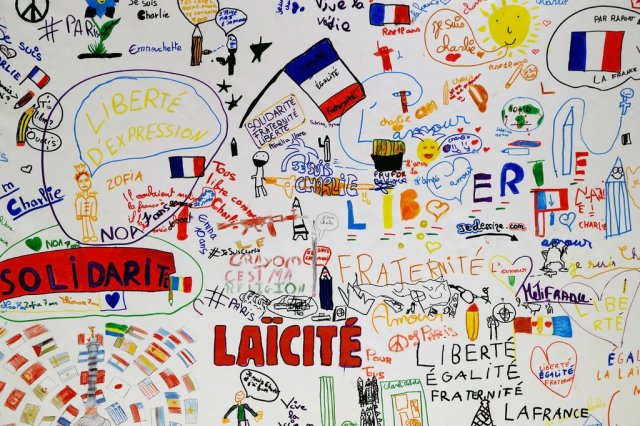
Detail from an exhibit of children’s drawings sent to the Charlie Hebdo office after the 2015 terrorist attack. Credit Francois Guillot/Agence France-Presse — Getty Images.

I have a taste for good satire. I also revere an ability to change one’s mind in a considered, informed way. The article quoted here moves me for what it shows of this process, which can be painful, as well as for what it articulates about satire. Mr. Smith, a professor of history and philosophy of science at the University of Paris, says that the real problem with satire now is “that it has become impossible to separate it cleanly from the toxic disinformation that defines our era.”

… Satire is a species of humor that works through impersonation: taking on the voices of others, saying the sort of things they would say, using one’s own voice while not speaking in one’s own name.
… I insisted that satire was speech in something like a grammatical mood of its own, as different from the declarative as the declarative is from the interrogative, and that it was therefore subject to its own rules.
… Over the past few years I have been made to see… that the nature and extent of satire is not nearly as simple a question as I had previously imagined. I am now prepared to agree that some varieties of expression that may have some claim to being satire should indeed be prohibited.
… The truth is that the nature and proper scope of satire remain an enormous problem, one that is not going to get any easier to resolve in the political and technological future we can all, by now, see coming.

(Justin E. H. Smith, “The End of Satire,” NYTimes, 4-8-19)

(c) 2019 JMN.

Posted in Quotations | Tagged | Leave a comment

A Black Hole Sings in B Flat

galaxy ngc 1275

Galaxy NGC 1275. Credit NASA.

There is great buzz today around black holes in celebration of the latest observations. The sense of awe these phenomena induce has intersected just now with my private boning up on fundamentals of music theory, leaving me astounded on many levels.

In 2003, an international team led by the X-ray astronomer Andrew Fabian discovered the longest, oldest, lowest note in the universe — a black hole’s song — using NASA’s Chandra X-ray Observatory. The B flat note, 57 octaves below middle C, appeared as sound waves that emanated from explosive events at the edge of a supermassive black hole in the galaxy NGC
1275.

The notes stayed in the galaxy and never reached us, but we couldn’t have heard them anyway. The lowest note the human ear can detect has an oscillation period of one-twentieth of a second. This B flat’s period was 10 million years.


(JoAnna Klein and Dennis Overbye, “What Is a Black Hole? Here’s Our Guide for Earthlings,” NYTimes, 4-10-19)

(c) 2019 JMN.

Posted in Anthology, Quotations | Tagged | 2 Comments

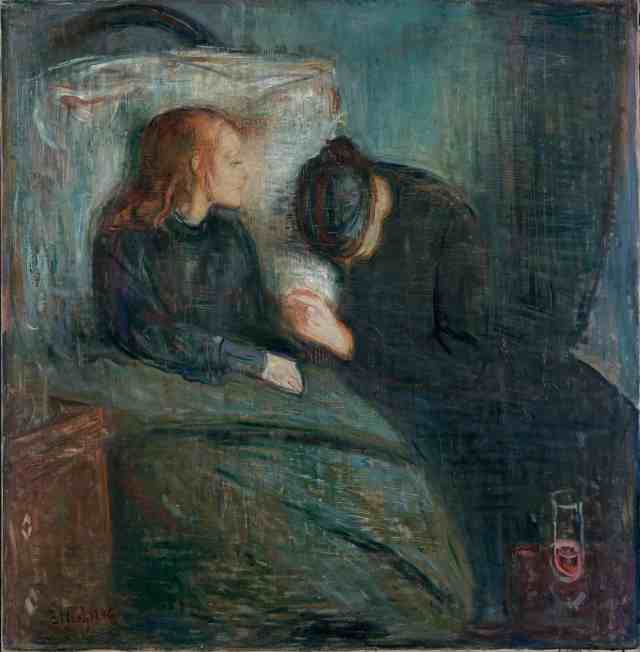
“I don’t paint what I see but what I saw”

munch sick child

Edvard Munch’s 1896 painting The Sick Child. Photograph: AP.

There’s much that’s discoverable for me about Munch. These excerpts stood out. Artists I admire are similarly self-critical and leery of pretty pictures.

Munch’s house and studio were on a remote hillside above Oslo, where he fled after his 1908 breakdown to escape “the enemy” – critics and fellow artists. He would live there with his beloved dogs, and the occasional horse, until his death. Liberated from his angst and alcoholism, he painted and repainted the nature around him, jealously hoarding his work while treating it with mind-boggling contempt. He would leave paintings outside in in all weathers beneath a narrow mansard, saying: “It does them good to fend for themselves.”

Munch drew animals beautifully, visiting zoos to study them. But he wrote: “We want more than a mere photograph of nature. We do not want to paint pretty pictures to be hung on drawing room walls. We want to create, or at least lay the foundations of, an art that gives something to humanity. An art that arrests and engages. An art created of one’s innermost heart.”

munch outside studio

Edvard Munch with brush and palette with his canvases at his house outside Oslo. Photograph: Munchmuseet.

(Claire Armitstead, “Edvard Munch: booze, bullets and breakdowns,” The Guardian, 4-8-19 — Note: “Armitstead” is not a typo.)

(c) 2019 JMN.

Posted in Anthology, Quotations | Tagged | Leave a comment

Side Hustle

rattlesnake9

How old are “old Chinese sayings” and how many are actually Chinese? Fewer than all of them, I surmise. However, one I encountered said that wisdom consists in getting things by their right names. It appealed to me because it stressed accuracy in speech.

Awash as we are in mendacity, the article quoted here refreshes by signaling how “cute” euphemisms can cloak misery — in this case, “the chaotic truth of working life in today’s America.” The author recommends that we improve the way we talk about work by shunning cynical, exploitative jargon.

The “side hustle” is one of a growing roster of trendy corporatized idioms, like ordinary household appliances that are now “smart” or plain vanilla businessmen and women remade into the more exotic “entrepreneurs.” Our jobs are now “flexible,” although we are the ones contorting ourselves to work at all hours, or we are professionally “nimble” because we are trying to survive on freelance gigs.

So what can we do? For starters, anyone writing about work… should stop glorifying long hours at work or juggling multiple workplace identities… As workers, we might acknowledge that “side hustle” is an insidious term and resolve never to use it again. More broadly, we must fight other forms of this falsifying new jargon and seek out more truthful language….

(Alissa Quart, “The Con of the Side Hustle,” NYTimes, 4-6-19)

(c) 2019 JMN.

Posted in Quotations | Tagged | Leave a comment