As a twenty-something aspiring writer I felt I was duty bound to tilt at every convention I could locate, and to speak unvarnishedly about it. I had read Burroughs and Berryman and Updike.
Regrettably, one redoubt I chose briefly to storm was pornography. I considered the literature on smut to be a creative void that needed filling.
Also, my studies at the time involved Hispano-Arabic literature. Western scholars used a cloaking device for the naughty allusions not uncommon in medieval texts: They rendered those passages in Latin, exiting temporarily whatever language — French and German mostly — they used to indite their learned treatises. This was especially true with female writers such as Wallada of Cordova.
My Latin was creaky, and sometimes I had to tap a classics colleague for elucidation. I formed a determination to make those saucy writers the subject of future research, and to demolish the decorous circumlocutions of the blushing Orientalists — uniformly male.
There was an “art theater” nearby in Zebulon. Student friends and I would make sorties there to watch the skin flicks with high purpose. Right.
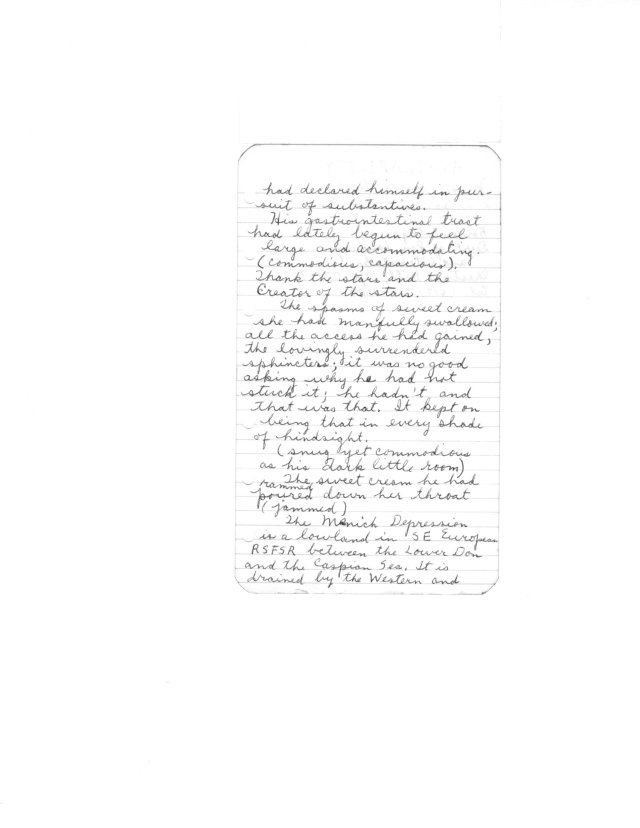
That became a source for journal entries that are acutely embarrassing now. I made a point of being granular and clinical and painfully explicit in my word experiments, calling a spade a damned shovel, so to speak. I thought to confront the prurient head-on and make it … artsy? Light a match.
Predictably, a comment in Portuguese flickered by yesterday. It seemed to credit me with premature ejaculation. If only. I can’t find the comment, I don’t know yet whence those things come nor where they land, but I’m sure it was a flame thrown in response to an unredacted journal entry. Ah well.
The bad news is that there are many pages of journal ahead. (This project is archival and preservative more than edifying.) The good news is that only a few of them (the pages) are about sex. And redaction is the subterfuge of retrospection. I’m hoping it will spare me at least a small deal of further contumely.
(Copyright 2018 James Mansfield Nichols. All rights reserved.)

 EthicalDative
Make Intelligent Mistakes
Make intelligent mistakes. (No idea who said this.)
What interests me about rhyming is how it can force you to say something that you didn’t intend to say. It can make your poem go in a new direction. It may not work, but sometimes it does. What I admire about poets who rhyme is their ability to make a rhyme fall naturally, as if it were planned and not a happy fuck-up.
“Whistler’s canvases for the works he called the ‘Nocturnes’ were prepared, Attlee explains, with a red or gray ground, on to which he would wash what he called his ‘sauce,’ a runny mixture of oil paint, linseed oil, turpentine and a mastic called copal. This medium was so liquid that canvases had to be placed on the floor to prevent the image slipping away entirely.” [Lost source.]
(Copyright 2018 James Mansfield Nichols. All rights reserved.)