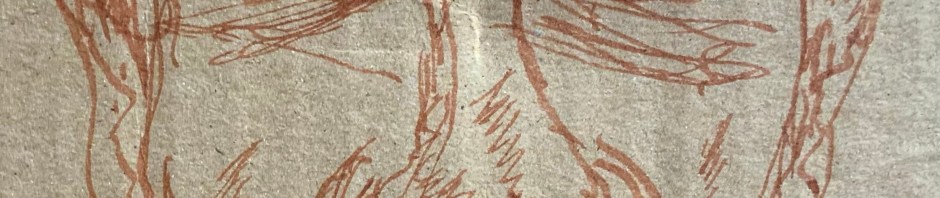

The horror vacui principle applies to messaging. A logodivergent text provokes suck-up from the reader’s own psychic aquifer. Demands are made, surmises enacted, leaps taken. A lucky text seduces its audience of one into a slow-reading entanglement.
Is it the translator’s job to help a text make sense? Putting it into “natural” or convincing English seems contingent on doing so. Or is the job rather to convey something of the experience of reading the original? Can you ride both of these bulls?
Are there cases where reading in one’s native tongue is an act of translation? Is paraphrase a legitimate recourse? My impression is that poets think it’s namby-pamby.
Maybe it’s not the writer’s role to care how the text feels to the reader. This is a challenging premise; it makes the act of writing look devil-may-care: Fuck you, reader, I’m doing me. But the mere act of propelling one’s words by hook or crook into the public sphere is an act of hawking. A reader is a buyer.
None of this is dark gray or light gray; it’s somewhere in between. To write (or draw) fulfills by alleviation; we talk to the self we occupy and fend off terror. But it’s also a way to drop a piece of that self in the dirt to see if anyone picks it up. When someone does, it feels good.
(c) 2023 JMN — EthicalDative. All rights reserved

 EthicalDative
Wow! This is right on the line between non-fiction and poetry 🙂
LikeLiked by 1 person
So kind. Thank you, Gary! I treasure your comment.
LikeLiked by 1 person