
Al-Khansā’, born near the end of the 6th century A.D., is renowned for elegies she composed for her slain brothers Mu^āwiya and Saẖr. Line 5, midway through the poem, is notable for the brusque transition to aggrieved resignation leading into the glorifying of the fallen brother. Line 6 is interesting for its apophatic rhetoric — describing a thing, in this case the brother’s nature and character, by stating traits it does not have. An arresting image is deployed in the final line. The speaker vows enmity toward’s Saẖr’s adversaries for what amounts to forever, i.e., for the time it would take for a pivotal utensil of desert hospitality, the blackened vessel used for cooking food, to turn white.
The Arabic text is from A.J. Arberry, Arabic Poetry: A Primer for Students. The crude copy, transliteration and translation appearing here are mine.
1 I found no sleep, kept watch all night long, as if my eyes were lined with muck.
2 Watching over stars, though not assigned their tending, sometimes I wrapped myself in shreds of rags.
3 I’d heard — the news gave me no joy — a messenger come spreading word of reports,
4 Saying, “Saẖr dwells there in a tomb next to a grave, struck down between stones.”
5 Go then! May God not keep you distant, man who fended off injury, seeking blood for blood.
6 You carried a heart not wronged mounted in a lineage not weak,
7 Like a spear-point illumining the night, you, bitter in resolve, free son of free men.
8 I’ll cry tears for you while ringdoves mourn and stars light the traveler’s way,
9 And not make peace with folk you warred against until the good host’s cooking pot turns white.
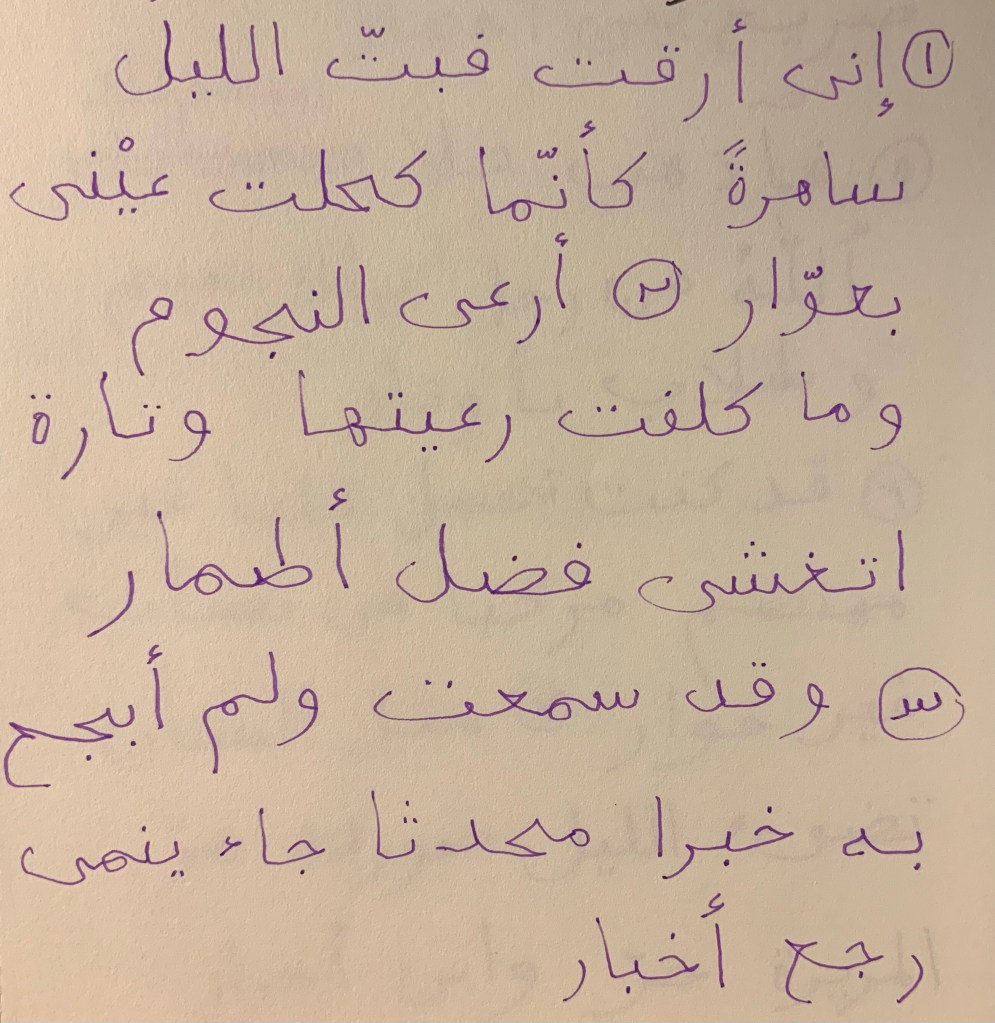
2 ‘ar^ā-n-nujūm(a) wa-mā kulliftu ri^yaẗ(a)-hā | wa-tāraẗ(an) ‘ataḡaššā faḍl(a) ‘aṭmār(i)
3 wa-qad sami^tu wa-lam ‘abjaḥ bi-hi ẖabar(an) | muḥaddiṯ(an) jā’a yanmī raj^(a) ‘aẖbār(i)
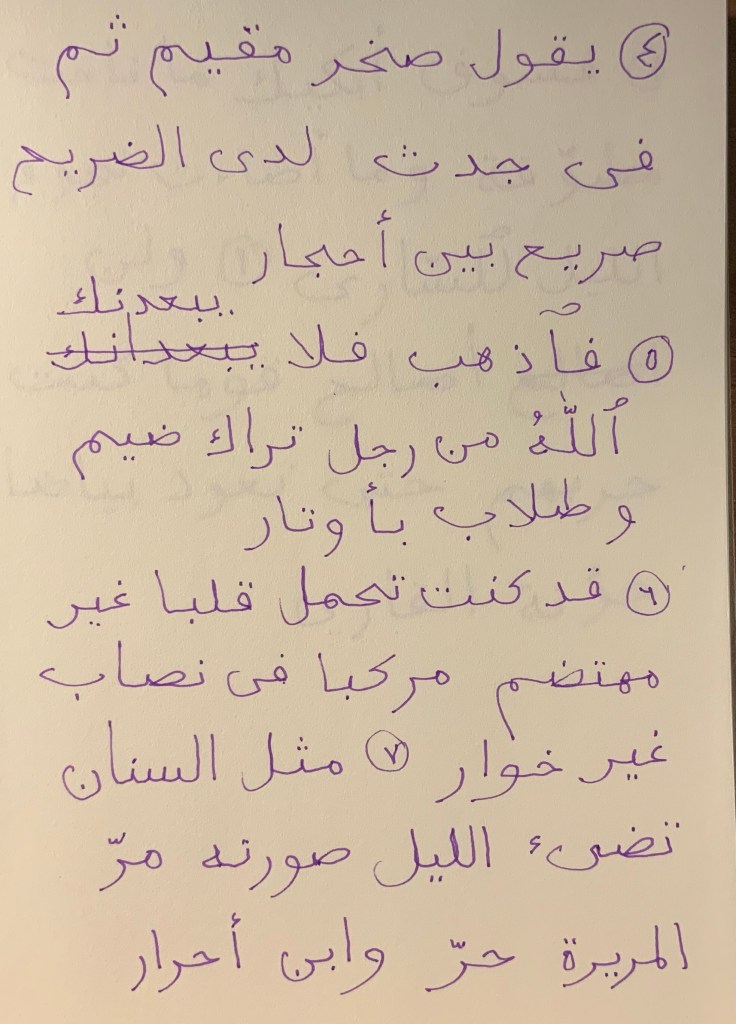
5 fa-ḏhab fa-lā yub^idan-ka-l-lāh(u) min rajul(in) | tarrāk(i) ḍaim(in) wa-ṭallāb(in) bi-‘awtār(i)
6 qad kunta taḥmilu qalb(an) ḡaira muhtaḍam(in) | murakkab(an) fī niṣāb(in) ḡaira ẖawwār(i)
7 miṯla-s-sinān(i) tuḍī’u-l-lail(a) ṣūraẗ(u)-hu | murr(u)-l-marīraẗ(i) ḥurr(un) wa~bn(u) ‘aḥrār(i)

9 wa-lan ‘uṣāliḥa qaum(an) kunta ḥarba-hum | ḥattā ta^ūda bayāḍ(an) ju’naẗ(u)-l-qārī
(c) 2023 JMN — EthicalDative. All rights reserved


💚
LikeLiked by 1 person
Pingback: Purulence, Pus, Matter? Anointed or Kohl’d? | EthicalDative