
In an essay, Meghan O’Rourke writes the following:
Ambivalence is, like so much poetry, paratactic. (Poetry, June 2024)
Ambivalence is a state of mind characterized by mixed feelings. Parataxis is a rhetorical move. It daisy-chains independent clauses, leaving it to the reader to intuit their relationships. I came. I saw. I conquered. Its opposite, hypotaxis, introduces dependent clauses into the mix, which “can bolster the meaning of a work.” Poems forego such bolstering by flaring off fussy back story.
O’Rourke invites attention to the ending of a famous Frost poem — never mind which one. She focuses on the line break which repeats “I“ across the enjambment. “These final rousing lines enact a kind of ambivalent epistemic stutter… that often goes unremarked,” she writes. If all that can be said about the choice not to lead a certain existence is that it “has made all the difference,” that line is “trickily ambivalent: is the difference good or bad?” she muses.”
Would “trickily ambiguous” have been a better descriptor of Frost’s line? (I hear you say it’s a distinction without a difference.) In distilling its contemplations, poetry augments cognitive load on the reader. In the best of cases it earns the right to do so; the reader’s exertions add value to the poem. Hell, let’s agree on this: A poem without a good reader is a breathless tuba.
Here’s where I land on the epistemic stutter gone unremarked: Frost doesn’t need for us to know. Or rather, Frost needs for us not to know. Imagine he had jotted the following in a pocket notebook where he kept his ideas:
Two roads diverged in a wood, and I stood contemplating which one to take. One looked heavily traveled, judging by the ruts; but the other path looked as if it hadn’t been traversed in months, which appealed to my instinct for discovery. I took the one less traveled by, because I was footloose and fancy free back then — just wanted to stretch my wings and see some country — and that has made all the difference. Why and how? Because I met my future wife when I spent the night in that little lodge on Lake Pottawatomie. If I hadn’t made that flippant decision to go one way and not another, I wouldn’t bask in the love of that good woman today.
Now imagine the road taken.
(c) 2024 JMN — EthicalDative. All rights reserved

 EthicalDative
⬇️
LikeLiked by 1 person
You keep my mind ticking over Jim. And that’s not an ambivalent thought! Sue
LikeLiked by 2 people
Thanks, Sue!
LikeLike
I didn’t know. Thank you!
LikeLiked by 2 people
No shame! I didn’t either. Thanks for visiting.
LikeLiked by 2 people
😁 Cool. I’ll keep visiting!
LikeLiked by 1 person
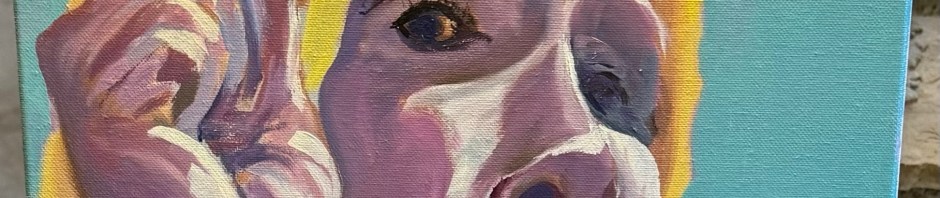
A very interesting post. I once had to write an exercise after the reading of this poem by Frost. What came out was interesting. You made me reread it yesterday and it was a good thing to do. I like the painting. It’s active. Sorry, I don’t know how to express it.
LikeLiked by 2 people
Thank you, Olga. Frost’s “road not taken” is woven into our culture. I’m glad you have experience of it. Also, gratified by your attention to my oil sketch. I like your word “active.” I’m trying to do more practice with quick renderings of expressive faces without burrowing down into detail and overworking the outcome. It entails leaving rough edges and moving on. I find it both challenging and harrowing. In the sketch of Greene I’m happiest with the peremptory hand and the snarling mouth — the gesticulatory organs are the window of the soul!
LikeLiked by 3 people