Nabokov and Borges differed over how translation should be done, the former favoring literalness (“The clumsiest literal translation is a thousand times more useful than the prettiest paraphrase”), the latter transformation (“Translation is… a more advanced stage of writing”). I gravitate increasingly towards Nabokov’s view, driven most by my practice in reading Arabic.
I like the Spanish word “fidedigno” for its suggestion of “faith-worthiness.” A faith-worthy translation isn’t gassy with interpretation; pays all but servile deference to the letter of the original; doesn’t reach unduly for the “spirit” of the text — that’s for the separate realm of commentary. Equally important, the faith-worthy translation resists overprocessing the source into target-friendly modalities, presuming that the reader must always be protected from strange-sounding language.
I’m on verse 5:60 of the Quran:
قُلْ هَلْ أُنَبِّئُكُم بِشَرٍّۢ مِّن ذَٰلِكَ مَثُوبَةً عِندَ ٱللَّهِ ۚ مَن لَّعَنَهُ ٱللَّهُ وَغَضِبَ عَلَيْهِ وَجَعَلَ مِنْهُمُ ٱلْقِرَدَةَ وَٱلْخَنَازِيرَ وَعَبَدَ ٱلطَّـٰغُوتَ ۚ أُو۟لَـٰٓئِكَ شَرٌّۭ مَّكَانًۭا وَأَضَلُّ عَن سَوَآءِ ٱلسَّبِيلِ ٦٠
My reading is this:
“Say: Do I inform you of worse than that, requital-wise, chez God? The one whom God cursed him and He was angry with him and made of them [plural pronoun!] monkeys and pigs and he worshiped idols. Those are worse, place-wise, and more astray from the sameness of the way.”
My reading is a trot, not a translation. It tries to peg analytically the operation of elements in the source text. I try to seize on what seems a core meaning of a word in a Wehr listing; this can mean passing over a dandy English phrase standardized by usage (ex. “right path” versus “sameness of the way”).
About those monkeys: In English a “simian” is an ape or a monkey, but an ape isn’t a monkey. I don’t find the distinction between the two as clearly marked in Arabic and Spanish. (Spanish doesn’t have different words for “elk” and “moose,” either.) For qird (its plural qiradaẗ occurs in the verse), Wehr lists “ape” and “monkey.” Lane lists “ape,” “monkey” and “baboon.”
I’ll cite two versions of the verse to show what solutions translators can hit upon.
Shall I tell thee of a worse (case) than theirs for retribution with Allah? (Worse is the case of him) whom Allah hath cursed, him on whom His wrath hath fallen and of whose sort Allah hath turned some to apes and swine, and who serveth idols. Such are in worse plight and further astray from the plain road.
— M. Pickthall
Di: <<No sé si informaros de algo peor aún que eso respecto a una retribución junto a Dios. Los que Dios ha maldecido, los que han incurrido en Su ira, los* [Cortés’s note: ‘Los judíos. C2:65’] que Él ha convertido en monos y cerdos, los que han servido a los taguts, ésos son los que se encuentran en la situación peor y los más extraviados del camino recto.>>
(Say: “I don’t know whether to inform you of something worse than that respecting a retribution next to God. Those whom God has cursed, those who have incurred His wrath, those* [Cortés’s note: ‘The Jews. Quran 2:65’] whom He has converted into monkeys and pigs, those who have served the idols, they are the ones who find themselves in the worst situation and strayed furthest from the straight road.”)
— Julio Cortés
(c) 2024 JMN — EthicalDative. All rights reserved

 EthicalDative
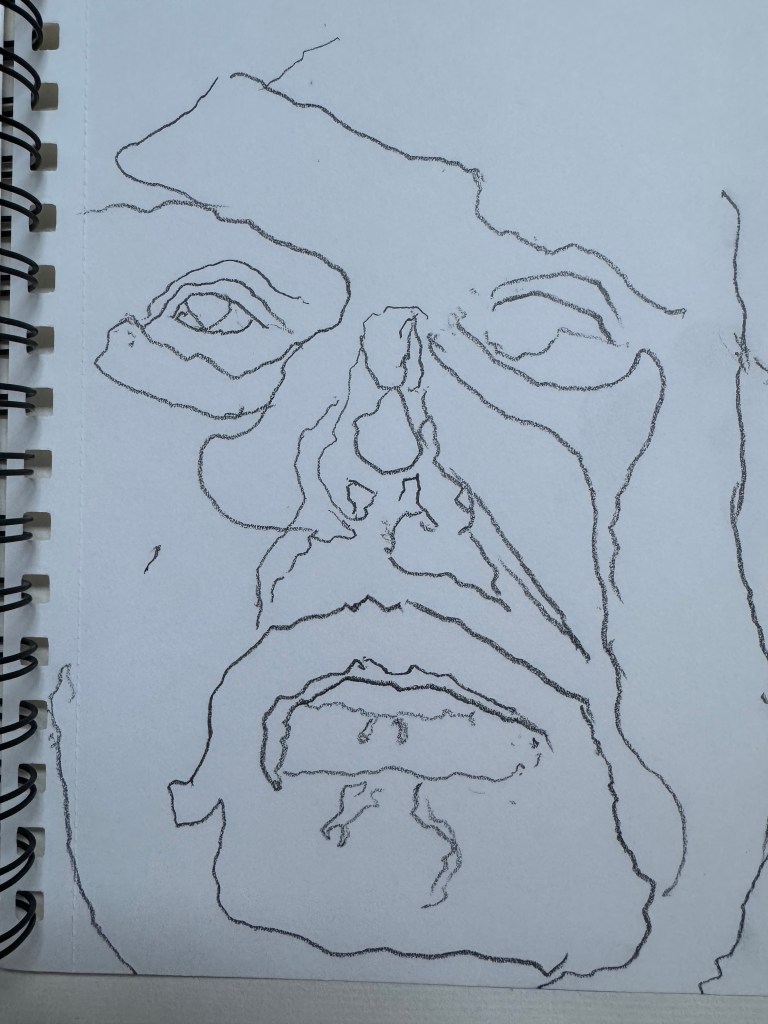
I love the drawing. Tell me about it.
LikeLiked by 2 people
Thank you, OA. It’s a stab at sketching with my left hand. I’m hoping my right brain will kick in at some point! 🙂
LikeLiked by 1 person
I see you’ve gone for shapes and areas instead of strict lines. I wondered how you jumped to that. It reminds me of a contour map.
LikeLiked by 2 people
I think observing your practice is helping me jump.
LikeLiked by 1 person
Too kind!
LikeLiked by 1 person
I love the drawing too – I like the way you’ve taken up the whole page. And, I find your analysis of how to tackle translation very interesting.
LikeLiked by 1 person
Thanks so much, Sue. I appreciate the compliment the more for how dexterous you are in your own work. Regarding translation, I think of it as an art itself and more important than often credited.
LikeLiked by 1 person