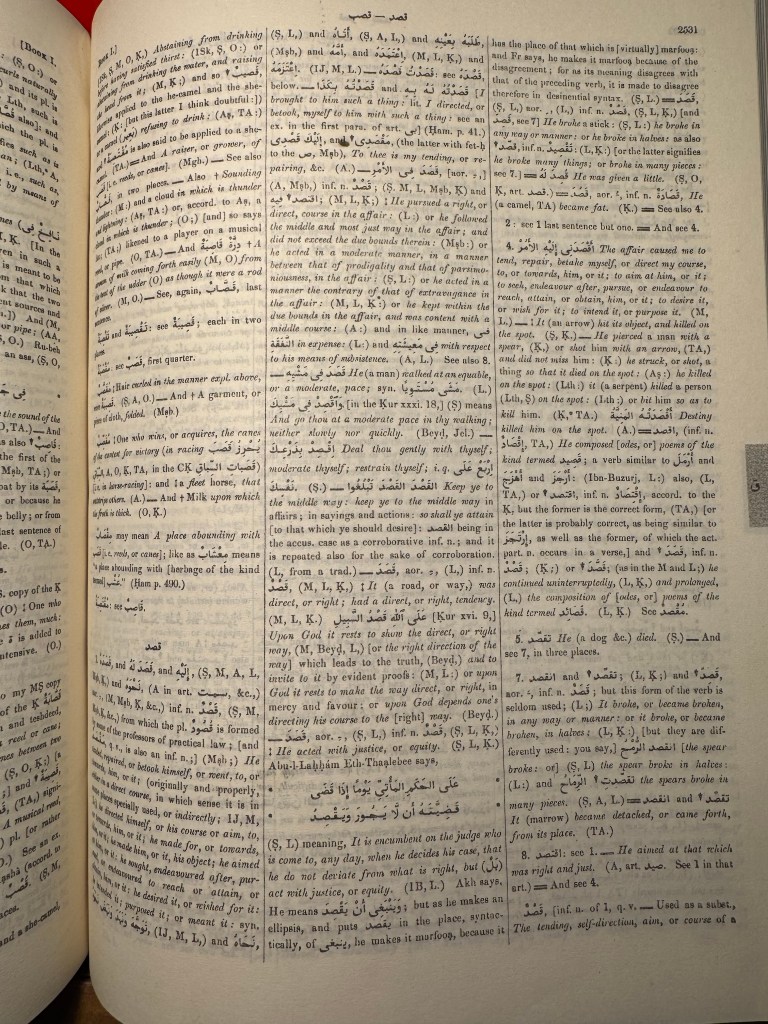
Lane’s entry for root q-ṣ-d spans two pages (1).
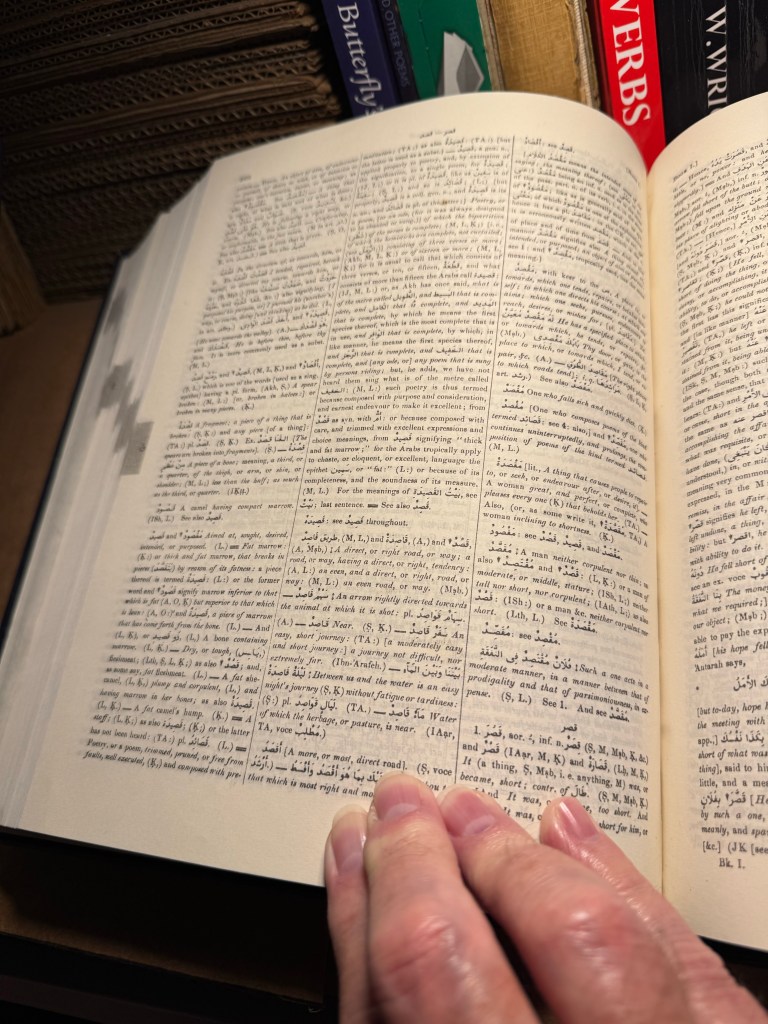
Lane’s entry for root q-ṣ-d spans two pages (2).
(Update, Oct. 26, 2025. Some time after writing what’s below I’ve encountered Mitch Teemley’s citation of Psalm 37:23. What’s a good word for how the Quran and the Bible interact? I’ve no expertise in either, but I see signs of their being in dialogue as I go. The idea of a deity “making firm” the steps of an individual “on his or her way” — “The” Way — to enlightenment has affinity with the phrase picked apart below.)
If you make it to the end of this post and are not a student of Arabic or scripture, you are an admirably straight-ahead, honor-bright, questing reader and receive my utmost doff of cap. I’m a short-form blogger. This entry breaks the mold, but I can’t make it any less than what it is if I’m to to lay bare the very marrow of the matter.
The phrase to ponder is at the beginning of a Quranic verse. Here’s my transliteration:
wa-^alā-l-lāh(i) qaṣd(u)-s-sabīl(i) […]
Here’s the full verse in Arabic:
وَعَلَى ٱللَّهِ قَصْدُ ٱلسَّبِيلِ وَمِنْهَا جَآئِرٌۭ ۚ وَلَوْ شَآءَ لَهَدَىٰكُمْ أَجْمَعِينَ ٩
My provisional translation of the transliterated phrase is this:
Upon God [is] the resolution of the way […]
The bolded word is the pivotal one, representing qaṣd. Here’s Wehr’s complete listing of possible equivalents for qaṣd:
endeavor, aspiration, intention, intent; design, purpose, resolution; object, goal, aim, end; frugality, thrift, economy
Which would you have chosen? Here are the translations I monitor as I read the Arabic text (my bolding):
It rests with Allah alone to show you the Right Way, even when there are many crooked ways. Had He so willed, He would have (perforce) guided you all aright.
— A. Maududi (Tafhim commentary)
Allah Se charge (d’indiquer) la direction menant à la juste voie [“Allah takes charge (of indicating) the direction leading to the right way”] dont certains s’écartent pourtant. S’Il voulait, Il vous y conduirait tous.
— Montada Islamic Foundation
A Dios le incumbe indicar el Camino [“Upon God it is incumbent to indicate the Way”], del que algunos se desvían. Si hubiera querido, os habría dirigido a todos.
— Julio Cortés, El Corán
They all alight on the notion of “showing” or “indicating” for qaṣd. I don’t find this sense satisfactorily accounted for in Wehr’s listing. Such an outcome always sets the hares running in my mind. I want to know how the experts reached their outcome, especially when they’re in agreement.
It often helps to see what the verb from which a noun derives can mean. For qaṣada Wehr lists these possible meanings:
to go or proceed straightaway, make a beeline, walk up to s.o. or s.th.; to go to see, call (on); to betake o.s., repair, go (to a place), be headed, be bound (for a place); to seek, pursue, strive, aspire, intend, have in mind; to aim; to have in view, contemplate, consider, purpose; to mean, try to say; to adopt a middle course; to be economical, frugal, thrifty, provident; to economize, save.
Here again I do not see the notion of showing and indicating satisfactorily accounted for. Wehr documents Modern Standard Arabic and solves most problems, given how conservative the language has been in its evolution from pre-Islamic times to the present. For what may be lapsed or archaic usage my last resort is the big gun: Lane’s Lexicon. Lane draws from the copious commentaries and compendiums of classic Eastern lexicographers and grammarians.
I feel I’ve really struck paydirt whenever Lane happens to cite the very verse of the Quran which I’m trying to elucidate textually. That happens to be the case here. Lane provides the following glosses of the phrase in question. (I’ve expanded its parenthetical abbreviated references to their titles as provided in the “Indications of Authorities,” p. xxxi):
Upon God it rests to show the direct, or right way, (“The Moḥkam,” El-Beydáwee’s “Exposition of the Kur-án,” The “Lisán el-‘Arab”) [or the right direction of the way] which leads to the truth, (El-Beydáwee’s “Exposition of the Kur-án”) and to invite to it by evident truths: (“The Moḥkam,” The “Lisán el-‘Arab”) or upon God it rests to make the way direct, or right, in mercy and favour: or upon God depends one’s directing his course to the [right] way. (El-Beydáwee’s “Exposition of the Kur-án”) […]
Are you still with me? I hope this sticky chase we’ve shared (remember the hares?) sheds light on my title. Have any of the proffered translations helped you understand exactly what qaṣd meant, say, to a seventh-century Arabic speaker?
Translations don’t actually or necessarily “fail”; most are useful in their way, but are often inflationary, bending in the direction of what feels like interpretive assumptions conforming to the strictures of a target language as well as to creed. This is especially true with ancient scriptures where vast temporal and cultural chasms yawn. The Montada French translation seems to me most consistently to track the Arabic in a reasonably close manner. It also manages to be graceful. Go figure! Accurate literalness is the trait I value most in a translation. My motto, for better and (!) worse, is “Not what it means, but what it says.” Is there Latin for that? Non indicare sed dicere?
Thanks for keeping me company on this little outing! Your seat is on the left. 🙂

Oil on canvas, 16×20 in. (JMN 2020).
(c) 2025 JMN — EthicalDative. All rights reserved

 EthicalDative
Lovely setting the course painting.
LikeLiked by 1 person
I appreciate your kind words. You’ve intuited the spirit of the little painting — someone who’s not sure where he’s going but is on his way there! 🙂 It reminds me of a recent painting of yours with the theme of voyaging to the unexpected. You have the craft piercing the picture plane from the bottom. Your word is a better framing of it than “the unknown.” Best regards.
LikeLiked by 1 person
Admiro tu tenacidad en el estudio de la Palabra. La Palabra, continente de Todo y Nada.
Magnífico óleo. Me gusta sentarse a la izquierda.
Un saludo amigo.
LikeLiked by 1 person
Me alegra tu comentario más de lo que pueda expresar en mi castellano pobre, Azurea. Te agradezco el compañerismo que me brindas con tanta amabilidad en el viaje de este bloguito. Te devuelvo un saludo amistoso.
LikeLike
Like you, I appreciate finding a word that conveys the essence. Thank you for appreciating the choice of the “unexpected.”
LikeLiked by 2 people