A. O. Scott on Sontag

against by sontag2

“Susan Sontag alone on a bed. N.Y.C. 1965.” Photograph by Diane Arbus.

The credit on this piece says “A.O. Scott is a chief film critic at The Times and the author of ‘Better Living Through Criticism: How to Think About Art, Pleasure, Beauty, and Truth.’” I read him frequently. (Strictly as a side note, I’m intrigued that The Times calls him “a” chief film critic at that newspaper. Generally, can there be more than one “chief”?) His engaging essay about Sontag’s writings helps me understand my early infatuation with her “Notes on Camp.”
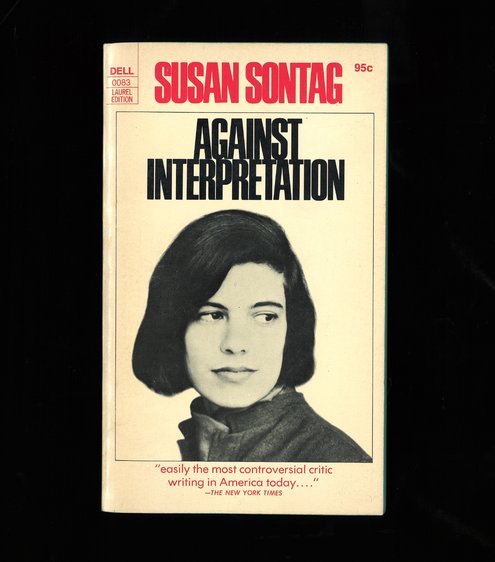
against by sontag

In the chapter of “Against Interpretation” called “Camus’ Notebooks” — originally published in The New York Review of Books — Sontag divides great writers into “husbands” and “lovers”…

[Quoting from Sontag:] Some writers supply the solid virtues of a husband: reliability, intelligibility, generosity, decency. There are other writers in whom one prizes the gifts of a lover, gifts of temperament rather than of moral goodness. Notoriously, women tolerate qualities in a lover — moodiness, selfishness, unreliability, brutality — that they would never countenance in a husband, in return for excitement, an infusion of intense feeling. In the same way, readers put up with unintelligibility, obsessiveness, painful truths, lies, bad grammar — if, in compensation, the writer allows them to savor rare emotions and dangerous sensations. [End of Quote from Sontag]

The sexual politics of this formulation are quite something. Reading is female, writing male. The lady reader exists to be seduced or provided for, ravished or served, by a man who is either a scamp or a solid citizen. Camus, in spite of his movie-star good looks (like Sontag, he photographed well), is condemned to husband status. He’s the guy the reader will settle for, who won’t ask too many questions when she returns from her flings with Kafka, Céline or Gide. He’s also the one who, more than any of
them, inspires love.

(A. O. Scott, “How Susan Sontag Taught Me To Think,” NYTimes, 10-8-19)

(c) 2019 JMN
Posted in Quotations | Tagged , , , , | 1 Comment

Robert Johnson

robert johnson

A photo booth portrait of the blues musician Robert Johnson. It was taken around 1930 and is one of two confirmed photographs of him. Credit…© 1986 Delta Haze Corporation. All Rights Reserved. Used by Permission.

It was in… popular juke joints — segregated stores or private houses that doubled, after hours, as recreational places — that his now legendary music career began… The young musician had trained on a diddley bow — one or more strings nailed taut to the side of a barn…

…The guitar playing on Johnson’s recordings was unusually complex for its time. Most early Delta blues musicians played simple guitar figures that harmonized with their voices. But Johnson, imitating the boogie-woogie style of piano playing, used his guitar to play rhythm, bass and slide simultaneously, all while singing.

(Reggie Ugwu, “Overlooked No More: Robert Johnson, Bluesman Whose Life Was a Riddle,” NYTimes, 9-25-19)

(c) 2019 JMN

Posted in Commentary | Tagged , , , , | Leave a comment

“Do Not Erase”

erase1

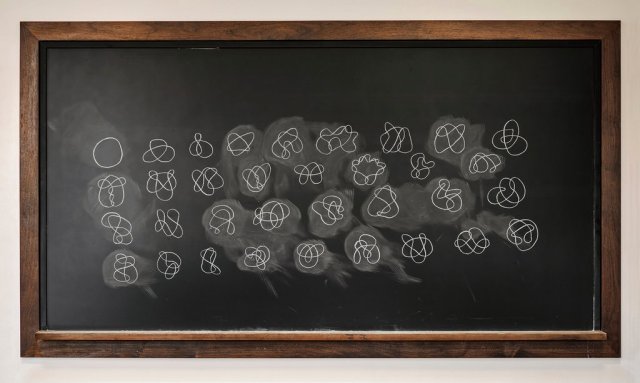
Sahar Khan’s blackboard at Columbia University.

For the last year, Jessica Wynne, a photographer and professor at the Fashion Institute of Technology in New York, has been photographing mathematicians’ blackboards, finding art in the swirling gangs of symbols sketched in the heat of imagination, argument and speculation. “Do Not Erase,” a collection of these images, will be published by Princeton University Press in the fall of 2020.

erase2

Amie Wilkinson, of the University of Chicago, at the Institut Poincare in Paris.

“I am attracted to the timeless beauty and physicality of the mathematicians’ chalkboard, and to their higher aspiration to uncover the truth and solve a problem,” Ms. Wynne said… “Their imagination guides them and they see images first, not words. They see pictures before meaning.”

erase3

Shuai Wang, Columbia University.

erase4

David Gabai, Princeton University.

(Jessica Wynne, Dennis Overbye, “Where Theory Meets Chalk, Dust Flies,” NYTimes, 9-23-19)

(c) 2019 JMN

Posted in Commentary | Tagged , | Leave a comment

Random Woke Affect & Filth Squirting

writing plume

A phrase from the past has pungent currency today. In 1896, an editorial in the Guardian mentioned a derogatory rumor about Lord Rosebery. Quoth the lord:

“… The allusion in the Guardian… gave me the opportunity that I had long desired of pulverising this lie… It is amusing to see how the squirters of this filth are now declaring that they never said or intended or thought anything of the sort.”

Wokeness: “an overly rigid commitment to identity politics and social justice ideology… a shorthand for puritanical political correctness… a pejorative wielded against liberal elitism.” (From African- American vernacular, where it meant “a broad awareness of anti-black oppression.”)

Affect (noun meaning “desire” or “emotion”): “A former vice president, Joe Biden, known for his centrist politics and blue-collar affect, leads the field.” (Would “affectation” be better here: “a studied display of real or pretended feeling”?)

Finally, a U.S. senator disremembers a potentially incriminating phone conversation.

“I’ll go back and check on my records… But it seems very unlikely that I would be taking calls from random people.”

The man illustrates why random voters need to show him and his fellow filth squirters the exit.

SOURCES
Paul Chadwick, “How The Guardian is moving on from a misjudged editorial,” theguardian.com, 12-1-19.
Jamelle Bouie, “Why the ‘Wokest’ Candidates Are the Weakest,” NYTimes, 12-6-19.
James Walker, “Lev Parnas’ Attorney Address Devin Nunes on Twitter: ‘Lev Remembers’,” Newsweek, 12-6-19.

(c) 2019 JMN

Posted in Commentary | Tagged | Leave a comment

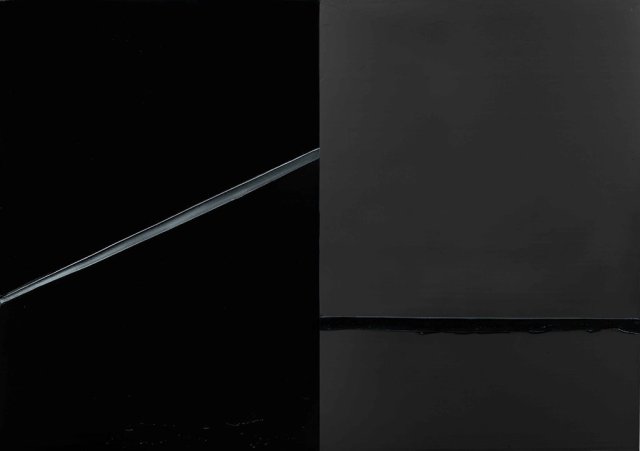
Outrenoir: Ultra-Black

soulages1

“Brou de noix” (1946) Credit…Archives Soulages/Artists Rights Society (ARS), NewYork/ADAGP, Paris.

French painter Pierre Soulages turns 100 this December, 2019. He is being accorded an exhibit at the Louvre. The only other painters given an exhibit there during their lifetimes were Picasso and Chagall. Since 1979, Soulages has worked exclusively in black, creating a series of works he calls “outrenoir,” or “beyond black.”

soulages2

“Painting” (2008) Credit…Archives Soulages/Artists Rights Society (ARS), New York/ADAGP, Paris.

“Black is never the same because light changes it,” he said, in French, through an interpreter. “There are nuances between the blacks. I paint with black but I’m working with light. I’m really working with the light more than with the paint.”

soulages3

“Painting” (1955) Credit…Archives Soulages/Artists Rights Society (ARS), New York/ADAGP, Paris.

Prehistoric art was his primary source of inspiration, Mr. Soulages said. “I always ask myself one question,” he said. “Who was this big ape who one day painted on the wall?”

(Nina Siegal, “Black Is Still the Only Color for Pierre Soulages,” NYTimes, 11-29-19)

(c) 2019 JMN

Posted in Quotations | Tagged , , , , , | 2 Comments

Don’t Slip, Ma’am

crown

Queen Elizabeth II and Prince Charles at the state opening of Parliament in London in October. Credit…Pool photo by Toby Melville.

Americans watch the royals, rapt, for signs of slippage and failure, but also out of a kind of awe at how long they’ve sustained the illusion of honor. Yes, they’re mooches and hypocrites, but—…

(Lili Loofbourow, “The Mesmerizing Disgrace of Prince Andrew,” Slate, 11-30-19)

(c) 2019 JMN

Posted in Quotations | Tagged | 1 Comment

‘Your Painting Is Your Best Friend’

brown

Cecily Brown at her studio in New York City. Credit…Danna Singer for The New York Times.

Cecily Brown, age 50, is the daughter of British writer Shena Mackay and David Sylvester, the art critic and curator. When Brown was 18 and struggling financially, the painter and sculptor Maggi Hambling let her paint in her garage.

“Maggi was the first real painter I knew,” she says. “Having the garage to paint in made the hugest difference. The work that eventually got me into the Slade was all made there. Maggi was also the person who told me I had to show up every day to paint or it wasn’t worth it. Your painting is your best friend — there when you’re down as well as up, she’d say….”

After finishing at the Slade, Brown moved to New York’s “friendlier” art world.

“In London, it was called a private view… In New York, it was called an opening… Desire itself was my driving force. Desire drives painting too. Sex was the closest thing to painting in the real world.”

Brown made a series of paintings based on “Ladyland,” a 1968 studio shot of 19 naked young women used for a Jimi Hendrix album cover. She realized reluctantly they “wouldn’t be simple positive depictions of women…”

brown2

“Untitled,” 2012, by Cecily Brown. Credit…Rob McKeever.

“Eventually I decided it couldn’t matter, and that in fact the true subject might be my conflicted and complicated feelings about… women and womanhood, being gazed upon, being a gazer oneself… thinking about women’s culpability, and women of our time who have helped set us all back decades, like the Kardashians.”

(Rachel Cusk, “Can a Woman Who Is an Artist Ever Just Be an Artist?” NYTimes, 11-7-19)

(c) 2019 JMN

Posted in Quotations | Tagged , , , , , | 1 Comment

Celia Paul

Celia Paul was one of five daughters of Christian missionaries. She spent her early childhood in India, then in Exmoor, southwest England. Her father became bishop of Bradford. “Why, she wonders, did he have all these children he didn’t have time for, daughter after daughter, one after the other dispatched to boarding school?”

In her second year at the Slade, at 18, Celia Paul was seduced by the 55-year-old Lucian Freud, who was there as a visiting professor.

The strangeness of her clerical childhood had left her with a number of qualities fatal to the situation: extreme innocence, an iron will, a hatred of her own body and an unusual capacity for both suffering and devotion… Socially odd and unconfident, rawly sensitive and isolated yet unusually committed and determined, she was a kind of modern-day Jane Eyre…

celia paul

“Family Group, 1980,” by Celia Paul. Credit…from Victoria Miro Gallery.

Celia rarely painted her father. It was her mother and sisters who became — and remain — her subject. Her breakthrough as a young art student was to draw intimate aspects of them in which her personal knowledge of them could be crystallized. At the Slade, the emphasis was on life drawing from a nude model: Celia did not see what she could be expected to learn from drawing someone she didn’t know.

(Rachel Cusk, “Can a Woman Who Is an Artist Ever Just Be an Artist?” NYTimes, 11-7-19)

(c) 2019 JMN

Posted in Quotations | Tagged , , , | 2 Comments

Exquisite Vapors

Adverbs Ahead

Banal Triangulations Ahead

These are voices echoed by Spencer Bokat-Lindell recently in the NYTimes.

Some of [Buttigieg’s] ideas… don’t fall neatly on the ideological spectrum… Mr. Buttigieg’s triangulations are more banal… Displays a facility with rhetoric … His appeal, in aesthetic terms, is antithetical to… He carries no populist resentment and can easily speak the language of the coastal elite… His image as a “verbally adept” moderate… His allure may be smaller than it appears… With his air of decency and grab bag of gifted-and-talented party tricks… For all his overdetermined virtuosity — an accomplished pianist! a Rhodes scholar! a polyglot! — he has demonstrated no political artistry…

(Spencer Bokat-Lindell, “Pete Buttigieg 2020?” NYTimes, 11-21-19)

The tone is that of a clubby commentariat hoist on its own effluvia trading lofty quips amongst itself.

I hope the party of Will Rogers will grasp the urgency of speaking plainly to citizens whose vote is needed to revive representative government from its coma.

(c) 2019 JMN

Posted in Commentary | Tagged , , , , | Leave a comment

Glitter Jitters

bacons pope

Francis Bacon’s “Pope,” from about 1958, at Sotheby’s. Credit…The Estate of Francis Bacon/DACS, London/ARS, NY; via Sotheby’s.

Here are nuggets tweezered from a story about heartburn in the high-dollar art market.

This time around, there are few museum-quality works by the most famous artists to tempt billionaires — no painting or sculpture is estimated to sell for more than $45 million…

The auction… includes a full-length Francis Bacon “Pope” painting from about 1958… It is certain to sell for at least $6 million… The painting was made in Tangier during his violent love affair with the ex-fighter pilot, Peter Lacy… This was one of six given by the artist to his friend Nicolas Brusilowski, on the understanding that the canvas would be reused… “It was a throw-out and it depresses me he did not destroy the image…,” wrote Bacon.

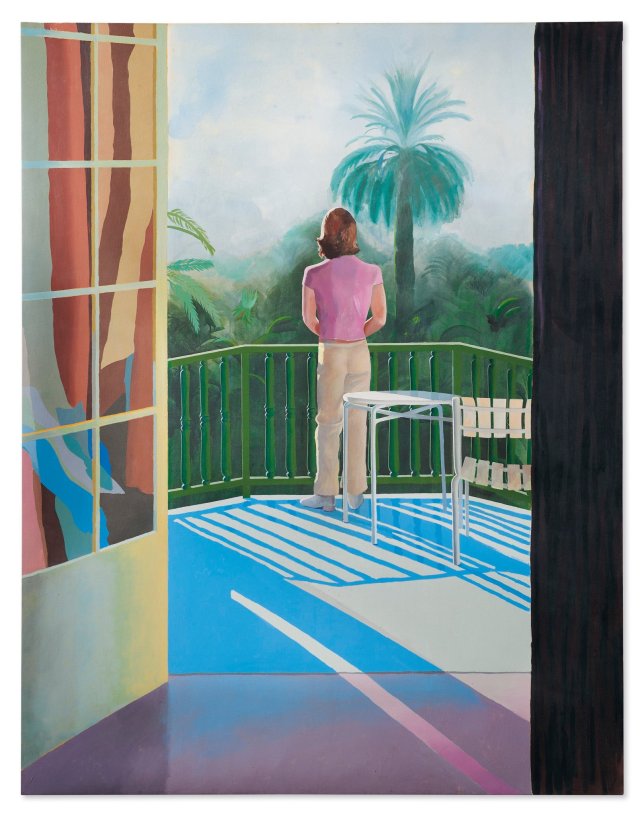
sur la terrasse

David Hockney’s rediscovered “Sur la Terrasse,” acrylic on canvas, 1971. Credit…via Christie’s.

For many, the one out-and-out trophy of the season is David Hockney’s rediscovered acrylic on canvas, “Sur la Terrasse”… The $25 million to $45 million estimate makes it the most highly valued lot of the week… The… composition… depicts Mr. Hockney’s then-lover, Peter Schlesinger, on the balcony of the couple’s room at the Hotel La Mamounia in Marrakesh in 1971…

(Scott Reyburn, “Will Global Jitters Dull the Glitter of New York’s Art Gigaweek?” NYTimes, 11-11-19)

(c) 2019 JMN

Posted in Commentary | Tagged , , , | Leave a comment