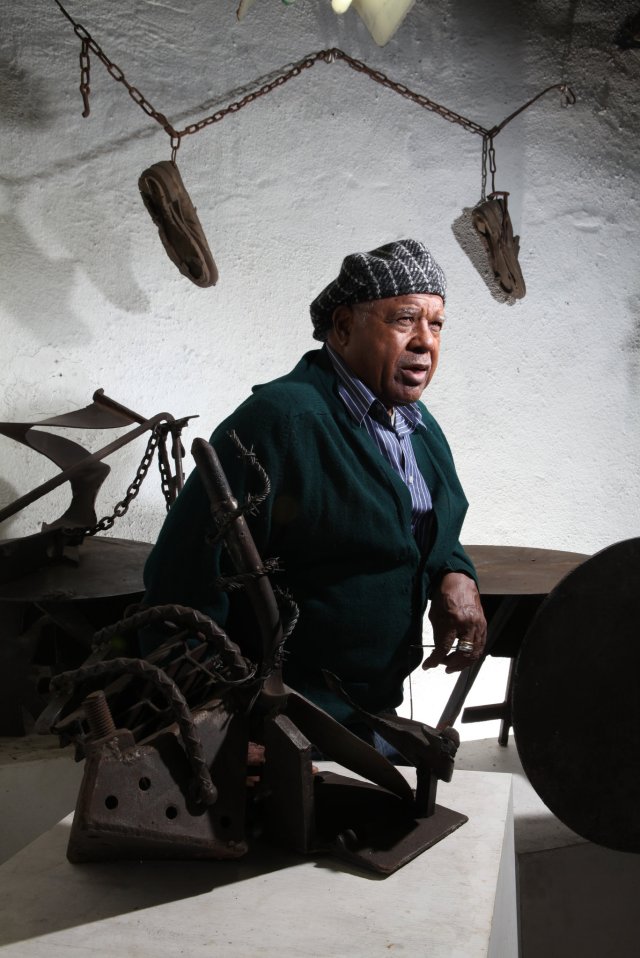
The sculptor Melvin Edwards at his studio in Plainfield, N.J., with “Nigba Lailai (The Past),” from 1979. Credit Melvin Edwards/Artists Rights Society (ARS), New York; Chester Higgins Jr./The New York Times.
Older artists profiled in this article are achieving belated critical and financial success after laboring in obscurity for much of their careers. In her title the author makes the artists’ ethnicity explicit, providing good context for the categorization, and it’s enough
said. Many don’t wish their art to be filtered through “the lens of identity.”

“Lorraine O’Grady: Cutting Out CONYT,” was an exhibition of her work using cut-out type from The New York Times. Credit Lorraine O’Grady/Artists Rights Society (ARS), New York; via Alexander Gray Associates.
Artists mentioned are: McArthur Binion, Howardena Pindell, Melvin Edwards, Lorraine O’Grady, Frank Bowling, Sam Gilliam, Barkley Hendricks, Jack Whitten, Mark Bradford, Charles Gaines, William T. Williams, Barbara Chase-Riboud, and Kerry James Marshall.
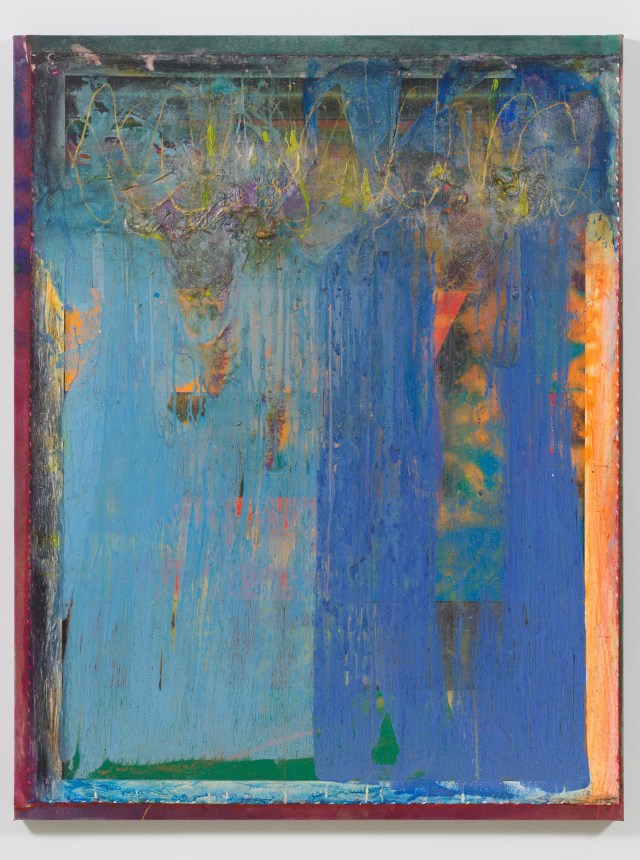
Last year Frank Bowling, 85, created “Two Blues,” acrylic and mixed media on collaged and printed canvas. Credit Frank Bowling/Artists Rights Society (ARS), New York; DACS, London; via Alexander Gray Associates; Hales Gallery.
I particularly savored Melvin Edwards’s pithy remarks:
“You invent your own game — and then you push it forward,” said Mr. Edwards, who taught at Rutgers for 30 years. “It’s about time the art world caught up.”
…He is philosophical about all the new attention.
“Some is serious, some is fickle and some is not at all positive — you just have to find your way through it,” he said.
(Hilarie M. Sheets, “Discovered After 70, Black Artists Find Success, Too, Has Its Price,” NYTimes, 3-23-19)
(c) 2019 JMN.






To ‘E’ or Not to ‘E’
BBC.
A silly title, yes.
I get pleasure from reflecting on minutiae of language — syntax, spelling, grammar, etymology, what have you. Language is part of “what makes us us,” to borrow Jacinda Ardern’s clarion phrase. It’s worth talking about. If I question a particular usage, it’s in a spirit of friendly inquiry, not derision.
(Margaret Renkl, “Let’s Hear It for State U.,” NYTimes, 3-25-19)
“Born” instead of “borne,” perhaps?
If I had the pleasure of meeting Margaret Renkl, a distinguished columnist whose work I read frequently, I would simply thank her (or her editor) for the opportunity to ponder a possible slip that’s inspiringly minute.
(c) 2019 JMN.