Expressions

My Spanish grandson, a computer science student, reads novels in English by authors such as Ken Follett to sharpen his skills in that language. He wrestles with colloquialisms and slang expressions that he encounters. The one he mentioned specifically was “It’s not my cup of tea.” He asked me recently to provide him a random list of such expressions off the top of my head for him to ponder and possibly recognize should he encounter them. I’ve free-associated thus far the following hodgepodge for him. (Nagging question: Is all slang this weighted toward the derogatory and snide? Or is it me?)

-a He’s… She’s… You’re… They’re…

-b I… You… He… She… They…

-c It’s…

Not my cup of tea.

Pulling my leg.

Took me for a ride.

Let sleeping dogs lie.

Make hay while the sun shines.

Lie with dogs, rise with fleas.

On it like a duck on a junebug.

Not a bowl of cherries.

Not all hats and horns.

Has a burr in his blanket.

Has a bee in her bonnet.

Old as the hills.

Wild and woolly.

High on the hog.

In high cotton.

High as a kite.

Free as a breeze.

There’s a new bull in the pasture.

All hat and no ranch.

Too far over his skis.

Under the weather.

Ugly as a mud fence.

Open a can of whup-up on him.

Long in the tooth.

Living on borrowed time.

Speaks with a forked tongue.

Over the moon.

Pencil-neck geek.

Straight arrow.

In over his head.

The sky’s the limit.

Butter my butt and call me a biscuit!

His cheese done slid right off his cracker.

Crazy as a loon.

Up a creek without a paddle.

Oil field trash and proud.

Busy as a bee.

Just got skunked.

One brick shy of a load.

Not playing with a full deck.

Not rowing with both oars.

A loose cannon.

(Cc) 2019 JMN.

Posted in Commentary | Tagged | 4 Comments

Traduced in Translation

m.media-amazon.com/images/M/MV5BOTc1MjY0ODA4MF5BMl5BanBnXkFtZTgwMjQyNTQ3NjM@._V1_.jpg

In the film, set in Mexico City in the 1970s, the actors speak Mexican Spanish and the indigenous Mixtec language. For that Spanish, Netflix added subtitles in Castilian, Spain’s main dialect, for the release in that country. On Wednesday, Netflix removed those Castilian subtitles after Cuarón told El País, a Spanish newspaper, that they were “parochial, ignorant and offensive to Spaniards themselves.”

“It’s like if you have an American film showing in the U.K. and the character says he’s going to the washroom, but the subtitles say he’s going to the loo,” [Jordi] Soler [Mexican author living in Barcelona] said in a telephone interview. “It’s ridiculous. They’re treating the people of Spain like they’re idiots.”

(Alex Marshall, “Mama to Madre? ‘Roma’ Subtitles in Spain Anger Alfonso Cuaron,” NYTimes, 1-12-19)

(c) 2019 JMN.

Posted in Quotations | Tagged | Leave a comment

Thank you for asking

“How many Likes?” It behooves me not to get fouled up in the stats. This blog is a self-pleasuring diary with benefits. I intend to let it spurt beyond my passing for a beat, then go poof with me into the Great Naught.

(c) 2019 JMN.

Posted in Commentary | Tagged | Leave a comment

Old English “Kennings”

s3.amazonaws.com/libapps/accounts/35417/images/sutton_hoo_bigger.jpg

There are ways of expressing feeling in the Old English kennings that do not exist in the formal English of today. Even if I were to dream up some delicious new portmanteau here — some melding of “history,” “poignant” and “solitude,” say — I still would not be creating a true kenning. That’s because, in our tongue, words get their meaning from the order we put them in: “Poignant” would end up modifying “solitude,” instead of the words just hovering next to each other in figurative space. We who speak contemporary English are so reliant on word order that we are no longer as able as our forebears to create lyrical, associative, figurative meaning in poetry. We just can’t do the same things with our vocabulary. Old English speakers can treat metaphor as an occasion to innovate; Modern English simply tries to describe. Their poetry can turn skeletons into exploding nation-states; we have to focus on keeping our adjectives in the right places. But to our immense good fortune, Old English poetry has survived, and we know how to read it. The kennings are out there waiting for you — so beautiful, so different and so very, very old.

(Josephine Livingstone, “Letter of Recommendation: Old English,” NYTimes, 1-4-19)

(c) 2019 JMN.

Posted in Quotations | Tagged , | 9 Comments

Language and Music

mediad.publicbroadcasting.net/p/wvxu/files/styles/small/public/201810/otis_rush.cobra_cover.jpg

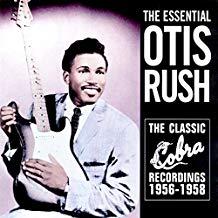
THE SONG BEGINS with a great resonating shout of joy and pain that resolves into the word “Well,” swooping down from a soaring A flat to E flat. “I can’t quit you, baby,” the singer continues, the band entering with a crashing seventh chord, “but I got to put you down for a while.” … The guitar responds with a six-note phrase, played twice. An ideal match for the voice, the guitar’s sound is stingingly incisive, rich with vibrato and its own exhilarating bends and sustains, at once lush and restrained.

(Carlo Rotella, “Otis Rush,” NYTimes Magazine, 12-2018)

I’m persuaded that painting enters our senses visually, and music enters them audibly, and that language is not involved in conveying what each medium conveys. I’m also convinced that the viewer or listener benefits from repeated encounters with a great work via the pertinent sensory faculty — eye or ear — scrubbed of the intrusion of narrative or doctrine. However, I confess that, be it a crutch or an illusion, I feel that sometimes a piece of good descriptive writing seems to enhance my apprehension of a work, especially with music. Afterwards, I can listen to it with greater esthetic rapture. In a sense, I can be taught to hear a work slightly better with the assistance of language.

(c) 2019 JMN.

Posted in Commentary | Tagged , | Leave a comment

The Anal Linguist Rides Again

Despite being sequenced, there are still many questions that remain unanswered about the 1918 strain, such as where it originated *from*.

(Nicole Karlis, “The same flu virus that caused the 1918 pandemic is back this year,” Salon, 1-3-19)

That “from” adds a layer of fat to the origination. Never mind. These “thoughts on language” aren’t meant to be a dreary litany of gotchas.

But, hello, what’s this?

…The greatest burden of any influenza pandemic can be expected to *effect* those least privileged…

(Same article)

There’s an affectionate tut-tut here by the sardonic range rider, but pity the poor scribbler after all. Even Homer nodded. The stories snap, crackle and pop; the need to keyboard them in passable journalese and press “Send” is fiery; deadlines hound; the gig is transient; pay is laughable; and the market for correctitude is slack anyhow. Hats off and hearts out.

(c) 2018 JMN.

Posted in Commentary | Tagged | 4 Comments

Spot On

i.pinimg.com/236x/af/0a/5e/af0a5e1f54ce7bd39bdacda274b78d97–iris-murdoch-irish-people.jpg

Dame Iris Murdoch had been a philosophy don at Oxford before she became a novelist, and as far as I was concerned, her philosophy of life was spot on, as someone in a British novel might say.

(Susan Scarf Merrell, “In Praise of Iris Murdoch,” NYTimes, 1-4-19)

(c) 2019 JMN.

Posted in Quotations | Tagged , | Leave a comment

A Good Guitar

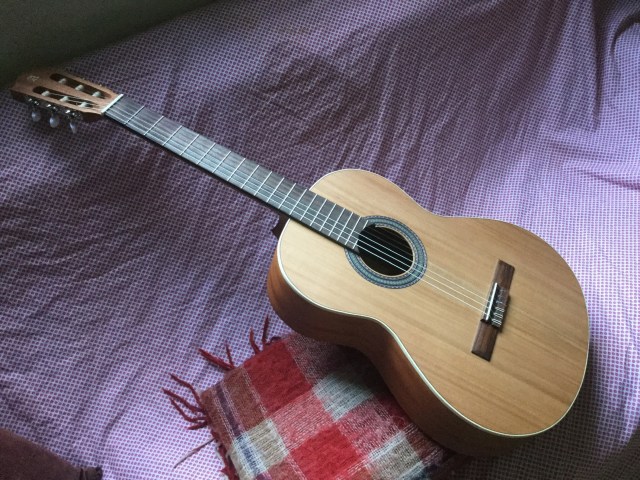
I bought this guitar new at a music store in Reus (Catalonia – Spain) for 260 euros. The brand is “Alhambra,” not one I was familiar with. Made in Spain. I must give it its due here and say that it’s an astoundingly fine instrument for the price. It’s well put-together and has a VERY light finish, almost raw — practically danced out of my clutch when I first played it — a surprisingly bright sound. I was told I could try out more expensive models of the line, but I said, naw, I’ll just take this one. I hadn’t wanted to lug a guitar with me to Spain — I’m just an amateur, anyway, but I try to abuse the best instrument I can afford as a general rule. My slogan is that mediocre players need good guitars more than good players do. I was shopping for a workaday guitar I could leave here pending my next visit so as to have my needs covered at both ends. This jewel does the trick. I almost wish I could take it home.

(c) 2018 JMN.

Posted in Commentary | Tagged | 2 Comments

Losing It

“I completely understand — it’s the two greatest players of all time,” Mouratoglou said of the attention. “But I’m really focused on the singles, because my goal is that she [Williams] wins the Australian Open.”

(Ben Rothenberg, “Serena Williams and Roger Federer Face Off for the First Time,” NYTimes, 1-1-19)

I would say “my goal is that she *win* the Australian Open.”

I’m content to publicize this further bit of evidence that the subjunctive mood is on the ropes in English. And why not? What problem does it solve? The speaker quoted, Patrick Mouratoglou, is Serena Williams’s coach. He’s French, and the French equivalent — “qu’elle gagne” — wouldn’t have distinctive present subjunctive marking either. Could that have influenced him to use the indicative in his English statement? To quote James Joyce, “Ask yourself the answer, I’m not giving you a short question.” I surmise that the past subjunctive form would rear its head if he said the French equivalent of “my goal *was* that she win (wins?) the Australian Open.” I forget, however, how to conjugate that particular form in French. Would it be “gagnasse”? I’ve dug myself down a French rabbit hole in pursuit of a fly speck of English trivia.

(c) 2018 JMN.

Posted in Commentary | Tagged | 6 Comments

“Where Have All the Vowels Gone”?

Time was that you had to be an experimental weirdo to ditch vowels. In “Finnegans Wake,” James Joyce used the word “disemvowelled” in a section that includes this exchange of crystal-clear dialogue:

— Nnn ttt wrd?

— Dmn ttt thg.

Before we are all Joyce — God bless him — I would suggest that we take a deep breath, a mndfl one even, and consider the culling of our five (maybe six) friends. After all, there are words that can hardly do without them: muumuu, audio and oboe, just to queue up a few. One cannot text someone “b” and expect them to know one is referring to an oboe.

(John Williams, “Where Have All the Vowels Gone?” NYTimes, 12-29-18)

[I’m dmnd if I can winkle out what the “Nnn ttt” part of Joyce’s “crystal-clear dialogue” signifies.]

(c) 2018 JMN.

Posted in Commentary | Tagged | Leave a comment