
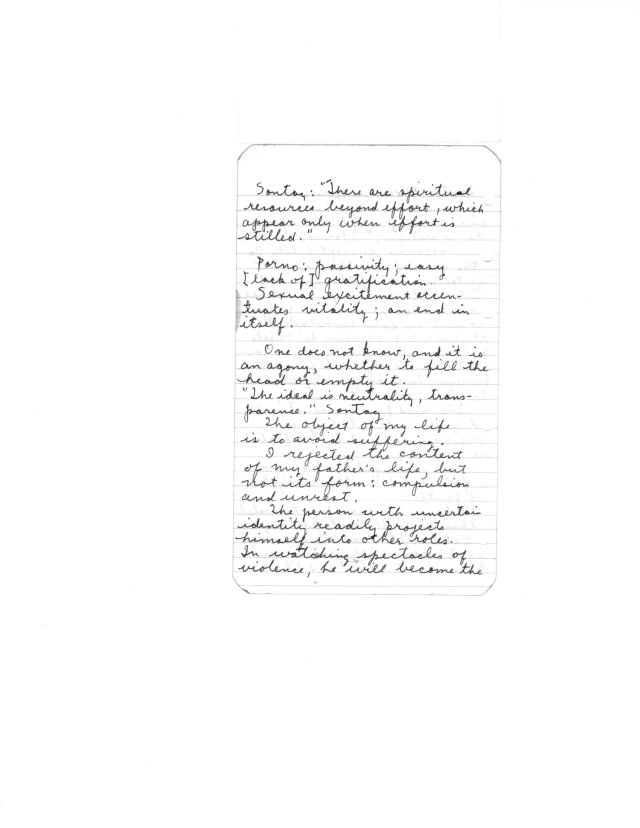
MANED EXETER (Sontag, 219)
Maned Exeter, beleaguered metalunan
victor or the victim. The success of such spectacles indicates that most people identify with the victor; they are immortal. I identify with the victim. Screen violence is horrible because I am its object. Thus, a taste for distance and formalism in art (Sontag on Bresson). Porno, on the other hand, involves a similar, but titillating, projection. In this case, I am aggressor.
Screen gore is the successor of the public execution. Could the sex act replace the death act as public spectacle? Mores and censors overwhelmingly favor the latter. But couldn’t ceremonial and stylized execution proceed from erotic drive?
The energies must address a specific, delimited goal.
(Copyright 2018 James Mansfield Nichols. All rights reserved.)

Written in the 70s, 70s-9. (Copyright 2018 James Mansfield Nichols. All rights reserved.)

 EthicalDative
“Lurchingly?
I’ve read and admired Peter Schjedahl’s writings about art in the New Yorker for years. His recent article is entitled “The Lurchingly Uneven Portraits of Paul Cezanne” (New Yorker, April 9, 2018).
The piece is unhelpful to me as an amateur engaged in people painting. Schejedahl lingers at the level of pronouncements that hover above practice. In “Self-Portrait With Bowler Hat,” I’m interested in how Cezanne handles the beard with its glimpses of underlying flesh, and the peekaboo lips with their highlight. In “Madame Cezanne In a Red Dress” I’m interested in the sketchiness of her facial features and her severe hairdo.
Schejedahl has a formidable eye and range. I would welcome more brush-to-canvas observations from him now and then. How precisely did Cezanne fall short, from a painterly standpoint, in specific instances, according to this eminent, highly readable critic?
(Copyright 2018 James Mansfield Nichols. All rights reserved.)