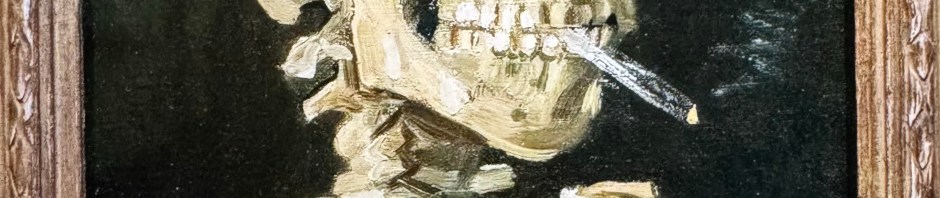

“Head of a Skeleton With a Burning Cigarette” (1886), by Vincent van Gogh. Credit… Juho Kuva for The New York Times. [New York Times caption and illustration (enlarged)]
Whether it’s taken as a grin or a snarl, all skulls bare their teeth; it goes with being a skull. But sometimes an art historian is in pursuit of a story to tell — it goes with being an art historian. Anna-Maria von Bonnsdorf, director of the Ateneum Art Museum, part of the Finnish National Gallery, says Vincent was “tuned into a late 19th-century trend that revived religious symbolism from the Middle Ages”:
Van Gogh gave the [Dance of Death] allegory an update, von Bonsdorff said. “Because it has a cigarette, and it’s grinning, it has this very modern attitude,” she said. “It’s death in a modern setting, death as the dandy.”
Art historian Juliet Simpson characterizes the alarming state of affairs at turn of century, when the first of two world wars was looming:
“The world is speeding up and rushing to a state of potential collapse or meltdown,” Simpson explained. “It shifts into a question: What is the meaning of all this, and what can artists do about that?”
The contrasting demonstratives stand out; “this” could be the speeding up, and “that” could be the meltdown. A matter of greater concern is that Nina Siegal’s second sentence in the following passage is missing a preposition and a predicate:
But for Northern Europe and the Nordic artists, from around 1870 until 1920, there was an alternative center of artistic influence in Berlin, Von Bonsdorff said. Artists inspired by the culture of the German capital who were interested a darker, more spiritual interpretation of life, and looked to the Middle Ages to express fin de siècle discontent and a search for deeper meaning. [My bolding.]
But I didn’t mean to dwell on style. I enjoy seeing the luscious modeling in shades of ivory of Vincent’s skeleton, which the article says he painted during his art student days. A second painting is also interesting — the Munch crucifixion. According to a curator of the National Museum of Norway in Oslo, it’s the artist himself who is depicted on the cross, “sacrificing himself for his art.”
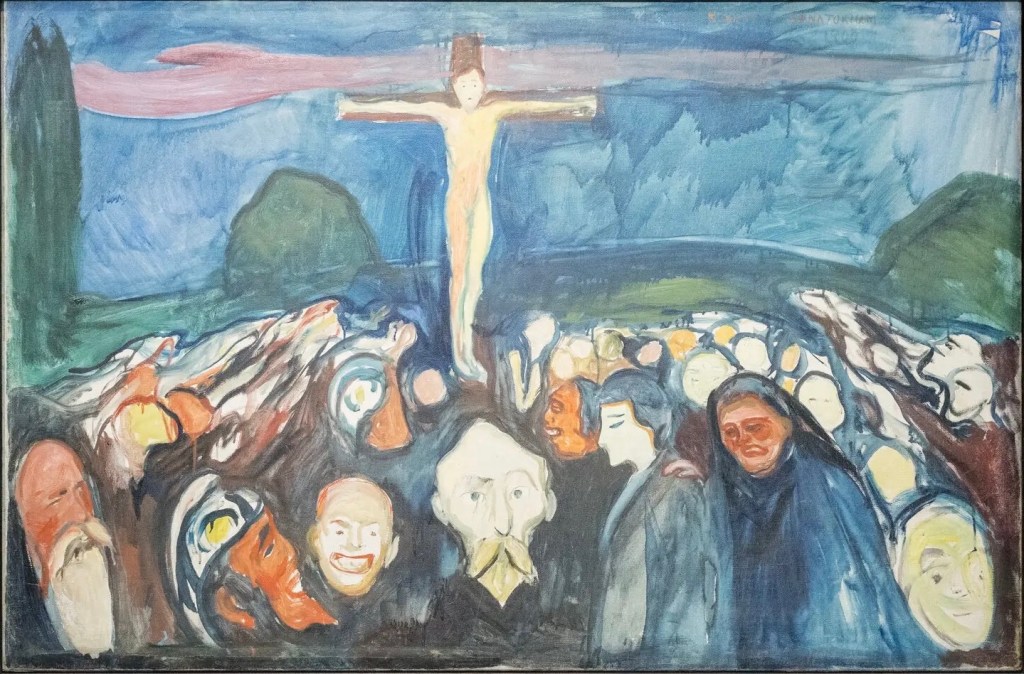
“Golgotha” (1900), by Edvard Munch. Credit… Juho Kuva for The New York Times. [New York Times caption and illustration (enlarged)]
(Nina Siegal, “Did van Gogh Have a Goth Phase?” New York Times, 10-26-24)
(c) 2024 JMN — EthicalDative. All rights reserved

 EthicalDative
Another interesting and informative post Jim! Thank you.
LikeLiked by 1 person
Thank you, Sue.
LikeLiked by 1 person