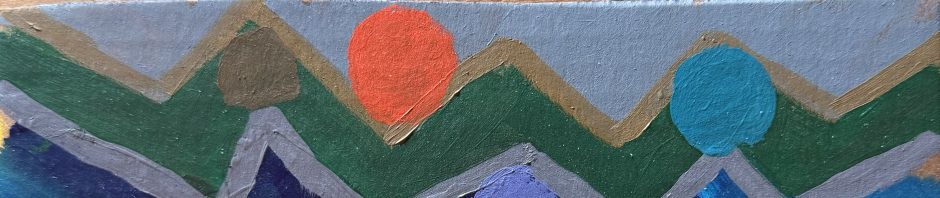
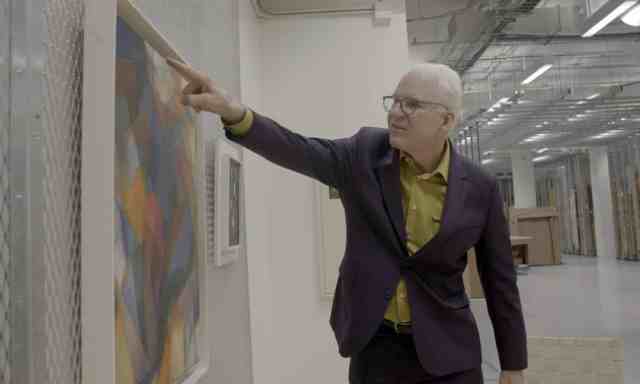
Steve Martin with Synchromy by Stanton MacDonald-Wright, painted in 1917 and now held at MoMA. Photograph: BBC.
I want to find this slightly bizarre article interesting, but I’m distracted by astonishment that it does not show a single illustration of the work of the artists it discusses: Stanton MacDonald-Wright and Morgan Russell. Well, unless you count the headline photograph of Steve Martin pointing to an indistinct painting. Absent anything else to look at, make of the following what you will:
They soon began to believe that colour was just as important as music to people, and that a painting should simply celebrate this, without straining to represent real life… “In Paris they started working in this completely abstract way of painting,” Martin said. “They called it synchromism, which means ‘with colour’… Yet the pair’s claim to have invented their own school of painting was challenged later by other well-known European abstract artists, such as Robert and Sonia Delaunay, who argued that the Americans had copied their own ideas about the use of colour and shape, referred to as orphism… For Martin, though, the work of the synchromists has been undervalued as a result and it is time for a reappraisal… It is not necessary to understand the technical principles of synchromism, he argues, because the works still communicate… “I don’t generally care about theories. The result of working from a theory could be fantastic, but you don’t really need to know the theory to look at it.”
(Vanessa Thorpe, “The history of art… according to Steve Martin,” theguardian.com, 9-21-19)
(c) 2019 JMN







 EthicalDative
Meaning vs. Making
The “All Connected” show features Hans Haacke’s “Oil Painting: Homage to Marcel Broodthaers,” 1982, with a portrait of Ronald Reagan. Credit Hans Haacke/Artists Rights Society (ARS), New York; Vincent Tullo for The New York Times.
Farago’s comment supports a bias of mine that an artist’s work may breathe more the less he verbalizes about it.
On a language note, this article acquaints me with the word “exudation,” a derivative from “exude,” meaning to ooze, as from a pore or wound.
(c) 2019 JMN