Homepage | Dilbert by Scott Adams

The Official Dilbert Website featuring Scott Adams Dilbert strips, animation, mashups and more starring Dilbert, Dogbert, Wally, The Pointy Haired Boss, Alice, Asok, Dogberts New Ruling Class and more.
— Read on dilbert.com/

Parody Inversion Point

Posted in Commentary | Tagged , | Leave a comment

The Dark Greys of Her Eyebrow

queen

Mr Cameron has released a book and spoken in a BBC documentary about his time in Downing Street. Getty Images.

Former PM David Cameron asked the Queen for “just a raising of the eyebrow even… a quarter of an inch” to convey opposition to Scottish independence in 2014. “I’ve already said perhaps a little bit too much,” he conceded recently. (“The Queen and David Cameron: What royal displeasure really means,” BBC.com, 9-19-19)

The Queen agreed with him. There’s an “understanding” about royal audiences, according to royal commentator Dickie Arbiter: Mums the word.

Royal correspondent Jonny Dymond reports the royal “displeasure” may be “something coming pretty close to real anger… It is difficult to imagine anything other than horror in the palace at David Cameron’s revelations.”

Pretty close, mind you. Verging on horror, if one can imagine. In the palace!

The Queen’s ostensible assignment is to swallow her tongue for all practical purposes. The Cameron case (amongst others) is said to highlight “the dark greys of the Queen’s constitutional position, the discretion she has or lacks [my emphasis], under extraordinary circumstances, to speak out and act.” Has or lacks! Take your pick.

Recent events suggest that the UK runs less on a written constitution than on a handshake amongst gentlemen. It’s an inconvenient truth in a post-gentlemanly age, nor does it make monarchy less baffling.

(c) 2019 JMN

Posted in Commentary | Tagged , | Leave a comment

Ways of Looking

sontag

Moser’s deep dive into Sontag’s personal life and her work includes exploration of published and unpublished writings. Credit Sonny Figueroa/The New York Times.

Benjamin Moser has published “Sontag,” a biography of Susan Sontag. This favorable review of it left me mulling the following remark:

“Biography is a metaphor,” Moser said. “It’s not the person’s life; it’s writing about a person’s life. Just like a photograph — lots of people have taken photographs of [Sontag], and they’re all different. You have to find your way of looking at her, and this is my way of looking at her.”
(Nina Siegal, “A Big New Biography of Susan Sontag Digs to Find the Person Beneath the Icon,” NYTimes, 9-15-19)

Calling biography “metaphor” is interesting. In an age when persons blithely deny the nose on their faces, it would be comforting to fantasize that biography recounted events in a person’s life more than ways of looking at the person. It must be inevitable that biography would assume its place next to politics, history, and climate in this gaslit moment of counterfactual perspectivism.

(c) 2019 JMN

Posted in Commentary | Tagged , , | 2 Comments

American Dream Nicked

golden toilet

The golden toilet made by the Italian artist Maurizio Cattelan. Credit Tom Lindboe, via Blenheim Art Foundation.

Someone recently stole a solid gold toilet from an exhibit at Blenheim Palace, the family home of Winston Churchill. Its Italian creator named it “America.” The toilet was functional. Its theft “caused significant damage and flooding.”

Dominic Hare, the chief executive of Blenheim Palace, said he hoped the art piece would be recovered… “It is deeply ironic that a work of art portraying the American dream and the idea of an elite object made available to all should be almost instantly snatched away and hidden from view,” he said.
(Kaly Soto, “Going, Golden, Gone: 18-Carat Toilet Is Stolen,” NYTimes, 9-14-19)

Really? The American dream is a golden crapper? If the elite object is recovered, I suggest it find a permanent home in the Churchill family “palace.” Dreams are for sharing.

(c) 2019 JMN

Posted in Commentary | Tagged , , , | Leave a comment

Possum Mechanics

quantum

Alejandro Guijarro, Tristan Hoare Gallery, London.

Max Planck invented the term “quantum,” writes Deepak Chopra, a professor of family medicine and public health, in a letter to the NYTimes. He quotes a 1931 interview with The Observer of London in which Planck said, “I regard matter as derivative from consciousness.”

Google riffs on “quantum” as “a discrete quantity of energy proportional in magnitude to the frequency of the radiation it represents.”

I have coined the term “possum” to mean “a discrete quantity of possible understanding proportional in magnitude to the clarity of the assertion it measures.”

Sean Carroll, in “Even Physicists Don’t Understand Quantum Mechanics” (Op-Ed, nytimes.com, Sept. 7), asks whether consciousness is somehow involved in our observations of the world. How could it not be?… Physics… went down a path that either took consciousness for granted or shrugged it off as part of our fickle, subjective world… [A] new generation of physicists is open to the notion that you cannot get around consciousness. I’d say it’s about time.
(“From Deepak Chopra: You Can’t Get Around Consciousness,” 9-15-19)

The possum of understanding I receive from Dr. Chopra would be augmented in magnitude if he defined “consciousness,” and also mentioned exactly what he intuits so clearly that the physicists have missed.

(c) 2019 JMN

Posted in Commentary | Tagged , , , , | Leave a comment

When Is Kill Not “Over”?

dystopia

Samplerman.

The illustration made me read this essay by Michelle Goldberg (“Margaret Atwood’s Dystopia, and Ours,” NYTimes, 9-14-19). On first glance, the picture’s Dairy Queen Blizzard ™ of cartoon imagery made me grumpy. Whatever it purports to symbolize, I thought, this illustration is overkill.

So I read the essay, and the illustration wasn’t. The topic is grim, but the language Goldberg unleashes is upscale and anomalously bracing. The illustration aptly evokes the cacophony she pillories.

She mentions the “salvific” potential of words.

She introduces me to a mock Latin phrase, “Nolite te bastardes carborundorum.” Like most mock language, it needs little translating.

She refers to a reality that “feels as if it’s disintegrating under the weight of digital simulacra and epistemological nihilism [my emphasis].

American journalism traditionally targets a sixth-grade reading level so as not to leave too many in the lurch. This piece, however, flouts tradition. Whereas I’m often guilty of using words as shields, Goldberg uses them as swords. They’re “elite” words, yes — but penetrative, and wielded unflinchingly.

(c) 2019 JMN

Posted in Commentary | Tagged , , , , | 2 Comments

Twice Broken

kirchner

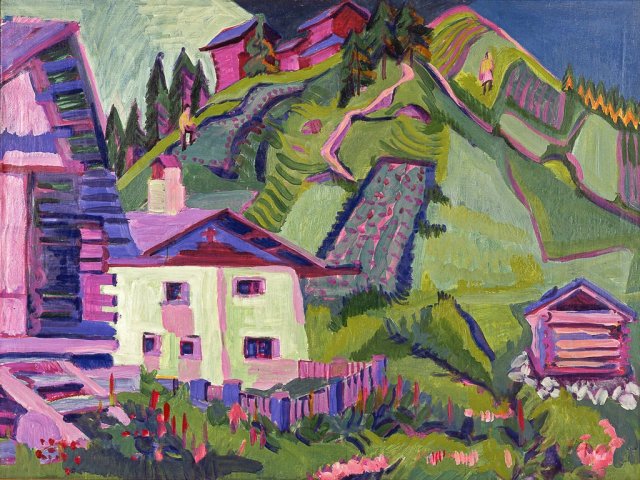
Ernst Ludwig Kirchner’s “White House in Sertig Valley,” 1926. Credit via Neuberger Museum of Art, Purchase College, State University of New York.

Roberta Smith describes Ernst Ludwig Kirchner as “the best and most versatile of the German Expressionists.”

Like many 20th-century German painters, Kirchner was twice broken, by World I, which resulted in his nervous breakdown, and the rise of Hitler, which ultimately drove him to suicide in 1938.
(Roberta Smith, “Modernism Reboots at the Museums — ‘Ernst Ludwig Kirchner’,” NYTimes, 9-13-19)

Smith mentions Kirchner’s “joltingly innovative color” and his “exuberantly jagged line.” These contributed to the “acidifying” of his images of modern life, she writes.

That captures some of what I admire in his “White House in Sertig Valley” (1926).

(c) 2019 JMN

Posted in Commentary | Tagged , , | Leave a comment

A Pioneer Gallerist

jacob lawrence

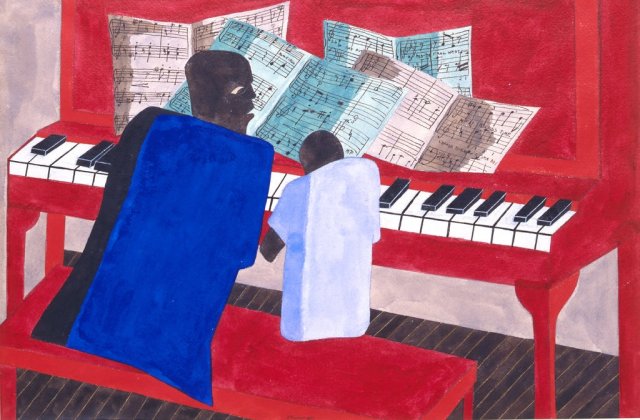
Jacob Lawrence “The Music Lesson,” from the “Harlem Series,” 1943. Credit The Jacob and Gwendolyn Knight Lawrence Foundation, Seattle/Artists Rights Society (ARS), New York; New Jersey State Museum.

In 1926, Edith Gregor Halpert (1900-1970), an émigré from Ukraine, opened the Downtown Gallery on West 13th Street. It was the first gallery in Greenwich Village and she was the city’s first female gallerist… Horace Pippin, Stuart Davis, Charles Sheeler and Georgia O’Keeffe were among the many others she showed. Intent on reaching everyday people and selling them art — on the installment plan if needed — Halpert was looked down on by male dealers.
(Roberta Smith, “Modernism Reboots at the Museums — Edith Halpert and the Rise of American Art,” NYTimes, 9-13-19)

Ms. Halpert gave African-American artist Jacob Lawrence his first show, “the famed ‘Migration’ series.” I’m drawn to his painting called “The Music Lesson” (1943) for the contrast between the extremely stylized figures of teacher and pupil and the meticulous depiction of the piano and the music they are playing.

(c) 2019 JMN

Posted in Commentary | Tagged , , , | Leave a comment

Grisaille

amy sherald

Artwork by Amy Sherald in her solo exhibition at Hauser & Wirth, clockwise from top left: “A single man in possession of a good fortune,” 2019; “The girl next door,” 2019; “When I let go of what I am, I become what I might be (Self-imagined atlas),” 2018; and “There is no charm equal to tenderness of heart,” 2019. Credit Artwork via Amy Sherald and Hauser & Wirth.

Roberta Smith situates artist Amy Sherald within a group of youngish painters

… who have broken with, absorbed or simply ignored modernist abstraction. Instead, they work with the figure as a way of reaching broader audiences; dealing with issues of identity, gender and sexuality… The many African-American artists working in this vein are also dismantling Western painting’s racial homogeneity, populating it as never before with images of black people.
(Roberta Smith, “Amy Sherald’s Shining Second Act,” NYTimes, 9-12-19)

Smith describes Sherald’s paintings as

… startlingly spare… paintings of confident, black people whose stylish clothes and backdrops contrast with their faces, which are uniformly grisaille… She also uses grisaille, she has said, because she wants to take race out of her paintings.

And yet for all that they are grayed, Sherald’s subjects are unmistakably African-American. And that seems to be an essential aspect of her art, the part she professes to take out.

(c) 2019 JMN

Posted in Commentary | Tagged , , , | 2 Comments

Don’t Worry: An Original Poem

dream

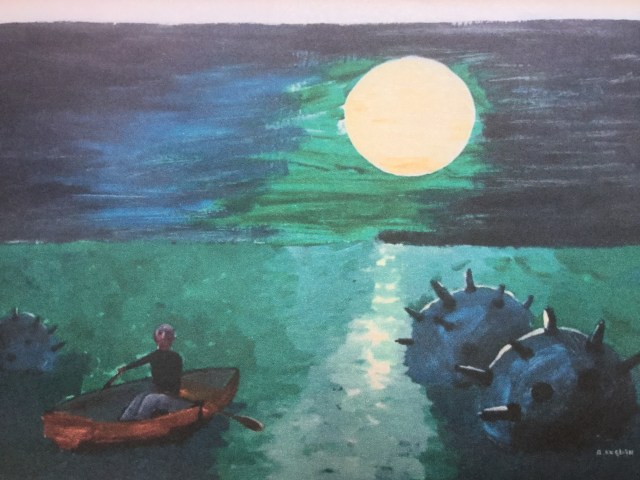
“Wet Dream,” by D. English.

It’s said worrying about the future is paying interest on a debt not owed. Yet, who worries about the past? The essence of worry is that it targets the unhappened.

Do not worry about Bahamians in Dorian’s path. Their flesh is being scraped from the shambles of huts. Worry about the pain when Nature eats your gizzard.

Do not worry about the Amazon burning. The environment is over. Worry about how your grandkids will fare in the competition for water and oxygen.

Do not worry about the Confederate flag. It flew. Worry about how it may fly in the hearts of the unborn.

Do not worry about disgracing yourself last night. It’s done. Worry about where the commas should go in something you haven’t written yet:

Here, here, and sometimes, here,

(c) 2019 JMN

Posted in Anthology | Tagged , , , | Leave a comment