“Ida, Not Georgia”

ida o'keeffe painting

Ida Ten Eyck O’Keeffe’s “Star Gazing in Texas,” 1938. Oil on canvas, framed. Credit Dallas Museum of Art.

Roberta Smith writes of an exhibition at the Clark Art Institute in Williamstown, Massachusetts entitled “Ida O’Keeffe: Escaping Georgia’s Shadow.” I don’t warm immediately to the work of Ida Ten Eyck O’Keefe (1889-1961), but I’m glad it has survived against challenging odds, including unkind relatives and the nastiness of Alfred Stieglitz, husband of Ida’s older sister Georgia O’Keeffe (1887-1986).

This show and its catalog reflect the exceptional scholarship of Sue Canterbury, American art curator at the Dallas Museum. The story she tells is one of loss, subterfuge and bad luck. Around 1925, Stieglitz, whose advances Ida had rebuffed, thwarted her relationship with the critic Paul Rosenfeld (1890-1946) and would later discourage New York dealers from showing her work. In the early 1930s, Georgia demanded that Ida stop exhibiting, creating a rift that never healed. In addition, more than two decades after her death in 1961, a great deal of Ida’s work was stolen from her survivors.

ida o'keeffe painting2

Ida Ten Eyck O’Keeffe’s “Variation on a Lighthouse Theme V,” about 1931-32. Credit Jeri L. Wolfson Collection.

(Roberta Smith, “Looking Twice at Renoir and O’Keeffe (Ida, not Georgia),” NYTimes, 8-8-19)

(c) 2019 JMN

Posted in Anthology, Commentary | Tagged , , , | Leave a comment

“A Saved Man”

I admire Renoir for the valor with which he carried on his work into old age, arthritic hands and all. I don’t care much for his nudes. Nor am I as fond of Boucher as he was, but I get pleasure from his comment on “Diana Leaving Her Bath”: “A painter who understands nipples and buttocks is a saved man!”

boucher diana

François Boucher’s “Diana Leaving Her Bath,” 1742. Credit Mathieu Rabeau/RMN-Grand Palais.

It’s also stimulating that “the masculine is evoked” by the package prominently displayed by the hound dog at the picture’s margin. Evoked indeed! That would have escaped my notice if Roberta Smith hadn’t pointed it out in her article.

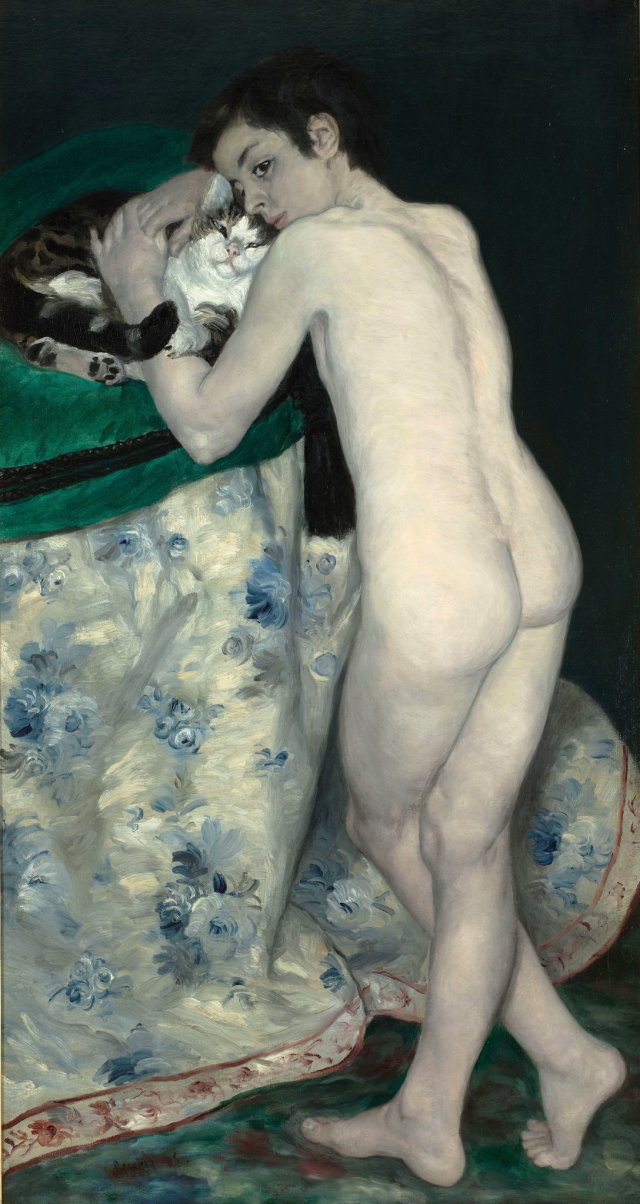
A more interesting Renoir nude is the “Boy with a Cat,” perhaps inspired by Manet, according to Smith. As someone owned by a cat, may I say this: Doesn’t the cat steal the show a bit in this painting?
renoir boy with cat

Renoir’s “Le Garçon au Chat (Boy with a Cat),” 1868. Credit Patrice Schmidt/RMN-Grand Palais.

Smith pronounces the creature “one of the most beautiful felines in Western painting.”

(Roberta Smith, “Looking Twice at Renoir and O’Keeffe (Ida, not Georgia),” NYTimes, 8-8-19)

(c) 2019 JMN

Posted in Commentary | Tagged , , , , , | Leave a comment

Four Rules

exclamation-mark

Krugman is a Nobel laureate with a knack for being right and wry. I value him for his thinking and for his rhetoric.

Last year, after an earlier stock market swoon brought on by headlines about the U.S.-China trade conflict, I laid out three rules for thinking about such events. First, the stock market is not the economy. Second, the stock market is not the economy. Third, the stock market is not the economy.

But maybe I should add a fourth rule: The bond market sorta kinda is the economy.

(Paul Krugman, “From Trump Boom to Trump Gloom,” NYTimes, 8-15-19)

(c) 2019 JMN

Posted in Quotations | Tagged , , , , , , | Leave a comment

“Amped Up to Grotesqueness”

beavers

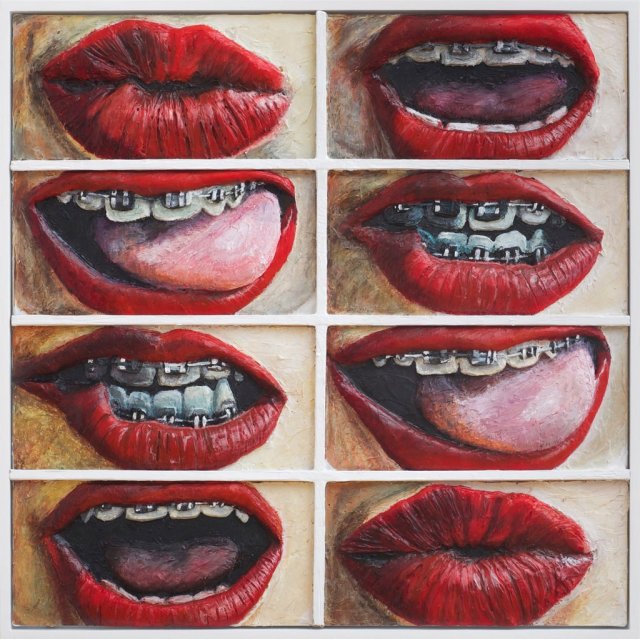
Gina Beavers’s “Who Has Braces?” (2014) in her show “The Life I Deserve” at MoMA PS1. Credit Gina Beavers.

Gina Beavers’s work hits a sweet spot for me. It’s impossible not to bumble where the talent has gone already, but I intend to explore serial, inflated, anatomical detail myself.

Her idiosyncratic aesthetic… [offers] canny statements on contemporary bodies, beauty and culture.

[Her] works tackle the weirdness of immaterial images floating through the ether, building them up into something monumental, rather than dismissing them, as most of us do.

(Martha Schwendener, “New York Galleries: What To See Right Now,” NYTimes, 8-14-19)

(c) 2019 JMN

Posted in Commentary | Tagged | Leave a comment

Help Drill

stacey abrams

Stacey Abrams speaking at a DNC gala in June. Credit Audra Melton for The New York Times.

Help fix inaccurate voter rolls
Help address shortages of voting machines
Help address shortages of provisional ballots
Help formalize the rules around counting absentee ballots
Help increase participation in the 2020 census.
Help increase youth turnout

Source: Melanye Price, “Stacey Abrams Is Playing the Long Game for Our Democracy,” NYTimes, 8-15-19)

(c) 2019 JMN

Posted in Commentary | Tagged | Leave a comment

Kudos to Automattic

tumblr

John J. Custer.

This commentary by Kara Swisher made me glad to be on WordPress.

… Tumblr has landed with WordPress, a former rival and the kind of company that it probably should have been with all along. [Founder, Matt Mullenweg] is one of tech’s most earnest entrepreneurs and also someone whose ethos has hewed most closely to the time when the internet was a lot more innocent…

As to why he bought it, despite all the rough times Tumblr has endured? “It’s just fun,” Mr. Mullenweg said to The Wall Street Journal… “We’re not going to change any of that.”

Fun? On the internet? Today? From his lips to our ears — and, maybe, to our souls, to take us back to when we were all a little bit better. Because we were.

(Kara Swisher, “Who Killed Tumblr? We All Did,” NYTimes, 8-14-19)

(c) 2019 JMN

Posted in Quotations | Tagged | Leave a comment

Song of the Ottoman: Original Poem

Our past is our mystery. It is the tangle we have made of our hopes when we have come up to them. The future alone is clear.
(Robert Henri)

INTRO
What it is not is an ottoman.
What it is is not an ottoman.
An ottoman is not what it is.
An ottoman is what it is not.
Not an ottoman is what it is.

BRIDGE
Not what an ottoman is, is it?
Is not an ottoman what it is?
Is an ottoman not what it is?
Is it not what an ottoman is?
Is not it what an ottoman is?

OUTRO
Ottoman is an it. What is not.
Not is what? An ottoman is it?
An is is not. What an ottoman!
An is not. What is? An ottoman!

(c) 2019 JMN

Posted in Anthology | Tagged | Leave a comment

Where Cate Sits

“My father was born in Texas. My mother is Australian. I’m married to a British citizen. So I sit in some weird fork in the road.”

(Cate Blanchett, Stephen Colbert Show, 8-12-19)

Posted in Quotations | Tagged | Leave a comment

Song of Theirselves

babel2

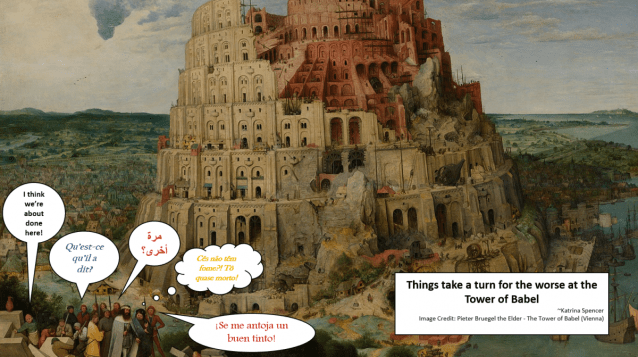
I’ve been at Amsterdam dinners where everyone is speaking brilliant English, but the minute I leave the table they switch back to Dutch. If all we know is English, we won’t know what the rest of the world is saying about us.

(Pamela Druckerman, “Parlez-Vous Anglais? Yes, Of Course,” NYTimes, 8-10-19)

The constipated grammarian holding out for correctitude is low-hanging fruit for parody. It’s fun to adopt the pose. He — or of course it could be “she” because of the accident of gender, or “they” in a travesty of number — is a milquetoast chewing tepid tea and crumble over a dog-eared book of rules.

Most people now learn English to communicate with other nonnative speakers — and even many of their teachers aren’t native — so they acquire few expressions and idioms.

English is being invaded by nonnatives! The language shrivels as it burgeons, shrinks as it grows, morphs as it sloughs. Worldwide, English is blasting a path of coinage, assimilation, and soon-to-be-standard barbarisms like “discussing about” in  advanced and “shithole” countries alike.

Here’s one of the most delightful points of this informative article:

Linguist Jennifer Jenkins writes that “at European Union conferences, nonnatives who can easily understand each other’s English switch on their translation headphones when someone from Britain or Ireland takes the stage.

It’s a phenomenon I have experienced more than once. I may have understood roughly half of the dialog spoken by my sister Anglophones in “Derry Girls.”

(c) 2019 JMN

Posted in Quotations | Tagged | Leave a comment

Here Lies a Scotsman

Adverbs Ahead

Grammar Ahead

There once was a Second Amendment paladin in the Houston area who lay in wait one night to discharge his Ruger into the belly of a nefarious shadow on his castle’s driveway; having done which he laid his weapon down, only to discover that the presumptive intruder, now dead, was a lost Scotsman from abroad who sought directions out of the neighborhood.

This true tragic tale illustrates how the English language lays traps for its natives. The traps lie in wait for the under-schooled journalist to come trudging by. When he (or she) trips a trap the effect is paradoxical for being little noted, if at all, by him (or her) — in stark contrast to how the slug affected the Scotsman — and even less by his (or her) lack-minded readers who have trod the same terrain where the trap has lain, and who have tripped it with the same effect.

(c) 2019 JMN

Posted in Commentary | Tagged | Leave a comment