“Amped Up to Grotesqueness”

beavers

Gina Beavers’s “Who Has Braces?” (2014) in her show “The Life I Deserve” at MoMA PS1. Credit Gina Beavers.

Gina Beavers’s work hits a sweet spot for me. It’s impossible not to bumble where the talent has gone already, but I intend to explore serial, inflated, anatomical detail myself.

Her idiosyncratic aesthetic… [offers] canny statements on contemporary bodies, beauty and culture.

[Her] works tackle the weirdness of immaterial images floating through the ether, building them up into something monumental, rather than dismissing them, as most of us do.

(Martha Schwendener, “New York Galleries: What To See Right Now,” NYTimes, 8-14-19)

(c) 2019 JMN

Posted in Commentary | Tagged | Leave a comment

Help Drill

stacey abrams

Stacey Abrams speaking at a DNC gala in June. Credit Audra Melton for The New York Times.

Help fix inaccurate voter rolls
Help address shortages of voting machines
Help address shortages of provisional ballots
Help formalize the rules around counting absentee ballots
Help increase participation in the 2020 census.
Help increase youth turnout

Source: Melanye Price, “Stacey Abrams Is Playing the Long Game for Our Democracy,” NYTimes, 8-15-19)

(c) 2019 JMN

Posted in Commentary | Tagged | Leave a comment

Kudos to Automattic

tumblr

John J. Custer.

This commentary by Kara Swisher made me glad to be on WordPress.

… Tumblr has landed with WordPress, a former rival and the kind of company that it probably should have been with all along. [Founder, Matt Mullenweg] is one of tech’s most earnest entrepreneurs and also someone whose ethos has hewed most closely to the time when the internet was a lot more innocent…

As to why he bought it, despite all the rough times Tumblr has endured? “It’s just fun,” Mr. Mullenweg said to The Wall Street Journal… “We’re not going to change any of that.”

Fun? On the internet? Today? From his lips to our ears — and, maybe, to our souls, to take us back to when we were all a little bit better. Because we were.

(Kara Swisher, “Who Killed Tumblr? We All Did,” NYTimes, 8-14-19)

(c) 2019 JMN

Posted in Quotations | Tagged | Leave a comment

Song of the Ottoman: Original Poem

Our past is our mystery. It is the tangle we have made of our hopes when we have come up to them. The future alone is clear.
(Robert Henri)

INTRO
What it is not is an ottoman.
What it is is not an ottoman.
An ottoman is not what it is.
An ottoman is what it is not.
Not an ottoman is what it is.

BRIDGE
Not what an ottoman is, is it?
Is not an ottoman what it is?
Is an ottoman not what it is?
Is it not what an ottoman is?
Is not it what an ottoman is?

OUTRO
Ottoman is an it. What is not.
Not is what? An ottoman is it?
An is is not. What an ottoman!
An is not. What is? An ottoman!

(c) 2019 JMN

Posted in Anthology | Tagged | Leave a comment

Where Cate Sits

“My father was born in Texas. My mother is Australian. I’m married to a British citizen. So I sit in some weird fork in the road.”

(Cate Blanchett, Stephen Colbert Show, 8-12-19)

Posted in Quotations | Tagged | Leave a comment

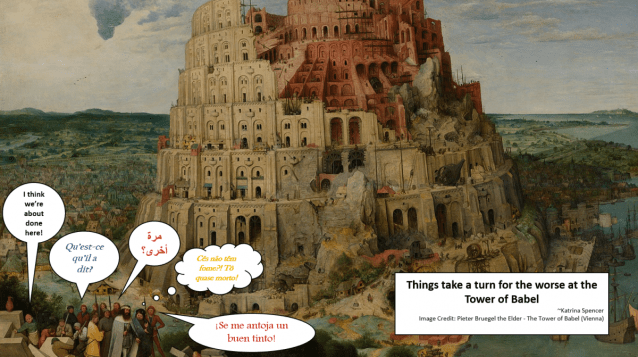
Song of Theirselves

babel2

I’ve been at Amsterdam dinners where everyone is speaking brilliant English, but the minute I leave the table they switch back to Dutch. If all we know is English, we won’t know what the rest of the world is saying about us.

(Pamela Druckerman, “Parlez-Vous Anglais? Yes, Of Course,” NYTimes, 8-10-19)

The constipated grammarian holding out for correctitude is low-hanging fruit for parody. It’s fun to adopt the pose. He — or of course it could be “she” because of the accident of gender, or “they” in a travesty of number — is a milquetoast chewing tepid tea and crumble over a dog-eared book of rules.

Most people now learn English to communicate with other nonnative speakers — and even many of their teachers aren’t native — so they acquire few expressions and idioms.

English is being invaded by nonnatives! The language shrivels as it burgeons, shrinks as it grows, morphs as it sloughs. Worldwide, English is blasting a path of coinage, assimilation, and soon-to-be-standard barbarisms like “discussing about” in  advanced and “shithole” countries alike.

Here’s one of the most delightful points of this informative article:

Linguist Jennifer Jenkins writes that “at European Union conferences, nonnatives who can easily understand each other’s English switch on their translation headphones when someone from Britain or Ireland takes the stage.

It’s a phenomenon I have experienced more than once. I may have understood roughly half of the dialog spoken by my sister Anglophones in “Derry Girls.”

(c) 2019 JMN

Posted in Quotations | Tagged | Leave a comment

Here Lies a Scotsman

Adverbs Ahead

Grammar Ahead

There once was a Second Amendment paladin in the Houston area who lay in wait one night to discharge his Ruger into the belly of a nefarious shadow on his castle’s driveway; having done which he laid his weapon down, only to discover that the presumptive intruder, now dead, was a lost Scotsman from abroad who sought directions out of the neighborhood.

This true tragic tale illustrates how the English language lays traps for its natives. The traps lie in wait for the under-schooled journalist to come trudging by. When he (or she) trips a trap the effect is paradoxical for being little noted, if at all, by him (or her) — in stark contrast to how the slug affected the Scotsman — and even less by his (or her) lack-minded readers who have trod the same terrain where the trap has lain, and who have tripped it with the same effect.

(c) 2019 JMN

Posted in Commentary | Tagged | Leave a comment

Tuba Career

betty gilpin

After toiling in semi-obscurity for nearly a decade, Betty Gilpin has received back-to-back Emmy nominations for her performance on Netflix’s “GLOW,” which returns Friday for its third season. Credit Caroline Tompkins for The New York Times.

As for what comes after the life-altering experience of “GLOW” — what will define her next persona — [Betty] Gilpin doesn’t know, but she has a hunch. “It feels like I’m in this room that I didn’t know existed, and there are all these things I ever wanted,” she said. “There’s still one more little locked box that I’m not quite sure what’s in there.”

“But honestly,” she added slyly. “I think it’s a tuba career.”

(Bruce Fretts, “How GLOW Helped Betty Gilpin Embrace Her Inner Weirdo,” NYTimes, 8-8-19)

(c) 2019 JMN

Posted in Quotations | Tagged , | Leave a comment

Disquieting Skein

question-mark

It has dawned on me in the last few days that the model of government from above visited upon the yielding heads of the governed by an all-powerful executive comports somewhat with what I take to be certain tenets of Christian theology.

In the church I grew up in there is an unchallenged deity whose plan for his subjects is inscrutable and beyond question, whose might is absolute, whose is word is law, whose will is to be obeyed and exalted by his followers. God can do what he wants because he is God. Do but praise him.

On the human scale there has arisen at times a type of “leader” who is not “elected” in our sense of the term but rather “chosen” and anointed to be duce, caudillo, fuehrer, or whatever he may be called. Do but praise him.

Are the Christian God and the human “leader” of the sort I’ve mentioned comparable in any way? And does that congruency account for the substantial support lent by the religious community to an executive branch that asserts immunity from, and sovereignty over, its nominally co-equal branches of government?

It’s a skein of associations that has many strands, and I’m not sure I can follow them to a knot. But it exercises me.

(c) 2019 JMN

Posted in Commentary | Tagged , , | 2 Comments

Ascribe It to Editing Lapse

writing plume

Domestic terrorism includes violence by Americans who belong to anti-government militias, white supremacist groups or individuals who ascribe to similar ideologies not connected to Islamic extremism.

(Frank Figliuzzi, “I Predicted More Hate-Based Violence. El Paso Won’t Be the End of It,” NYTimes, 7-31-19)

I’ve no bone to pick with Mr. Figliuzzi’s message; only with his verb. It should be “subscribe” instead of “ascribe.”

Some may consider niceties of lexicon and syntax to be irrelevant in texts that deal with deadly matters. I choose to believe a text’s message gains force by being expressed accurately and with good form.

(c) 2019 JMN

Posted in Commentary | Tagged | Leave a comment