Guide by the Perplexed — Restatement

gris guitar

Juan Gris, “Guitare sur une table,” from 1916, at Helly Nahmad. Credit via Helly Nahmad Gallery.

Here we restate and complement our OO schemes as follows:

Octave-of-Following (OOF)

*E-string-1 at Fret-0 is an E-note with OOF state re E-string-6
E-string-1 at Fret-7 is a B-note with OOF state re B-string-2
B-string-2 at Fret-8 is a G-note with OOF state re G-string-3
G-string-3 at Fret-7 is a D-note with OOF state re D-string-4
D-string-4 at Fret-7 is an A-note with OOF state re A-string-5
A-string-5 at Fret-7 is an E-note with OOF state re E-string-6
*E-string-6 at Fret-0 is an E-note with OOP state re E-string-1

Octave-of-Preceding (OOP)

*E-string-6 at Fret-0 is an E-note with OOP state re E-string-1
E-string-6 at Fret-5 is an A-note with OOP state re A-string-5
A-string-5 at Fret-5 is a D-note with OOP state re D-string-4
D-string-4 at Fret-5 is a G-note with OOP state re G-string-3
G-string-3 at Fret-4 is a B-note with OOP state re B-string-2
B-string-2 at Fret-5 is an E-note with OOP state re E-string-1
*E-string-1 at Fret-0 is an E-note with OOF state re E-string-6

*Fret-0 means the string is open — no fret is fingered. These additions make explicit that strings 1 and 6 are tuned to the same note — an E — one octave apart.

And there you have it. It’s time to consolidate the cognitive handhold on the fretboard that we’ve gained so far — coming next.

(c) 2019 JMN

Posted in Anthology | Tagged , | Leave a comment

Rust in Peace

decay11

White Bay’s turbine hall [Australia].

There’s this sense of wonder you get when looking at abandoned buildings. You try to imagine what these spaces were like when they were filled with busy workers trying to meet production targets. And why did they close?

(Brett Patman, “Beauty in ruins: the wonder of abandoned buildings — a photo essay,” The Guardian, 5-11-19)

decay3

Kandos cement works [Australia].

The spectacle of decay and decrepitude on an industrial scale is somehow stirring.

decay4

Women’s wards at Callan Park [Australia].

The so-called advances in how we make buildings seem to be matched by an acceleration of the rate at which they disintegrate.

decay9

The lounge of the Kinugawa Kan Hotel [Australia].

decay10

A former snack bar in Yubari [Australia].

It’s hard to imagine anything erected today standing — like a Roman bridge — a thousand years from now.

stans5

Residential building, 1980s, Chkalovsk, Tajikistan. Photograph: Stefano Perego.

However, …

stans6

Residential building, 1980s, Tashkent, Uzbekistan Photograph: Stefano Perego.

… toxic, putrefying, oxidized, infested, cankerous, crumbling, melancholy, five-star has-beens…

stans4

Aul housing complex, 1986, Almaty, Kazakhstan. Architects: B. Voronin, L. Andreyeva, Y. Ratushny, V. Lepeshov, V. Vi. Photograph: Stefano Perego.

… are fertile ground for art and piety,…

stans1

Residential building, 1984, Dushanbe, Tajikistan. E. Yerzovsky. Photograph Roberto Conte.

… which spring from death anyway.

stans8

Residential building, 1980s. Tashkent, Uzbekistan. Photograph: Stefano Perego.

(Roberto Conte and Stefano Perego, “When Soviets met Stans: the tower blocks of central Asia — in pictures,” The Guardian, 5-3-19.

(c) 2019 JMN

Posted in Commentary | Tagged , , , , , , , | 2 Comments

Parting Looks

This inadvertently comical drawing by Harold J. Nichols (1924-2013) has a vigor and intensity that I find seductive. It has the top-of-head deficit common amongst us untrained drawers. The brain fools the eye somehow. I think it discounts what’s above … Continue reading

More Galleries | Tagged , , | Leave a comment

Guide by the Perplexed — Denial

gris guitar

Juan Gris, “Guitare sur une table,” from 1916, at Helly Nahmad. Credit via Helly Nahmad Gallery.

I did not err in an earlier post; the post simply misspoke itself. Derived Octave-of-Following (DOOF) state was announced as coming next. The post should have intended to say: “Octave-of-Preceding (OOP) state — coming next.”

Octave-of-Preceding (OOP) state is the state in which a fretted note is the octave of the preceding open string.

This is true:

E-string-6 at Fret-5 is an A-note with OOP state re A-string-5

A-string-5 at Fret-5 is a D-note with OOP state re D-string-4

D-string-4 at Fret-5 is a G-note with OOP state re G-string-3

*G-string-3 at Fret-4 is a B-note with OOP state re B-string-2

B-string-2 at Fret-5 is an E-note with OOP state re E-string-1

*OOP state occurs at Fret-5 often enough to be useful for raising note consciousness. The exception is on G-string-3. The interval between G-string-3 and B-string-2 is the only interval that isn’t a Perfect-Fourth; it’s a Major-Third. Therefore, OOP state is a half-step lower at Fret-4.

And there you have it. It’s time for a summary of what we’ve learned so far — coming next.

(c) 2019 JMN
Posted in Anthology | Tagged , | Leave a comment

Guide by the Perplexed

gris guitar

Juan Gris, “Guitare sur une table,” from 1916, at Helly Nahmad. Credit via Helly Nahmad Gallery.

Octave-of-Following (OOF) state is the state in which a fretted note is the octave of the following open string.

This is true:

E-string-1 at Fret-7 is a B-note with OOF state re B-string-2

*B-string-2 at Fret-8 is a G-note with OOF state re G-string-3

G-string-3 at Fret-7 is a D-note with OOF state re D-string-4

D-string-4 at Fret-7 is an A-note with OOF state re A-string-5

A-string-5 at Fret-7 is an E-note with OOF state re E-string-6

*OOF state occurs at Fret-7 often enough to be useful for raising note consciousness. The exception is on B-string-2. The interval between G-string-3 and B-string-2 is the only interval that isn’t a Perfect-Fourth; it’s a Major-Third. Therefore, OOF state is a half-step higher at Fret-8.

And there you have it. It’s time now for Derived Octave-of-Following (DOOF) state — coming next.

(c) 2019 JMN

Posted in Anthology | Tagged , | Leave a comment

Guide by the Perplexed

gris guitar

Juan Gris, “Guitare sur une table,” from 1916, at Helly Nahmad. Credit via Helly Nahmad Gallery.

The Poet sat in a dive on 52nd Street “uncertain and afraid.” I sit in a shed on 3rd Street where I, too, watch “the clever dreams expire of a low, dishonest decade.” The manic hubbub of tear-it-downers and bust-it-uppers and look-at-miners washes over the world like a toxic red tide.

For respite from anomie I resort to the guitar fretboard. It supports a lifetime of soothing obsession. Full disclosure: I haven’t read Maimonides. I know him only by name and reputation. My version of his title reflects a conviction that the best guide for the perplexed is the perplexed.

And here we go:

Guitar strings are numbered 1 through 6, tuned E-B-G-D-A-E unless you learned them 6 through 1 in E-A-D-G-B-E order, as I did. For a mnemonic phrase, use “Easter Bunnies Get Drunk At Easter” or vice versa according to the situation.

With string nomenclature and tuning mastered, it’s time for Octave-of-Following (OOF) state, coming next.

(c) 2019 JMN

Posted in Anthology | Tagged , , , | Leave a comment

“Islands of Daring”

Any drawings that are “like letters of a foreign language” would get my attention. This is so with the drawings of Susan Hefuna.

susan hefuna drawing

“Untitled, 1994” by Susan Hefuna — ink drawings inspired by the wooden screens of Cairo. Credit Rebecca Smeyne for The New York Times.

… Susan Hefuna makes ink drawings inspired by the intricate wooden screens of her Cairo childhood… done on overlapping sheets of tracing paper fastened with rice glue… a fascinating tension between clarity and ambiguity — the drawings are like letters of a foreign language glimpsed in a dream.

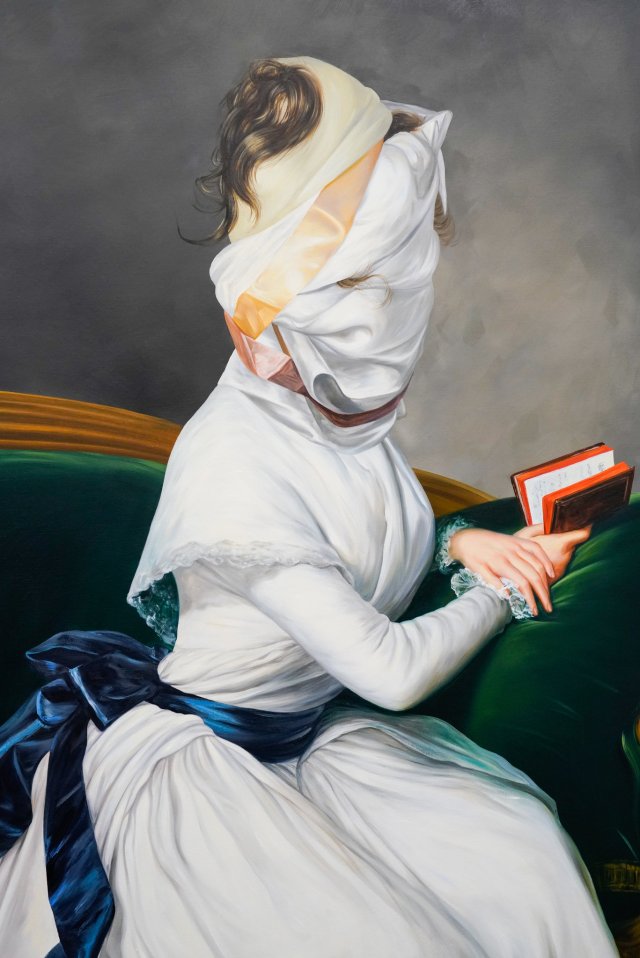
And the notion of repainting famous portraits of women while eerily disguising their faces, is cheeky and provoking in a thoughtful way. The painting by Ewa Juszkiewicz shows that the scariest masks don’t have horny ears and dripping teeth. They’re much closer to what we expect to see, then don’t. They creep up on us by distorting the familiar, cobbling a fiendish false face for it.

ewa juszkiewicz painting

“Untitled (after Élisabeth Vigée Le Brun)” by Ewa Juszkiewicz, 2019: one of the artist’s altered representations of classic portraits of women. Credit Rebecca Smeyne for The New York Times.

… Ewa Juszkiewicz, who repaints classic portraits of women, but hides their faces with cloth, ears of corn or a backward French braid.

(Martha Schewendener, Will Heinrich et al., “At Frieze New York, Islands of Daring,” NYTimes, 5-2-19)

(c) 2019 JMN

Posted in Commentary | Tagged , , , , | Leave a comment

“Splendidly Cagey”

Work by Klee always gives me a boost. I also enjoy the critic’s sprightly accounting of it, which I excerpt here.

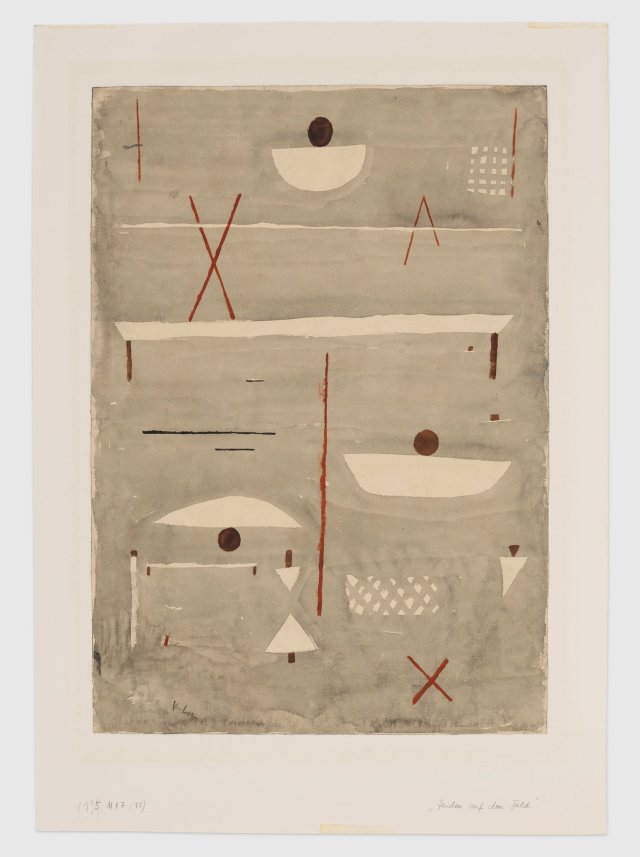
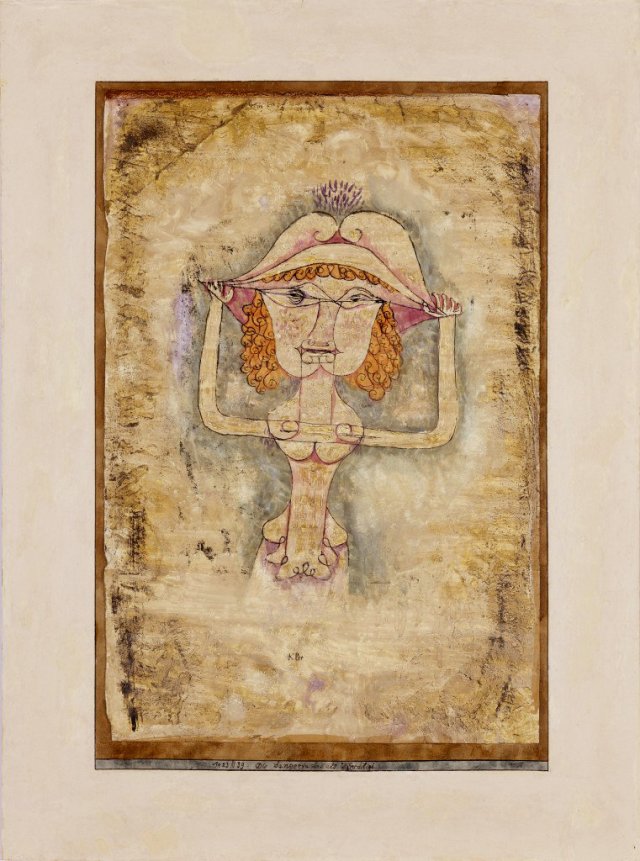
… David Zwirner [Gallery] has nabbed a heavyweight: Paul Klee, the splendidly cagey Swiss-German modernist and Bauhaus professor.

klee 1

Paul Klee’s “Signs in the Field,” from 1935, at David Zwirner. Credit Artists Rights Society (ARS), New York, via David Zwirner.

… Full of wily small-scale watercolors like “Signs in the Field” (1935), with its joyously inscrutable cloud of glyphs, ovals and eyes.

klee 2

Klee’s “The Singer L. as Fiordiligi,” from 1923, at David Tunick. Credit Artists Rights Society (ARS), New York, via David Tunick.

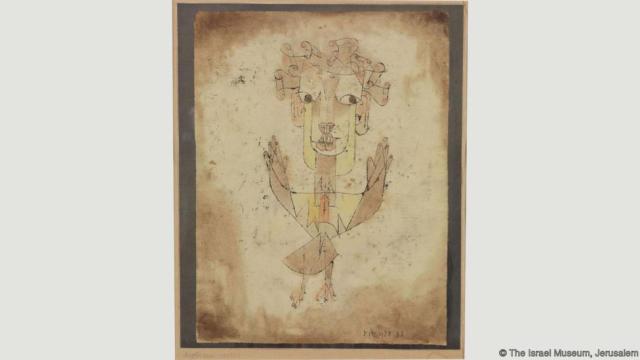
… A knockout 1923 portrait of the soprano Lilli Lehmann, goggle-eyed and adrift in a sea of beige… executed… with a unique blend of oil and watercolor… almost… a comedic double of his imposing “Angelus Novus.”

klee 3 angelus

“A storm is blowing from Paradise,” wrote [Walter] Benjamin. “It has got caught in his wings with such violence the angel can no longer close them.” (Credit: The Israel Museum, Jerusalem).


(Jason Farago, “Tefaf Brings Masterpieces (and Tulips) to the Armory,” NYTimes, 5-2-19; links to his article “How Klee’s ‘angel of history’ took flight,” BBC Culture, 4-6-16)

(c) 2019 JMN

Posted in Commentary | Tagged , , , , , , , | 2 Comments

Parting Looks

This gallery contains 1 photo.

The humans are cartoonish, with unsettling ocular highlights. The man’s buckle and spurs gleam unexpectedly. The beakish woman (clad in denim?) grasps a shepherd’s crook. A bucket dangling from block and tackle drips water drawn from an artesian well. It … Continue reading

More Galleries | Tagged , , , | Leave a comment

“Corrupted Formalism”

julia rommel

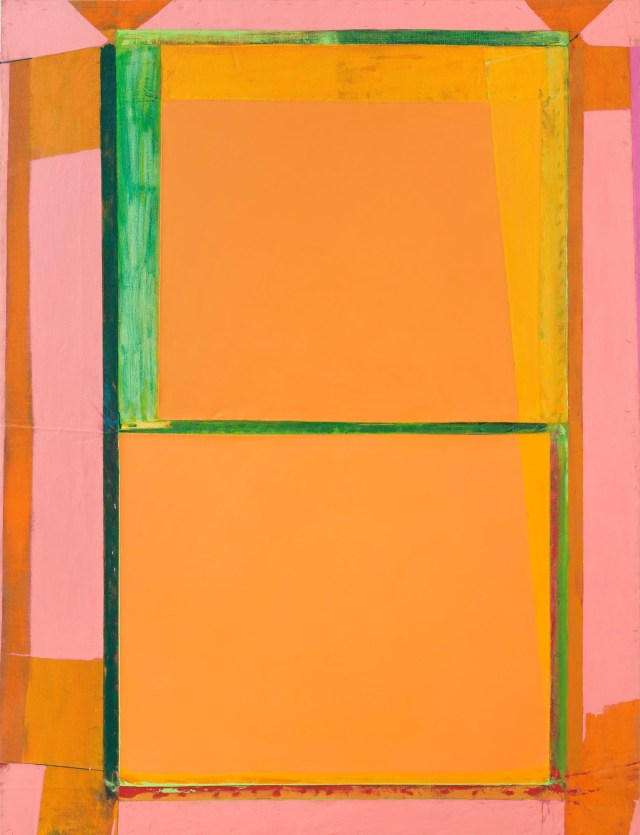
Julia Rommel uses color to great effect in works like “Volvo 240,” 2019. Credit Julia Rommel and Bureau, New York.

I ponder what exactly the relationship between professional critic and working artist is. I, of course, am neither — a nosy bystander at best. I’m aware glancingly of debates in the professional art community about who says and does what. Sounding off  from my provincial redoubt feels daring, if not foolhardy.

But fools venture. It’s hard not to fall, first of all, for “Candy Jail,” the title of artist Julia Rommel’s fourth show at Bureau, a New York City gallery.

Second of all, I’m seduced by art critic Roberta Smith’s statement that Rommel “continues her brand of corrupted formalism, exploring ways to revivify Minimalist abstraction with a non-Minimalist, piecemeal sense of process.”

Say what you will, that statement has loft and verve.

This one lands smoothly: “… Ms. Rommel’s color is as beautiful as ever, especially in simpler works like ‘Volvo 240,’ where two orange squares both divided by and edged in green rivet the eyes.”

(Roberta Smith, “Spring Gallery Guide: Lower East Side,” NYTimes, 4-26-19)

(c) 2019 JMN

Posted in Anthology, Commentary | Tagged , , , , , , , | 2 Comments