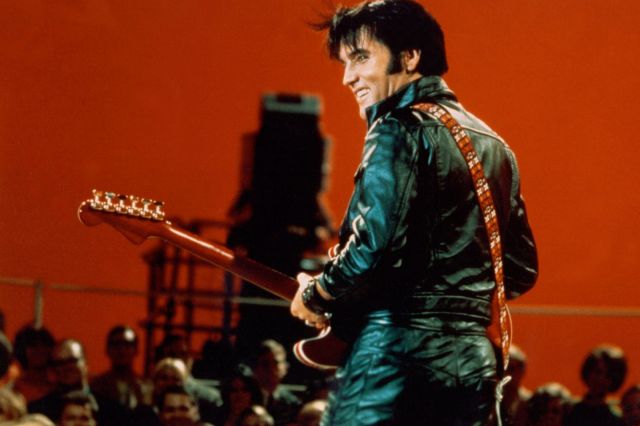
Rock and roll musician Elvis Presley performing on the Elvis comeback TV special on June 27, 1968. NBC/Getty [From Rolling Stone, August 16, 2017].
Elvis sang those words and I can understand them. They’re etched in my head. Julie London: “Cry Me a River”; Tony Bennett: “I Left My Heart In San Francisco”; Frank Sinatra: “Fly Me To the Moon”; Bobby Darin: “Mack the Knife”; Peggy Lee: “Fever”; Bobbie Gentry: “Ode to Billie Joe”; Simon and Garfunkel: “Bridge Over Troubled Water”; (Name any artist): “Stardust,” “Summertime,” “Night and Day,” “My Buddy,” “Tumbling Tumbleweeds,” etc. The words come across in the recordings I’ve heard. My mother, a superb alto, taught my sister and me a lot of these old songs from our toddlerhood. The music predated us. We harmonized as a trio.
I’m not troubled or indignant over how the lyrics in many modern songs get swamped by the wall of sound or stranded in the singer’s pharynx, in contrast to earlier styles. I’m simply bemused in a good way at how a certain evolution has occurred in popular music from Tin Pan Alley times to modern times. Cole Porter, Hoagy Carmichael, Vincent Youmans, Ira Gershwin and their sort wrote lyrics that received musical accompaniment. In the music of many modern performers and bands, lyrics seem to recede from the
foreground and be absorbed into, not to say overcome by, the instrumentation. It coincides with advances in studio production technology, I surmise, and with the increasingly robust amplification machinery that’s available for large audience venues. Loud is good and louder’s better, it goes. Bring it.
The music’s the thing. It’s about melodies and intervals and chords and rhythms. I’m led to wonder in certain instances: Why bother with lyrics at all? Given that the voice is functioning as another instrument in such cases, why not just sing sonorous nonsense syllables instead of words. Or something along the lines of the solfege warmups of a cappella Sacred Harp choirs. For most American audiences the lyrics of many classic operas are nonsense; it’s the singing and spectacle that captivate aficionados. Then again, though, why bother not to bother? If the lyrics of certain songs are incomprehensible, they’re already functioning as nonsense syllables! Might as well belt out “ripped up like a douche and did a no no in the night” or whatever. I’ve cornered myself into a speculative irrelevancy of botheringsomeness. I salute you if you’ve persisted to the end of it.
(c) 2018 JMN.








 EthicalDative
Since My Baby Left Me
Rock and roll musician Elvis Presley performing on the Elvis comeback TV special on June 27, 1968. NBC/Getty [From Rolling Stone, August 16, 2017].
Elvis sang those words and I can understand them. They’re etched in my head. Julie London: “Cry Me a River”; Tony Bennett: “I Left My Heart In San Francisco”; Frank Sinatra: “Fly Me To the Moon”; Bobby Darin: “Mack the Knife”; Peggy Lee: “Fever”; Bobbie Gentry: “Ode to Billie Joe”; Simon and Garfunkel: “Bridge Over Troubled Water”; (Name any artist): “Stardust,” “Summertime,” “Night and Day,” “My Buddy,” “Tumbling Tumbleweeds,” etc. The words come across in the recordings I’ve heard. My mother, a superb alto, taught my sister and me a lot of these old songs from our toddlerhood. The music predated us. We harmonized as a trio.
I’m not troubled or indignant over how the lyrics in many modern songs get swamped by the wall of sound or stranded in the singer’s pharynx, in contrast to earlier styles. I’m simply bemused in a good way at how a certain evolution has occurred in popular music from Tin Pan Alley times to modern times. Cole Porter, Hoagy Carmichael, Vincent Youmans, Ira Gershwin and their sort wrote lyrics that received musical accompaniment. In the music of many modern performers and bands, lyrics seem to recede from the
foreground and be absorbed into, not to say overcome by, the instrumentation. It coincides with advances in studio production technology, I surmise, and with the increasingly robust amplification machinery that’s available for large audience venues. Loud is good and louder’s better, it goes. Bring it.
The music’s the thing. It’s about melodies and intervals and chords and rhythms. I’m led to wonder in certain instances: Why bother with lyrics at all? Given that the voice is functioning as another instrument in such cases, why not just sing sonorous nonsense syllables instead of words. Or something along the lines of the solfege warmups of a cappella Sacred Harp choirs. For most American audiences the lyrics of many classic operas are nonsense; it’s the singing and spectacle that captivate aficionados. Then again, though, why bother not to bother? If the lyrics of certain songs are incomprehensible, they’re already functioning as nonsense syllables! Might as well belt out “ripped up like a douche and did a no no in the night” or whatever. I’ve cornered myself into a speculative irrelevancy of botheringsomeness. I salute you if you’ve persisted to the end of it.
(c) 2018 JMN.