Ottoline Morrell on T.S. Eliot, 1916

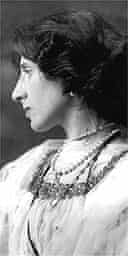
Ottoline Morrell

Lady Ottoline Morrell: recognisable in at least a dozen novels, by authors from Huxley to Lawrence. Photograph: Getty [from The Guardian, 10-10-06].

“He is obviously very ignorant of England and imagines that it is essential to be highly polite and conventional and decorous and meticulous.”

(Quoted by Louis Menand, “Practical Cat, How T.S. Eliot became T.S. Eliot,” (The New Yorker, September 19, 2011)

(c) 2018 JMN.

Posted in Quotations | Tagged | 2 Comments

Out-tut-tutting the Tut-tutters

JMN

Doesn’t one write for oneself primordially? That alone will keep me powering out the posts ‘til kingdom come. If any one of them catches another eye, its ice cream on the frosting.

I often bend double laughing at my own nonsense. In a recent exchange with Eric Wayne I asked rhetorically, “How far does one go to out-tut-tut the tut-tutters?” I was referring to strident rhetoric used by irate cognoscenti to excoriate cynical poseurs in the art world. After recovering from gales of mirth at my inventiveness, I determined that I must create a blog post justifying use of the phrase for a title. Mission accomplished.

(c) 2018 JMN.

Posted in Commentary | Tagged | 3 Comments

Wordsong

Senators

Kakistocracy.

Kleptocratic kakistocracy.

Kleptocratic kakistocracy of pettifoggers.

Kleptocratic kakistocracy of pettifoggIng snollygosters.

(c) 2018 JMN.

Posted in Commentary | Tagged | Leave a comment

Horacio Cardo

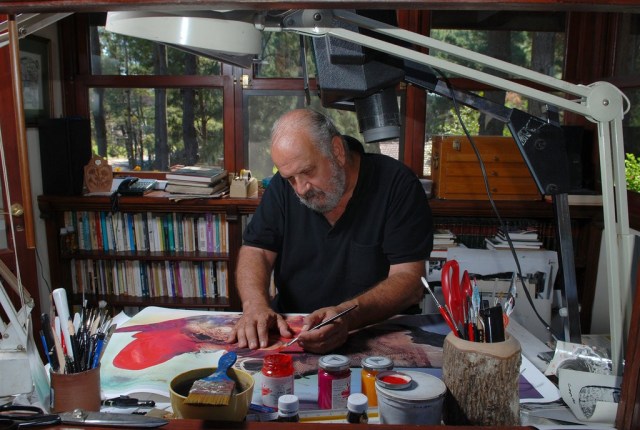
Horacio Cardo

Horacio Cardo in 2009 at his studio in Pinamar, a resort city on the eastern coast of Buenos Aires Province. “In Cardo’s work,” an art critic wrote, “nothing is naïve.” Credit Juan Carlos Casas.

Some of Mr. Cardo’s earlier works were painted in oils, to which he added fabric, lace and plaster of Paris to create various textures. Later on, he created dramatic illustrations with ink and acrylic paint that he altered with digital tools like Photoshop.

“Photoshop has allowed me to get closer to what I consider reality: the permanent transit (mutation, imbrication) of the images within the psyche,” he said in an interview with Artefacto magazine in 2010. “I would like to capture that permanently changing reality in my work, where past and present are interconnected.”

(Richard Sandomir, “Horacio Cardo, Illustrator With a Political Edge, Is Dead at 74,” NYTimes, 10-31- 18)

(c) 2018 JMN.

Posted in Quotations | Tagged , | Leave a comment

Alex Katz at 91

Alex Katz

Katz at work in his studio. Photograph: Ali Smith.

“I was in the abstract art world, socially – they all thought I was really stupid. The poets all liked my work – I had some of the smartest people on the planet buying my work. I knew I was OK…

Rather than his fellow artists, Katz looked to poets for inspiration: Frank O’Hara (whose portrait he painted in 1959) and Gertrude Stein… “The language is beautiful. And the ideas are kind of impressive too. The thing with the present tense is the thing that I bought.” This has long been Katz’s ambition – to capture the fleeting moment, although not in what he considers the navel-gazing style of the French philosophers… “Camus – he’s depressed and can’t figure out what to do on a Sunday? I was like, ‘Oh,
come on’…”

[Katz’s] portraits are concerned primarily with surface energy, which he finds as meaningful as works that claim to unearth a “deeper” meaning. “When the dominant characteristic of a painting is called sincerity, that’s a bad sign. Sincere painting means it relies on things outside of the painting. ‘Sincere art’ – as if painting pretty people isn’t. Well, it depends who does it.”

(Emma Brockes, “Alex Katz: ‘The smartest people bought my work,'” The Guardian, 10-29-18)

(c) 2018 JMN.

Posted in Quotations | Tagged , , | 5 Comments

Limits of Art?

Ai Weiwei

Ai Weiwei – Cao/Humanity. Photograph: Courtesy UTA Artist Space and photo by Jeff McLane.

What kind of change his or any political artist’s work can actually achieve remains an open question. In his book 9.5 Theses on Art and Class, the art critic Ben Davis argues that political art is not a force on par with real-life organizing and the in-depth analysis of policy. The shortcoming of aesthetic political gestures is that while they present us with a problem, they rarely offer a course of resolution. Quoting Susan Sontag, he writes: “Photographs of an atrocity may give rise to opposing responses. Or, simply the bemused awareness, continually restocked by photographic information, that terrible things happen.”

(Janelle Zara, “Ai Weiwei hits Los Angeles: ‘I cannot accept anything which is not precise,'” The Guardian, 10-10-18)

(c) 2018 JMN.

Posted in Anthology, Quotations | Tagged | 4 Comments

Martha Nussbaum, Philosopher

Martha Nussbaum

Martha Nussbaum, a professor at the University of Chicago, is one of the most visible philosophers in the United States. Credit University of Chicago Law School.

She is also known for helping to advance the so-called capabilities approach to economic development, which holds that progress should be measured by things like increases in life expectancy and education, rather than simply by increases in income.

Her work, the prize announcement said, “shows how philosophy, far from being merely an armchair discipline, offers a greater understanding of who we are, our place in the world, and a way to live a well-lived life.”

(Jennifer Schuessler, “Martha Nussbaum Wins $1 Million Berggruen Prize,” NYTimes, 10-30-18)

(c) 2018 JMN.

Posted in Quotations | Tagged | 1 Comment

“… Mind of a Genius at Work”

Leonardo Scientific Notebook

“Studies on the Ashen Glow of the Moon,” from Leonardo Da Vinci’s scientific treatise “Codex Leicester,” which is on display at the Uffizi Gallery in Florence, Italy. Credit Bill Gates/bgC3, via Uffizi Gallery.

One note Leonardo wrote to himself reads, “Make eyeglasses to see the moon larger.” The first known record of a telescope came around a century later.

(Elisabetta Povoledo, “In Leonardo da Vinci’s Scientific Notebook, the Mind of a Genius at Work,” NYTimes, 10-30-18)

(c) 2018 JMN.

Posted in Quotations | Tagged , | Leave a comment

Subjoins Mons Veneris? Nope

Mars Arsia Mons

A picture taken by the European Space Agency’s Mars Express spacecraft showing an elongated white plume that resembles volcanic ejecta. Credit ESA/GCP/UPV/EHU Bilbao.

This week, the European Space Agency released a picture taken by its Mars Express orbiter that showed what it described as “a curious cloud formation” stretching from east to west near Arsia Mons, the southernmost in a string of three volcanoes.

(Kenneth Chang, “A Volcanic Eruption on Mars? Nope,” NYTimes, 10-30-18)

(c) 2018 JMN

Posted in Quotations | Tagged | Leave a comment

Marmite versus Vegemite

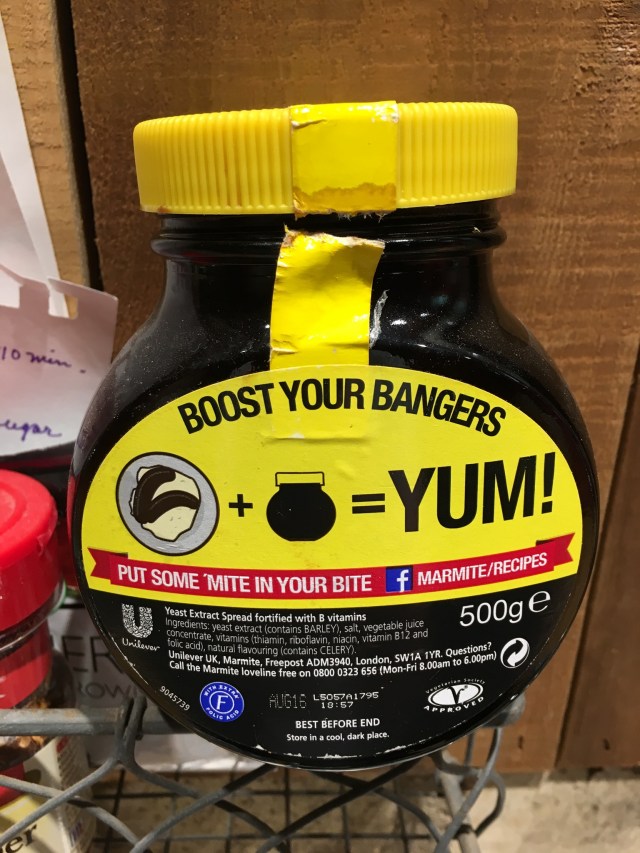
Boost Your Bangers, JMN, photo. (Copyright 2018 James Mansfield Nichols. All rights reserved.)

YUM! Photo, JMN.

Faced with delay in receiving my mail-order Marmite, I recently ordered for the first time a supply of Vegemite as backup. They were, I assumed, essentially the same product under different labeling. Far from it! Here’s what I discovered.

Consistency: Marmite has an asphaltic tarriness to it, like unpourable molasses. You don’t so much spread it as squeegee it onto your toast with a trowel or the like, and as you draw your tool away, dark filaments of goo stretch from it like an extremely elastic thread of hot cheese from French onion soup. Vegemite, on the other hand, is pasty, like peanut butter; comes out in a clump on the knife and lends itself to docile distribution over the soldier’s surface. On first exposure I thought: Have they processed it in an underhanded way — hydrogenation or something — to create this user friendliness? I’m never far from mistrusting the industrial food-and-snack complex.

Adhesiveness: Marmite is industrially sticky. Some days, just removing the cap from the jar is challenging. Marmite would suffice, I believe, to keep the heat shield tiles stuck to the space shuttle — the ones that must not fall off under any circumstances upon fiery re-entry into the atmosphere. The adhering qualities of Vegemite are negligible. It wouldn’t stick a tissue nub to a shaving nick.

Flavor: Here where, after all, the rubber meets the road, I’m on shifting ground. There is a difference in the whiff and taste of the two products, which I didn’t expect. But it doesn’t just smash one in the face right off the bat. Smell and taste are such interlocking senses, and so fickle according to length of exposure, nostril conditions, palate weather, and who knows what else? I’m only on day two of the Vegemite experience. It may be a while before I can give urgently needed feedback on the subtle variations in taste of these two condiments.

(c) 2018 JMN.
Posted in Commentary | Tagged | 5 Comments