Some Ado About Little


Blackstrap Molasses

Blackstrap Molasses

Blackstrap Tea

I’ve heard the adage that if you kiss a toad at the start of your day nothing worse will happen that day. Or is it “lick” a toad? It may be a distinction without a difference.

Apple Cider Vinegar

Apple Cider Vinegar

I thought of saying in a jocular way that if you drink a cup of blackstrap tea in the morning, nothing worse will happen that day. But it’s an exaggeration. Drinking a tablespoon of blackstrap molasses mixed with a tablespoon of apple vinegar in warm water isn’t as bad as kissing a toad, and likely more beneficial.

People who ask more questions are better liked by their converesation partners, researchers say. Vincent Tullo for The New York Times.

People who ask more questions are better liked by their converesation partners, researchers say. Vincent Tullo for The New York Times.

“Want to Seem More Likable? Try This” (“It’s easier than you think!”)

That’s the headline and subhead in the NYTimes of an article by Tim Herrera. I’ve skimmed by it several times this week without reading the article because I get a wry twitch of satisfaction from the notion of “seeming” more likable. I say to myself, “Naw, I think I seem just about right. In fact, I may already seem more likable than I am.”

Title Classical ballet dancers performing on stage theatre. There is a fog on the stage.

Title: Classical ballet dancers performing on stage in theatre. There is a fog on the stage.

“In a Rehearsal Room” (YouTube)

A fellow blogger features the marvelous ballet video of the title. The dancers are Cynthia Gregory and Ivan Nagy. I have far too little direct experience of the wonderful art form of classical ballet. The closest I came was vicariously, when following for several years Arlene Croce’s writings on dance in The New Yorker.

In several watchings of the “Rehearsal Room” video my mind takes an unseemly detour that surely betrays my lowbrow roots. The ballerina’s “romantic” tutu, the longer version of tutus, cloaks her modestly, whereas the ballerino’s tights render him exuberantly apparent anatomically. There’s more in the male to shelter with a tutu than there is in the female, if “sheltering” were the point.

A fashion journalist commented recently on the persistence of the vestigial “skirt” in female tennis attire on the professional circuit when it makes no practical sense for the women players, who train in shorts just like men until the big tournaments foist costume on them. The thesis was that the tennis skirt is an archaic gender marker of sorts, a genteel throwback in dress code that has outlived its purpose. I wonder if the classical ballet tutu comes from a similar tradition, one requiring a certain draping of the female figure, even if symbolic? I take no position on the matter — just a passing thought caught in the blog-net.

(c) 2018 JMN.

Posted in Commentary | Tagged | 3 Comments

A Pause to Reflect About Blogging

Selfie, JMN.

Selfie, JMN.

In several postings I’ve tapped a vein of old correspondence to my mother that describes events I forgot ever happened and thoughts I forgot I ever had. It’s a bit like clinically examining an earlier version of yourself preserved in a jar.

In the last fragment I posted I was struck by how eerily prescient it seemed in light of today’s happenings. In that 1987 moment I question reaction to the press’s treatment of Reagan when he was president, and I defend the fourth estate’s prerogative to pose tough questions to holders of elected office. That post has garnered virtually no response, and I think I’m learning why.

Just recently I read a useful advisory piece by a fellow blogger about successful blogging. It said, among many things, that blog posts were more likely to attract notice and approval if they were useful. My Reagan post, intriguing as it might be to me on a personal level, isn’t useful, instructive or entertaining. It merely adds to the volume of contentious noise already out there that must be as exhausting to many as it is to me.

I don’t want my posts to be too frequent, too lengthy, or too topical. Nor do I want to overload them with autobiography or confession. I want to write and share things that are edifying, amusing, informative, maybe provocative or puzzling, but not inflammatory. Also not shallow or superficial too often, I hope.

If I excavate anything else from 1987 or elsewhere to exhibit on EthicalDative, I intend to give extra thought before publishing to whether it’s noteworthy — likely to be useful in some way — to the blogging audience I’m privileged to encounter.

(c) 2018 JMN.
Posted in Commentary | Tagged | 2 Comments

William Faulkner Loved Mysteries

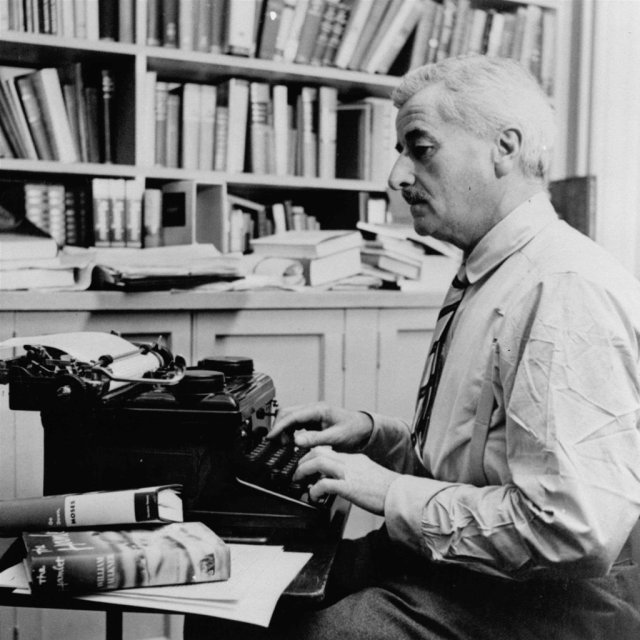
William Faulkner received the Nobel Prize for literature in 1949 and won Pulitzer Prizes for his novels “A Fable” and “The Reivers.” Credit Associated Press

William Faulkner received the Nobel Prize for literature in 1949 and won Pulitzer Prizes for his novels “A Fable” and “The Reivers.” Credit Associated Press

Faulkner rarely discussed his love of mysteries, perhaps considering them lowbrow, but he seemed to understand their importance to his writing.

A friend recalled visiting a library with him, so Faulkner could “exchange a stack of mystery stories for a new stack. I asked him, ‘Why do you read all of these damn mysteries?’ and he said, ‘Bud, no matter what you write, it’s a mystery of one kind or another.’ ”
(Nancy Wartik, “Back Story, NYTimes, 9-25-18)

(c) 2018 JMN.

Posted in Quotations | Tagged | Leave a comment

Luminous Calligraphy from “DeviantArt”

zsul Arabic_Calligraphy_IV_by_zsulaiman

Arabic Calligraphy IV by zsulaiman.

I had a fruitful exchange with a fellow blogger about incorporating alphabets into pictures — not an original idea of mine, of course. But it made me locate some images I had saved from several years ago.

zsul arabic_calligraphy_vii_by_zsulaiman-d2xit5a

Arabic Calligraphy VII by zsulaiman.

These are from “zsulaiman” at https://www.deviantart.com/zartanddesign.

I hope this is proper attribution. She is a digital art professional based in Norway, according to the website. I found her work with Arabic calligraphy colorful and intriguing.

zsul dfe118e46b463cc9c2ba6e36ff05f49d-d2xit1h

[Arabic Calligraphy by zsulaiman.]

zsul they_said__so_we_said_by_zsulaiman-d1l9ypw

They Said So We Said by zsulaiman.

(c) 2018 JMN.

Posted in Commentary | Tagged | 9 Comments

Cecily Brown: Saying More Than One Thing at Once

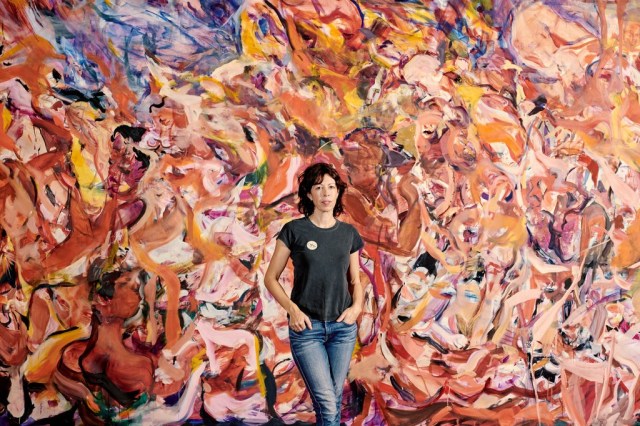
Cecily Brown with her painting “Triumph of the Vanities II,” in the Dress Circle of the

Cecily Brown with her painting “Triumph of the Vanities II,” in the Dress Circle of the Metropolitan Opera House. Credit Vincent Tullo for The New York Times.

“I wanted to make the painting that New York deserves right now,” she said. “It’s such a bloody awful time in so many ways. At the same time, New York is having one of its richest moments in history for lots of people. So I wanted a very celebratory picture, but also that tumultuousness and dysfunction.”

“Painting,” she added, “is very good at saying more than one thing at once.”
(Hilarie M. Sheets, “Cecily Brown’s Paintings Are at the (Other) Met,” NYTimes, 9-20-18)

[Copyright (c) 2018 James Mansfield Nichols. All rights reserved.]

Posted in Quotations | Tagged | 1 Comment

Getting Recognition

Red Square, 1959 (center) by Helen Frankenthaler at the Gagosian gallery in 2013.CreditCreditRichard PerryThe New York Times

Red Square, 1959 (center) by Helen Frankenthaler at the Gagosian gallery in 2013. Credit Richard Perry/The New York Times.

Once, when asked about discrimination against female artists, the Abstract Expressionist Lee Krasner said the bias was as old as Judeo-Christian history. Brushing aside the weight of that realization, she added, “There’s nothing I can do about those 5,000 years.” She painted anyway, as have women throughout the ages who have continued to create despite official disdain.
(Mary Gabriel, “Want to Get Rich Buying Art? Invest in Women,” NYTimes, 9-24-18)

[Copyright (c) 2018 James Mansfield Nichols. All rights reserved.]

Posted in Quotations | Tagged | Leave a comment

“Ears Wide Open”

nyti.ms/2DgcwrX

Nice little video about traveling on sound, suppressing text to enhance the experience.

Posted in Commentary | Tagged , | Leave a comment

1987: There are two “topics” on my mind…

Coyote pups in Hinckley, Minn., gleefully joined in as the adult started to howl. ( Credit Debbie DiCarlo Photography)

Coyote pups in Hinckley, Minn., gleefully joined in as the adult started to howl. ( Credit: Debbie DiCarlo Photography)

[Dear Mother,]

There are two “topics” on my mind. One results from watching the C-Span show where people call in from all over the country, usually to a group of journalists. I’ve seen it twice in the last several days; yesterday the journalists represented the Cleveland Plain Dealer, the New York Times and Newsweek; today just one journalist, a young woman from the Wall Street Journal, with a degree from Yale in something and a masters from Oxford in history.

So many of the callers are excoriating “the media” or “the press” for presenting Reagan in a negative light, or else for being too hard on him during questioning sessions. I know you’ve heard or read the same sort of thing. In fact, I saw the congressman (or senator) Alan Cranston on TV in Lionville thrashing the press for asking Reagan the wrong questions at some occasion prior to his recent press conference. (The woman today from the Wall Street Journal remarked that journalists get a chance to ask questions of Reagan for 30 minutes every four months, given his current rate of holding news conferences.)

All this is irritating to me, and I hope the journalists stick to their guns. They respond with grace and restraint in the shows I’ve seen. Can you make some connection between the apparent great rate of semi-literacy in the country and the obvious great concern of Reaganite media-critics that masses of people will be swayed against Reagan by a partisan press? Was it Jefferson that made such a thing of an educated electorate able to make its own judgments and come to its own conclusions? I wonder if the people whom they fear might be swayed even read the press; on the other hand, everyone watches TV, and that’s probably the medium they (the media-critics) fear the most.

It’s a good thing I’m not a journalist, because I can’t extract any telling thoughts out of this soup of impressions, at the moment, but I “feel” that there’s something dangerously deviant and sinister and irrelevant in these great howlings about maltreatment of public figures at the hands of the “media,” which 9 out of 10 of the howlers treat as a singular word!

[Correspondence, Copyright (c) 2018 James Mansfield Nichols. All rights reserved.]

Posted in Anthology | Tagged | Leave a comment

How It Goes

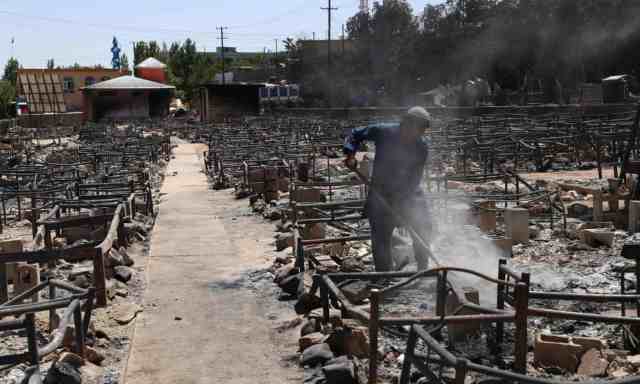
A man clears debris after Taliban militants burned a market in Ghazni. Photograph Zakeria HashimiAFPGetty Images

A man clears debris after Taliban militants burned a market in Ghazni. Photograph: Zakeria Hashimi/AFP/Getty Images

Governor Nimati said that disaster in the Baghlan-e-Markazi district was averted last week only after the American military sent Special Forces troops to fight alongside Afghan commandos, backed up by airstrikes. But as soon as the Americans and the commandos left, he said, Taliban forces immediately began filtering back in, and by the weekend the bases in the district were again in Taliban hands.
(Rod Nordland, “The Death Toll for Afghan Forces Is Secret. Here’s Why,” NYTimes, 9-21-18)

[Copyright (c) 2018 James Mansfield Nichols. All rights reserved.]

Posted in Quotations | Tagged | Leave a comment

Help Wanted

Joey Guidone [NYTimes]

Joey Guidone [NYTimes]

I count ninety-six pieces of J.S. Bach’s “Das Wohltemperirte Klavier” (The Well-tempered Clavier — does “tempered” mean “tuned”?). I don’t know if ninety-six is the canonical count. I may have miscounted. I purchased the recording from iTunes some years ago and usually access it on my iPhone. I’ve never listened to the whole series in one sitting because it goes on for hours. I stake out arbitrarily a dozen or so pieces, and switch to Laurindo Almeida or Charlie Byrd when I realize I’ve listened to music that has a dizzying torrent of notes struck at unstintingly strict tempo, now with muscular dexterity, now with serene detachment, by Angela Hewitt long enough, not to want to pierce my temple with an icepick necessarily, but to become testy.

It’s me, not Bach (or Ms. Hewitt).

I feel like this profligate genius, this “stolid” family man and church organist, Herr Bach, is having his way methodically and sublimely with musical mysteries that are over my head. It’s not narrative music like “Night on Bald Mountain” or “Peter and the Wolf.” It’s cerebral, even somewhat technical music, I surmise, and I would give a lot to get guidance from a musician (or musicologist?) who would help me not just listen to these exercises — is that what they are? — but also understand what they’re doing. This hankering for greater insight reminds me a little of the pleasure I get from conjugating model verbs, both regular and irregular. It’s the savoring of ordered complexity, of the serried rigor of eighth-notes and inflections. It’s diving past the petty shore ripple and into the big waves where the serious surfers play. Except I’m not that strong a musical swimmer, or maybe the metaphor requires me to say I don’t have a surfboard.

It strikes me that with painting I don’t need someone to tell me what I’m seeing, even if it’s otherworldly, but with music I’m over my head, at least in Baroque waters, though I must say I have a much better time with Bach’s cello compositions. I’ve heard them adapted to guitar, also, and either way they sound more modern and less… mechanical (an ugly word) to me.

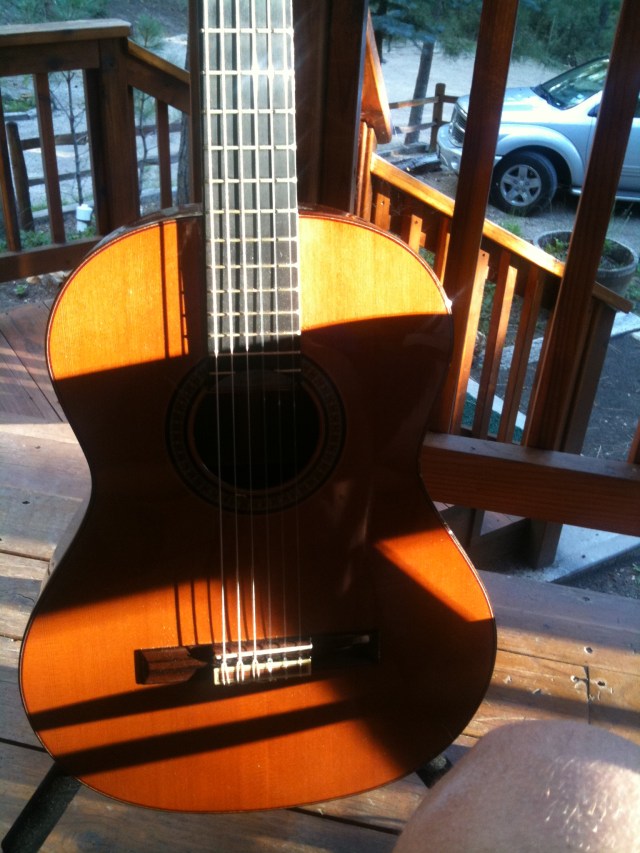
I fantasize fishing out my Ramírez from its velvet coffin and laboriously fingering by ear — I’m not fluent in notation but I have a wicked ear — some of the melodic lines that Bach puts out in this torrent of keyboard music. Maybe translating patches of it to the fretboard will help me get smarter at listening to it.

[Copyright (c) 2018 James Mansfield Nichols. All rights reserved.]

Posted in Commentary | Tagged | 2 Comments