There’ll Always Be a Japan

Japanese Politician

Yuka Ogata claims attitudes towards her have hardened since she took her child into the assembly last November (above). Photograph: The Asahi Shimbun via Getty Images.

Ogata was speaking at the podium when the chairman, Shinya Kutsuki, asked her if she had something in her mouth. She explained that she was sucking a lozenge because she was suffering from a cold and did not want to disrupt proceedings by coughing repeatedly.

The session was suspended while assembly members voted in favour of forming an ad hoc committee to decide how to discipline her. It composed an apology and demanded that she read it out. When Ogata refused, the committee reconvened and the chamber voted to suspend her for the rest of the day. The incident held up council business for eight hours.

“It is unacceptable for a responsible adult to ask questions with a cough drop in their mouth,” said the mayor of Kumamoto, Kazufumi Onishi, according to Kyodo News. “She needs to admit that she was at fault.”
(Justin McCurry, “Japanese politician in baby row thrown out again — for sucking cough drop,” The Guardian, 10-1-18)

(c) 2018 JMN.

Posted in Quotations | Tagged | Leave a comment

Boosler, Eisenberg, Cage, Aznavour, Hockney

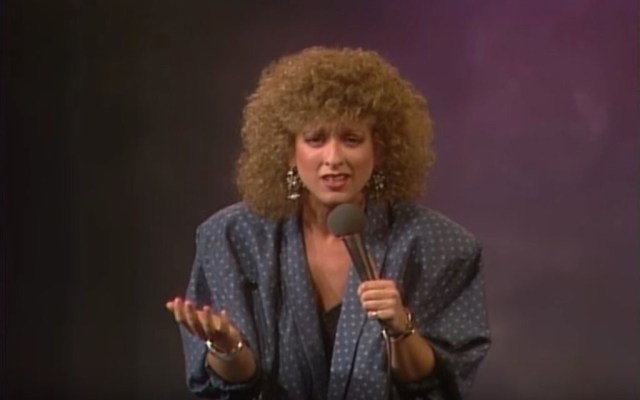
Elayne Boosler

Elayne Boosler in a screen shot from her “Party of One” special, part of a box set of her work. Credit Showtime Networks.

Men, she sighs, expect her to cook breakfast the morning after sex. “They want things like toast,” she says, exasperated. “I don’t have these recipes.”
(Jason Zinoman, “The Comedy Master Who Hasn’t Gotten Her Due: Elayne Boosler,” NYTimes, 10-1-18)

Deborah Eisenberg

Ruven Afanador for The New York Times.

“I just fall over guffawing when people say, ‘This isn’t who we are.’ Who are you other than what you do?”
(Giles Harvey, “Deborah Eisenberg, Chronicler of American Insanity,” NYTimes, 10-1-18)

Nicolas Cage

‘It’s like, wow, I’m 54 and single again. Didn’t see that coming. It’s pretty grim’ … Cage. Photograph: John Parra/Getty Images for for The Hollywood Reporter.

“I can do photorealism, but I wanted to let it be known that acting can break forms and hark back to something else. I’m a big fan of artistic synchronicity, when you do one form in another, like Munch’s Scream in Ghostrider,” he says, pulling the aforementioned face. “Not natural but truthful, not crazy for craziness’s sake.”
(Hadley Freeman, “Nicolas Cage: ‘If I don’t have a job to do, I can be very self-destructive,’” The Guardian, 10-1-18)

Charles Aznavour

Sometimes spectacularly bleak… Charles Aznavour. Photograph: INA/Getty Images.

Among the pantheon of great chansonniers, Aznavour was a born rule-breaker. “Before Aznavour, despair was unpopular,” joked director Jean Cocteau, who cast him in 1960’s Le Testament d’Orphée….
(Alexis Petridis, “From drag queens to dead marriages, Charles Aznavour was far from easy listening,” The Guardian, 10-1-18)

David Hockney

David Hockney in his London living room in September. On his right is a facsimile of the of a stained- glass window he designed, which was formally dedicated at Westminster Abbey on Tuesday. Credit Suzanne Plunkett for The New York Times.

But when he was later asked to paint [Queen Elizabeth], he turned that down, too. In the interview, he recalled [Lucian] Freud’s depiction of the monarch. “He got 10 hours from her, which is not very much for him, but a lot for her to sit… I knew the portrait. It was O.K. But I’m not sure how to paint her, you see, because she’s not an ordinary human being. She has majesty… How do you paint majesty today?… What am I going to do with [money]? An artist can’t really be a hedonist, because he’s a worker… If all you’re aiming for is longevity, it’s life-denying… Everything turns to dust eventually. Even Westminster Abbey will.”
(Farah Nayeri, “David Hockney Wouldn’t Paint the Queen. But He Made Her a Stained-Glass Window,” NYTimes, 10-2-18)

(c) 2018 JMN.

Posted in Anthology, Quotations | Tagged , , , | Leave a comment

Old Mother Goose

Mother Goose, Oil on canvas, 48x48 in. JMN, 2017

Old Mother Goose, Oil on canvas, 48 x 48 in. JMN, 2017.

This is a painting based on a badly faded image in an old children’s book I possess. The image is an illustration by Anne Anderson, a Scottish illustrator (1874-1952). It’s intriguing in various ways, prominent of which for me is a certain unnerving monstrousness. If I were a child and saw this figure making her way down the cobblestone path in my direction, I would likely run in terror in the other direction.

I say this good-naturedly. I admire Anderson’s work. What strikes me in this image is the interesting ways in which her attire is … distorted? Her clothing seems to be literally inflated, like a balloon! Let’s not even dwell on the diamonds and stripes of her costume, the odd, puffy things around her wrists, her rather large feet in the buckled slippers, and the brobdingnagian, witch-like hat!

It’s all wonderful and mysterious and surely period-centric in its way, but not exactly cuddly. In a way it smacks of today’s clowns and Santa Clauses: How many kids want to snuggle with either of those?

(c) 2018 JMN.

Posted in Anthology, Commentary | Tagged | 1 Comment

“Why not just paint a mustache on everything?”

Why Not T-Shirt, JMN.

Why Not T-Shirt, JMN.

I read this in the Times or Guardian last year: When Gutzon Borglum was promoting his idea of carving faces into Mount Rushmore (1927-1941), many people were scandalized and incredulous. What a silly, useless notion! What a lack of respect for nature! Such pretension, such hubris! The project wasn’t popular with a substantial segment of the public.

The quote on my T-shirt is from an anonymous person who sounded off on the matter in a newspaper article of the time. It has a zaniness I find appealing.

(c) 2018 JMN.

Posted in Commentary | Tagged , | Leave a comment

Tip #2 for the Male Homemaker

Shovel and Dustpan, JMN.

Shovel and Dustpan, JMN.

For the infrequent occasions when your dog doesn’t make it through the night and poops in her usual spot on the tile floor in front of the fireplace, an ancient ash shovel and a metal dustpan are of the essence. (The vise in the picture is incidental and not part of the required equipment.) The rustier and more battered these tools are, the better, for they will be permanently besmirched with feces residue, hence tucked discretely away in your workshop. Two utensils are essential; with only one, it becomes an exercise in spreading the poop rather than picking it up. Fling it away outside somewhere no one is likely to tread, and you’re halfway done.

Phase 2 of the tip elevates it to a true life hack, if I understand that term correctly. [Associative meander: The first time I encountered the term “hack” was in the cyberpunk novels of William Gibson. In one of them, each of the characters in the survivalist community of a dystopian future has a hack, which is a special skill or field of expertise that the person has acquired and exercises for the benefit of the eccentric, motley crew. Gibson and Bruce Sterling were prominent writers in the genre, which focused on a near-future collapsed civilization and the scrappy, resourceful people who made their way amidst the ruins. Another favorite author, Paul Theroux, wrote a good novel in this vein, too. So did Walker Percy, but I think “hack,” like “cyberspace,” is Gibson’s coinage. When I was a programmer, the term “hacking” usually meant writing code that worked OK, but was sloppy or inelegant. Hacking was often associated with creating a “kludge” (rhymes with “Scrooge”), meaning a fudgy workaround or crude algorithm. The semantic drift of jargon is fascinating. I take the word “hack” in today’s usage to mean something akin to a clever solution for a problem or chore. (?)]

Cleaner and Paper Towels, JMN.

Cleaner and Paper Towels, JMN.

A liquid cleaner of some sort and paper towels are the ancillary equipment you’ll need. Puddle up the poop stain on your tile with the antibacterial cleaner, drop paper towels on top, and walk away. Have yourself a blackstrap tea or mint julep. If most of your activities occur at the opposite end of your shed from the towel-covered stain, it’s quite possible to forget about it until your housekeeping assistant comes on Wednesday from noon until 5. That person will complete the cleanup of the stain whose cleanup  you have so considerately facilitated for that person.

Depending on the timing of your dog’s accident, and assuming your assistant comes once a week like mine, the longest the towel-covered stain could remain is one week. If, like me, you entertain virtually not at all, there will be no urgency to remove the dried towels and clean the stain yourself before guests arrive.

(c) 2018 JMN.

Posted in Anthology, Commentary | Tagged | Leave a comment

Tip #1 for the Male Homemaker

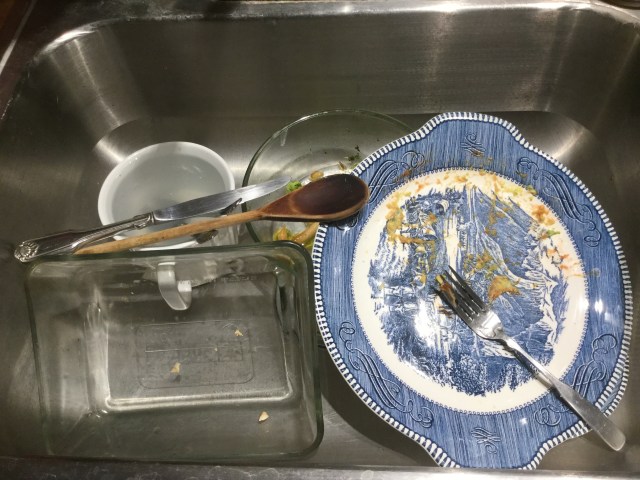
Kitchen Sink, JMN.

Kitchen Sink, JMN.

Dirty dishes left in the kitchen sink have the instinct of all species, which is to propagate their kind. It takes almost superhuman discipline, but you can control this feral population through timely wash-up, limiting their opportunities to spawn. Soiled pans, flatware and cutlery are nocturnal — that’s their prime mating time — so washing dishes before bedtime is a sound habit, though for me it’s the hardest time of day to practice this grueling ritual. I’ll just wash those in the morning, when I’m fresh. No! Man up, my brothers! Confronting that mess in the morning isn’t the way to start your day — and there’ll be twice as much!

Good luck, solitary males everywhere, as you hone a skill that helps you fend for yourself in the kitchen. Remember, the man who doesn’t cook for himself eats dearly and poorly.

Tip #2 will feature two must-have tools for scooping dog poop off tile floors.

(c) 2018 JMN.

Posted in Commentary | Tagged | Leave a comment

“Texas My Texas”

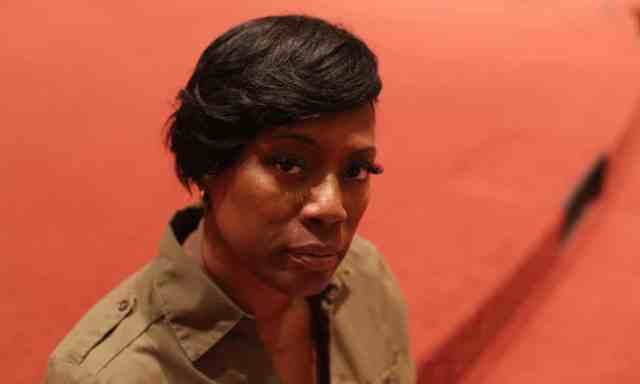
Mason, in a case seen as emblematic of voter suppression, faces over five years in prison for a

Crystal Mason … faces over five years in prison for a mistaken vote in Fort Worth that was not counted. Photograph: Ed Pilkington for the Guardian.

Growing up, I was exposed occasionally to the Texas state anthem. I know the tune but can recall only the first verse — I don’t think I ever learned all the lyrics: “Texas, my Texas, all hail the mighty state!” Throughout most of my youth I thought we were singing “aw hell the mighty state!” In my family “hell” was a cuss word, a bad place men told other men to go to, and to which the preacher said self-abuse led. I may have been scandalized at first, but soon thought no more about it, presuming it worked somehow in the song.

Nowadays, for no earthly reason, I sing the state anthem occasionally in my head, but just repeating the one verse I know. For the wind-up, or close-out — whatever it’s called in a song — I sing “All hail, all hail, all hail, aw hell! All hail the mighty state!” It gives me a wry sense of satisfaction to treat the anthem with a soupçon of disdain, a pleasure similar to that furnished by working a French word into one’s discourse: Saucy, a little naughty, like my ten-year-old self saying “Hell!” out of the hearing of adults.

I’m fairly sure I recall an essay by Larry McMurtry, a fellow Texan, about taboo language and its close cousin, euphemism, in his youthful experience. One instance was the use in childish lingo of “grunt” to designate a specific call of nature. Presumably it was a kind of onomatopoeia deriving from effortful vocals emanating from the privy. I, too, knew this usage from summers spent with my grandparents: “Grandmother, I have to grunt.”

The other instance was McMurtry’s tale of blurting out, as an adolescent at the family dinner table, for no reason he could fathom, “Please pass the fucking butter.” The opprobrium he incurred was severe. He did not dine that evening. His experience and mine diverge in that respect. I can’t recall when the F-word first crossed my lips, but I was probably a grown, immature man when it did.

(c) 2018. JMN.

Posted in Commentary | Tagged | Leave a comment

Bodily Fluid Clean-up Kit

Victoria Advocate

Victoria Advocate.

The latest Food Service Inspection Report is published in my local newspaper, and it strikes chillingly close to home. “Moo Moo” is a decades-old fast-food joint specializing in fried chicken and burgers. Once a week, on “Wacky Wednesday,” you can get fried chicken for a dollar a piece, but limit is five pieces per person. Patrons are known to include orders for their infant babies to get around this constraint. Moo Moo is so close that when there’s a northerly breeze I can smell the frying from my patio. It’s not unpleasant, even though I don’t eat what they serve.

This hoary establishment is third on the report, with 21 demerits: Walk-in cooler ambient 45 degrees, chicken 44 degrees. 200+ bleach at bleach bucket. Need employee health and personal hygiene handbook. Need to label yellow bucket. Cannot have over-the-counter bug spray in the establishment. Need to fix leak at three-compartment sink and in the restroom. Need bodily fluid clean-up kit. Expired food handlers certificates. Do not cover shelves with cardboard.

I posted once about “bodily fluid clean-up kits” and promised a fellow blogger I’d report it if I found out what this much-mentioned item is. A friend who worked once in food service said it’s most likely a dedicated mop, bucket, and jug of bleach for the eventuality that a patron has an attack of food poisoning with explosive emissions. I can understand why a restaurant might downplay this possibility and neglect to plan for it. The inspectors are adamant, however.

(c) 2018 JMN.

Posted in Anthology, Commentary | Tagged | 5 Comments

More Liberties Taken

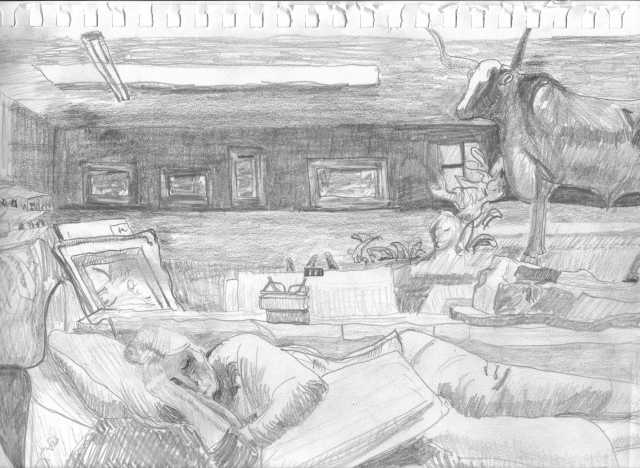
Napping in the Studio. JMN.

Napping in the Studio. JMN.

I puzzle over how the formal properties of verse help, or fail to help, verse. How do meter and rhyme support imagery and diction if they do, and why not if they don’t?

I think rhythm and rhyme originally were mnemonic tools to help the rhapsode recite from memory his (her?) thousands of lines of tribal lore before writing came along.

Which of the following texts are poems or fragments of poems, which prose? (Key below.)

(A) … In a larger sense, we can not dedicate — we can not consecrate — we can not hallow — this ground. The brave men, living and dead, who struggled here, have consecrated it, far above our poor power to add or detract. The world will little note, nor long remember what we say here, but it can never forget what they did here.

(B) No man is an Iland, intire of it selfe; every man is a peece of the Continent, a part of the maine; if a Clod bee washed away by the Sea, Europe is the lesse, as well as if a Promontorie were, as well as if a Mannor of thy friends or of thine owne were; any mans death diminishes me, because I am involved in Mankinde; And therefore never send to know for whom the bell tolls; It tolls for thee.

(C) These and all else were to me the same as they are to you, I loved well those cities, loved well the stately and rapid river, the men and women I saw were all near to me, others the same — others who look back on me because I look’d forward to them, (The time will come, though I stop here to-day and to-night.)

(D) so much depends upon a red wheel barrow glazed with rain water beside the white chickens

(E) You’re stepping on your father, my mother said, and indeed I was standing exactly in the center of a bed of grass, mown so neatly it could have been my father’s grave, although there was no stone saying so.

(F) If I suffer at this typewriter think how I’d feel among the lettuce-pickers of Salinas?

(G) We were living in trees when they met us. They showed us each in turn that water would certainly wet us, as fire would certainly burn: But we found them lacking in uplift, vision and breadth of mind, so we left them to teach the gorillas while we followed the march of mankind.

(H) He’d a French cocked-hat on his forehead, a bunch of lace at his chin. A coat of the claret velvet, and breeches of brown doe-skin; they fitted with never a wrinkle: his boots were up to the thigh! And he rode with a jeweled twinkle, his pistol butts a-twinkle, his rapier hilt a-twinkle, under the jeweled sky.

What role does typography play in verse? If meter isn’t at work, what criteria trigger a line break? What’s a “prose poem”?

There are answers, though I don’t want to slog through treatises any more to get them. Having the experience of a truism that blossoms into obviousness as the result of a unique lived moment thumps hearsay.

Key:
(A) Abraham Lincoln, “Gettysburg Address”; (B) John Donne, “Devotions Upon Emergent Occasions”; (C) Walt Whitman “Crossing Brooklyn Ferry”; (D) William Carlos Williams, “Red Wheelbarrow”; (E) Louise Glûck, “Aboriginal Landscape”; (F) Charles Bukowski, “The Meek Shall Inherit the Earth”; (G) Rudyard Kipling, “The Gods of the Copybook Headings”; (H) Alfred Noyes, “The Highwayman.”

(c) 2018 JMN.

Posted in Commentary | Tagged | Leave a comment

Yo-Yo Ma, America’s Cellist

Yo-Yo Ma, performing at Stadtteilpark in Leipzig, Germany, earlier this month as part of his planned

Yo-Yo Ma, performing at Stadtteilpark in Leipzig, Germany, earlier this month as part of his planned 36-city, six-continent tour that blends performances of Bach with community engagement. Credit Mustafah Abdulaziz for The New York Times.

And what Mr. Ma plays at moments like those [i.e. historic occasions], to make us cry and then soothe us, is, more often than not, a selection from the Bach cello suites.

“Learning a new piece is like moving from one place to another,” Mr. Ma said to a small audience,

“Learning a new piece is like moving from one place to another,” Mr. Ma said to a small audience, including immigrants, at a community center in Leipzig. Credit Mustafah Abdulaziz for The New York Times.

These six works are the Everest of his instrument’s repertory, offering a guide to nearly everything a cello can do — as well as, many believe, charting a remarkably complete anatomy of emotion and aspiration.

(Zachary Woolfe, “Yo-Yo Ma Wants Bach to Save the World,” NYTimes, 9-28-18)

(c) 2018 JMN.

Posted in Anthology, Quotations | Tagged | Leave a comment