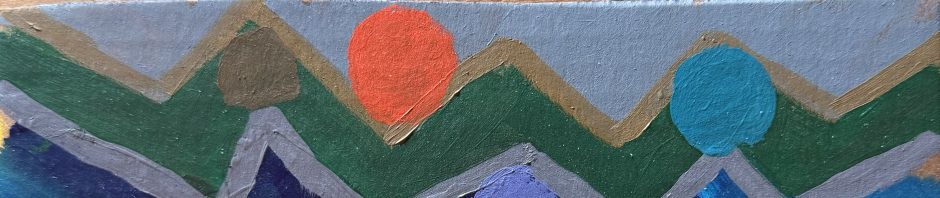
“Sock Hop Bop Flop”

Friday Night, JMN, photo.

Friday Night, JMN, photo.

Sock Hop Bop Flop
An Admonitory Fable for Tragedies Averted
(To all my students who made it through graduation)

Bee-Bop-A-Ree-Bop,
A lockdown jam,
A lockjawed ham,
Good golly, Miss Molly,
Lookin’ hot damn!

Bee-Bop-A-Ree-Bop,
A hounddog dude,
Blue suede shoe’d,
Sideburnt sugardaddy
Bawlin’ The Jude.

Bee-Bop-A-Ree-Bop,
A half-baked bean,
A boppin’ teen,
Cotton-eyed Joe
For a bullshit queen.*

Bee-Bop-A-Ree-Bop,
Haulin’ some ass,
Takin’ no sass,
Ten foot tall
And tokin’ the grass.

Bee-Bop-A-Ree-Bop,
A bang and a boom,
A six-foot room,
Shooby-dooby-doo,
Cool as a tomb.

*Note: A feature of the Cotton-eyed Joe dance step in Texas is a sort of conga line of men and women rhythmically shouting “Bullshit!”

[Copyright (c) 2018 James Mansfield Nichols. All rights reserved.]
Posted in Anthology | Tagged | Leave a comment

Poetaster

OLYMPUS DIGITAL CAMERA

Brancusi’s “Endless Column” By Mike Master – Own work, CC BY-SA 3.0 ro, https://commons.wikimedia.org/w/index.php?curid=21034498

More joy courtesy of Blake Gopnik, “In His Films, Brancusi Takes Flight,” NYTimes.

Given all the chestnuts in this show, the challenge is to see if we can still find a way to be astonished by them, as we were when they first appeared. In 2018, can Brancusi still release our inner poetaster?
[I’ve long known of the word “poetaster” and what it means, but I can’t recall having seen it used recently, especially in journalism. Indeed, as “one who writes inferior poetry” I stake claim to the title myself. Not having heard the word either, I note that in the handy online recording its pronunciation tracks the cadences of a phrase such as “pope disaster” or “poll forecaster” — four syllables with more presence of the ass-sounding part of the word than I would have thought. In my head I always said it in three syllables — POET-uh-str — diphthongizing -oe- and reducing the -a- to schwa.]

“Chestnut” is an old friend, too — “something that has been discussed or repeated ad nauseam.” It’s good to bump into this useful term. I knew a professor of English literature who quipped of a prolific rival in the field, “He lets a scholarly article every morning before breakfast.” I do that with chestnuts.

[Copyright (c) 2018 James Mansfield Nichols. All rights reserved.]

Posted in Commentary, Quotations | Tagged | Leave a comment

Jolly Comeuppance

DjotEKxU8AEbH17

I was a retentive student. I would remember being exposed to the political geography of the kingdom across the English Channel from Europe. I was not exposed to that geography.

Yesterday I learned that “Great Britain” consists of England, Scotland and Wales; the “United Kingdom” is made up of those three countries plus Northern Ireland. England can still be called England provided one is referring to… England.

I’m thinking of coining an old Chinese saying: “The path to wisdom runs through confession of ignorance.” It skirts closely a fellow blogger’s statement: “Now I know that I don’t know.” A real Chinese saying (perhaps) is “Wisdom consists in getting things by their right names.”

I taught myself that “Ireland” embraces both Northern Ireland, still in the UK, and the Republic of Ireland, a separate country and member of the EU. The two Irelands arose, I believe, in resolution of The Troubles. Their sharing of a border is causing heartburn in the Brexit negotiations.

I make cheeky sport of UK social mores via a cartoonish character named Sir Alistair Chichester. Better late than never to know the precise toponymy of — dare I say it? — the British Isles.

A clever bit from a “Seinfeld” episode comes to mind. Responding to George’s queries, Jerry clarifies that Holland and The Netherlands are the same country. “Then who are the Dutch?” asks George. (Since writing this yesterday I’ve seen evidence of this gag going around. It may be a chestnut by now. Keeping up with Internetwit is like catching lightning in a bottle.)

[Copyright (c) 2018 James Mansfield Nichols. All rights reserved.]

Posted in Commentary | Tagged | Leave a comment

“Toot Toot Tutu Toodle-oo.”

New words encountered! Courtesy of Roberta Smith, “Painting: An (Incomplete) Survey of the State of the Art,” NYTimes.

“Dahlias and Birch Trees,” from 2004, is one of Lois Dodd_s 10 small oil studies of nature in the survey.CreditLois Dodd Greene Naftali Gallery and Matthew Marks Gallery

“Dahlias and Birch Trees,” from 2004, is one of Lois Dodd’s 10 small oil studies of nature in the survey.Credit Lois Dodd Greene/Naftali Gallery and Matthew Marks Gallery

“gamin” — Ms. Hearne was a gamin performance artist turned art dealer with an audacious eye…
[I knew this word from French but checked my recall of what it means in an abundance of caution: “urchin, ragamuffin, waif, stray, guttersnipe.” Funny, I had a notion that it was something a little more cute in French usage. Indeed, checking further I find the feminine form “gamine” translated as “a girl with mischievous or boyish charm.” There’s the cuteness that I remembered. Should Ms. Smith have written Ms. Hearne was a *gamine* performance artist….? News to me is the pronunciation of “gamin” in English to sound like “gammon.” I’ve never heard it used.]

Robert Bechtle painted himself as a kind of mystic in North Adams Studio, from 2008. CreditRobert Bechtle Gladstone Gallery

Robert Bechtle painted himself as a kind of mystic in “North Adams Studio,” from 2008. Credit Robert Bechtle/ Gladstone Gallery

“norm-core” (or “normcore”) — In the Matthew Marks space on West 24th Street, a 2008 self-portrait by the Photo Realist Robert Bechtle presents him as a kind of norm-core mystic, standing at the center of his darkened studio, like Munch, in a subtly hazy pointillist atmosphere.
[Interesting, rather opaque word unknown to me: “a style of dressing that involves the deliberate choice of unremarkable or unfashionable casual clothes.” Ms. Smith’s use of the word is apt. The Bechtle painting is scary realistic. There’s a longish article about normcore by Alex Williams in the NYTimes, April 2, 2014. I can’t pursue it now. So much to know about hipster fashion fads, so little time. I can’t even keep up with the Kardashians.]

An installation view of Karl Wirsum_s colorful toy-robot-figures at the Matthew Marks space. Credit Sean Logue

An installation view of Karl Wirsum’s colorful toy-robot-figures at the Matthew Marks space. Credit Sean Logue.

And here are two picture titles by Karl Wirsum that make my day: “Sputter in the Niche of Time” (left) and “Toot Toot Tutu Toodle-oo” (right).

Ms. Smith concludes: For me, the resurrection of images in “Painting” is both a development out of and a rebuke to Conceptual Art. It indicates a renewed faith in the ability of painting to communicate holistically by fusing form, style, process and narrative. The problem is that too many of the younger painters in this exhibition don’t seem very interested in inventing their own process or form, which results in images that, while they may be briefly refreshing, are too often painted in familiar, unexciting ways.

Those would be deadeye, gut-smacking words if I were a professional painter striving to be sustainedly refreshing for the likes of Roberta Smith. I savored an exchange in “The Crown” between the Queen and her tutor. She needs to know something personal about President Eisenhower to prepare for making small talk at a state dinner. Casting about, the tutor says, “I believe,  ma’am, that he paints.” The Queen replies distractedly, “Don’t they all?”

Yep, I’m a tyro in that herd, painting in a familiar, unexciting way, blissfully unremarked and unrebuked. Obscurity has its uses.

[Copyright (c) 2018 James Mansfield Nichols. All rights reserved.]
Posted in Commentary, Quotations | Tagged , | Leave a comment

A Prayer of Sorts

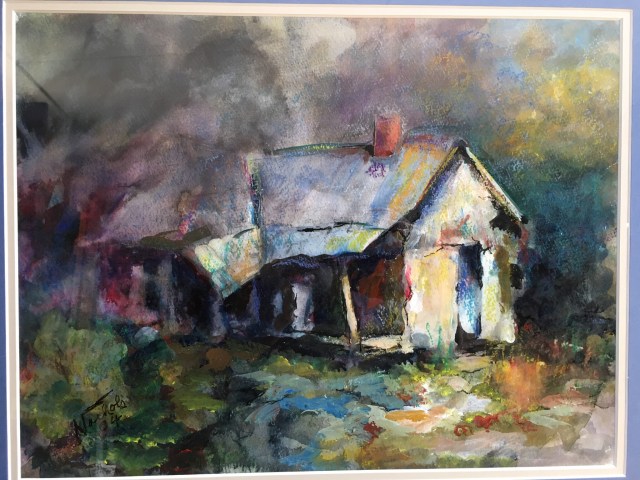
HJN, Apocalypse, oil on canvas, 24 x 30 in.

HJN, Apocalypse, oil on canvas, 24 x 30 in.

I pay more attention than I’d like, for personal reasons, to news coming from a region of ceaseless conflict. Recently, three men attacked a secure place. One breached the gate by killing himself with explosives so that the other two could enter and mount their assault. The upshot: much loss of life. In other words, a Monday or a Tuesday in that part of the world.

I struggle to imagine the chillingly mundane planning that must precede operations that incorporate voluntary death as part of the plan: “You park your car at this place and kill yourself so that we can enter the gate and pursue the attack.” And perhaps it’s diagrammed on paper.

Such acts are celebrated and reviled by the usual suspects with the usual rhetoric, but what strikes me is the fearsome devotion to cause that must underlie such ruthless, calculated giving and taking of life. Also, the sheer difficulty of defending against attacks by persons whose exit strategy is not to have one, whose battlefields are neighborhoods, and whose targets are brazenly collateral.

The memory springs unbidden to me of bluestocking ladies of a certain age — mothers, grandmothers, widows perhaps — maintaining a card table on Franklin Street in Chapel Hill. Their placard said “Pray for Peace,” and they invited passersby to sign a petition requesting that another long conflict be brought to an end. Their action seemed quixotic even then, but it gibed with a streak of idealism that was present in towns like that.

It’s been ages since I’ve seen or heard the slogan “Pray for Peace.” It even has a quaint, anachronistic ring to it. I’m not sure but what it might be taken as slightly heretical or unpatriotic now. But prayer for peace would not seem to argue with support of the troops. Now that I’m supporting one very specific “troop” I wish fervently for peace to break out where he will serve. It’s said all politics is local. War has turned local for me where my own blood is in it.

A kind fellow blogger left a comment wishing me well in what might prove to be my analogue to the non-quest that surprised C.S. Lewis with joy. The comment itself gave me joy. For some reason I think of the repentant slave trader who penned “Amazing Grace.” Also, of Francis Thompson’s “Hound of Heaven” poem in which the speaker, fleeing desperately from it, is virtually hunted down and subdued by the beast of salvation. I seem to resonate to the unsought or sneaked-up-upon aspect of these several tales
of spiritual revelation. A faint star’s light is brighter when we look not at but past it.

My mother, a practicing Methodist, would say now and then, “Send one up for me” when facing a challenge of some sort. I’m her very son and not beyond praying, though I be heathenish! I send one up for peace.

(Copyright (c) 2018 James Mansfield Nichols. All rights reserved.)

Posted in Commentary | Tagged | 5 Comments

Sigh… but I’d love to be surprised.

Luis de Góngora y Argote by Diego Rodríguez de Silva y Velázquez, Google_Art_Project

Luis de Góngora y Argote by Diego Rodríguez de Silva y Velázquez, Google_Art_Project

If he’s proven to have not told the whole truth about the fact that campaigns look for dirt, and if someone offers it, you listen to them, nobody’s going to be surprised. There are some things in politics that you just take for granted.
[Darrell Isa]

Copyright (c) 2018 James Mansfield Nichols. All rights reserved.

Posted in Anthology, Quotations | Tagged | Leave a comment

Onward and Upward with the Language

Francisco Gómez de Quevedo y Santibáñez Villegas, Juan van der Hamen, 17th century (Instituto Valencia de Don Juan)

Francisco Gómez de Quevedo y Santibáñez Villegas, by Juan van der Hamen, 17th century (Instituto Valencia de Don Juan)

I learned a new word today: “derp,” meaning “foolishness or stupidity.” Here’s the context:

So that’s why I’m a crypto skeptic. Could I be wrong? Of course. But if you want to argue that I’m wrong, please answer the question, what problem does cryptocurrency solve? Don’t just try to shout down the skeptics with a mixture of technobabble and libertarian derp.
[Paul Krugman, “Transaction Costs and Tethers: Why I’m a Crypto Skeptic,” NYTimes]

Irrelevant Postscript: I wanted to confirm my instinct not to capitalize “with” in my title. (I recalled learning not to capitalize prepositions.) I consulted the World Wide Wind. It passed the following:

“Short” words, those with less than five letters, are lowercase in titles, unless they are the first or last words.

And there we are. I’m taking language advice from a site that says “less than five letters” instead of “fewer than five letters.”

Copyright (c) 2018 James Mansfield Nichols. All rights reserved.

Posted in Commentary, Quotations | Tagged | 2 Comments

Sir Alistair Has Much in Common

Tagg's Island, Sir Alfred Munnings, 1919. Philip Wilson Publishers, 1978.

Tagg’s Island, Sir Alfred Munnings, 1919. Philip Wilson Publishers, 1978.

Sir Alistair Chichester is just like you in so many ways: He can quaff a pint with the next man at the Thane of Thoth; he enjoys his Marmite soldiers with an egg, his faggots with mushy peas, his bangers and mash, syllabub on weekdays, Eton mess on Sundays. Moreover, when Wadsworth dresses him Sir Alistair puts first one leg, then the other, into his trousers, just like you. Well, perhaps you don’t have a butler, but the point is made. It only so happens that Sir Alistair is a hereditary wealthy nobleman and you are common.

It likewise so happens that Sir Alistair owns the Tottenham Hotspurs, a professional football team. Though it be infra dig for the august man to rub elbows with the hobbledyhoys who throng Wadham-Threadneedle Stadium, he joins them in roaring approval for sundry maneuvers on the pitch from the luxury of his private box. “Well done, you!” Who would deny a man saddled with preferment the fugitive spasm of ebullience?

As it happens, a berobed potentate from sands of the desert has tendered to Sir Alistair an offer to purchase the Hotspurs at a price little short of breathtaking. The exact amount is irrelevant for lesser mortals — suffice it for your paltriness to say that Sir Alistair would realize a gain of some seventeen percent over his original investment.

Here the plot thickens. Whilst Sir Alistair mulls the sheikh’s gesture, the Council of Worthies has found an anonymous potential buyer who would give Sir Alistair only a thirteen-percent current profit; with, however, a promise to press the Exchequer for abatement in perpetuity from certain taxation inflicted upon rents and interest income of the struggling well-to-do. The deferred profit to Sir Alistair over 2.4 years would surpass his immediate take from the potentate.

Your assignment is as follows: Pretend you are Sir Alistair’s advisor. (Implore assistance from a social superior to lend verisimilitude to your impersonation.) It’s clear Sir Alistair profits serenely from either offer — pecuniary advantage is not at issue here. But which currency more complements the Chichester line’s preeminence: petrodollars or pounds? Also, Panama or the Caymans? Speculate as to which haven for proceeds of the transaction Sir Alistair’s accountants will prefer.

(Social Math — UK, Copyright (c) 2018 James Mansfield Nichols. All rights reserved.)

Posted in Anthology | Tagged | Leave a comment

Making Bold

Tom Jones drawing, bronc-riding cowboy

Tom Jones drawing, bronc-riding cowboy

They say seek forgiveness, not permission, if you’re bold. I make bold here to respond publicly to a fellow blogger with whom I am enjoying a rewarding exchange of views — one of several bloggers who kindly respond to me with discriminating and sensitive comments, and I thank you all. He’s an artist and writer, and here I talk to him pell-mell (I hope to cite his blog soon, but I’m uncertain of the protocols for that at present, and would like to consult him first):

I’ve read all your latest comments and they’re echoing for me as I write this. Your remarks just keep on ringing bells. It’s so stimulating to talk about art with you. When I say something like “don’t-give-a-shit” painting, after feeling clever for a moment I regress to “uh-oh, that sounds cocky and glib.” I’ve said before that I’m a passive-aggressive expressionist. I’m torn between bold sallies and remorseful retrenchings — whatever that means. In fencing you thrust and you parry. And I think you “lunge.” What’s it called when you back up like hell? “Retreat” sounds a little wussy! Yes I’m a wuss.

I admire painting that’s… daring. Your work is daring. It springs from elsewhere, the haunted imagination lassoed with fiery technique. I’ve always wanted to live “elsewhere.” One of the many Waterloos in my life is that I will die in Texas, whence I came. I “fondly” call it a buttcrack state, along with its southern sisters whose glutes sandwich the Mississippi. I would like to have expired at a remote time in the future near Colby College, for example. Or Bard. Or Salamanca or Soria in Castilla la Vieja. As it stands, I’ll just tell my son to scatter my ashes somewhere in the yard where they don’t blow back into the house.

Your remark on “trained” eye is insightful. “Seasoned” eye would have been good. I’ve internalized the shibboleth that says true artists earn the right to paint unconventionally (daringly) by having traversed the rungs of rigorous academic training first. Like all received wisdom I’m sure it’s rife with exceptions (is Basquiat one?), but you show the marks of having mastered much craft. As you say, you’ve gained your eye with much looking. And your ear for music with much listening! — another thing I admire.

I spent most of a summer in Paris once and hung out at the Louvre. One day I was staring at a painting — I wish I could remember the picture precisely. Its title was something like “Tâche violet” (or “violette”? — I’m not sure of the gender). A lady came up beside me, looked for a moment, then turned and said in French, “What is it?” I answered, “Madame, it’s a ‘Purple Splotch,’ ” simply quoting the label. I thought I was so smart and hip. “What you see is what you see.” (I know “violet” is a closer match, but I like “purple” for the story!)

To give you an example, I have a book of Milton Avery’s work, and I like his work. It has something of the feel I noticed in Henry Taylor, sort of a willed coarseness (?) — a terrible word, I’m really going out on a limb which will probably break off as soon as you blow on it, but it feels good to ramble. In much of my writing I edit my stuff until it’s terse and clenched to a fault. But do you recall the literally *white* face on the horseback guy in Taylor’s painting? It’s stark and startling. Some of his portraits look like he has literally shit pigment on the canvas. The eyes have no nuance whatsoever. Yet those paintings grab me. I didn’t post a couple of his pictures that are truly wrenching. I’m loath to court controversy on my shingle, and we’re all full up with arguments anyway.

Painting like Taylor’s and Avery’s gives me a feeling not so much of “I could have done that” but rather “I should have done that.” How dare they thwart my expectations so seductively! As a hobbyist I labor to model plausible representations in the oils my dad left behind. I’m OK with that, I didn’t make the sacrifices necessary to be an artist, but as a viewer I’ve been a fan of painters like Kandinsky and Mondrian. Degas was my early idol. I have half-sleeping in my brain a moonscape by Albert Ryder. Was it “Albert”? I haven’t thought of him in years. I liked the so-called Ashcan painters. The gritty urban scene was exotic to a country boy longing for escape. Eliot wrote of the poet’s duty to find beauty in the not-beautiful — I paraphrase him drastically and from memory. It reminds me of a phrase by a friend who is a “Texas poet.” He speaks of the “bluebonnet plague” that swamps our Sunday landscape painters. Ouch, I think I’m one of the pack, though my landscapes usually try to be faces. And I paint during the week. At least not sunsets though. Yet! (But they *are* so pretty.)

Copyright (c) 2018 James Mansfield Nichols. All rights reserved.

Posted in Commentary | Tagged | 4 Comments

Waking the Dogs

13 Cookie napping

Bess fills the paw prints left by Cookie, shown napping here.

It’s been a red-letter several days in my quiet life, and I’m afraid it has me sounding off more than I should here on topics that normally I would let lie with sleeping dogs. I have a fear of goading beyond their endurance persons who generously visit my blog.

Two days ago I received a letter from my former wife with news of our only child, a daughter, who has grown up and thrived in another country. Three children of her own, a good marriage, a prosperous career — all fantastic. It was a bolt from the blue which literally brought tears of gratitude. We’ve had no contact all this time. I’ve mailed  letters to both of them, and hope mightily to continue the conversation.

A dear friend and neighbor with whom I’ve shared the details said today, “I know you don’t believe in God, but I think your ex-wife’s reaching out to you is a blessing from God. He is responsible.” And here is where the dogs stir.

I wouldn’t have this dialog with my neighbor because I renounce any effort to argue with another person’s piety. For me “freedom of religion” implies freedom *from* religion as well, but also respect for others’ beliefs provided they don’t cause harm.

But here I say with trepidation that I don’t actually *disbelieve* in God either, it’s more like I don’t have an opinion on the matter. Can I choose not to believe anything for now except that the universe makes more sense if we respect all life? I like the “don’t kill” commandment. Is it number six? I don’t want to live in a world that doesn’t have lizards and tarantulas.

Atheism isn’t an option for me because it is itself a systematized form of thinking about being without God, of disbelieving in “him.” It’s as much an article of faith that “He” isn’t as that “He” is. Neither leap is congenial to me personally. I simply choose not to take a stance. “I would prefer not to,” like Bartleby the Scrivener.

A canny philosopher or theologian might say that my being on the fence is not a tenable position, or not an honest one, that I must poop or get off the pot. (That metaphor wears out quickly.) It may be true. I try with all my heart to keep an open mind about most things. I may yet be “surprised by joy” like C.S. Lewis in the matter of religion.

Meanwhile, my question is: Why the rush to attribute a good happening to God? Is it possible my ex-wife, bless her soul, acted on a generous impulse of her own accord with no divine intervention? Should God be credited also with bad happenings? The burning deaths of folks in Greece and California due to wildfires? The drowning of children in the duck boat? I don’t want to be the one telling relatives and parents it was God’s will. I know the debate over “why bad things happen to good people” is as old as the rocks in my driveway, but I haven’t followed it closely.

My aunt, member of a mainstream Protestant sect, told me once she believed with all her heart that on the Day of Judgment every person who ever lived would be resurrected in the flesh. We were driving home from having held hands and wept as we watched my uncle, her brother, draw his last breath. All I said was, “Ina Bess, I love you.” I believed that she believed her belief. That was enough. Love fills in the blanks. I implore forgiveness if any of this comment smacks of squib. It’s far from my intention to be sarcastic or ironic about matters of faith.

Copyright (c) 2018 James Mansfield Nichols. All rights reserved.

Posted in Commentary | Tagged | 4 Comments