This gallery contains 1 photo.
This gallery contains 1 photo.
The exoplanet Kepler-twenty-two-B
Has temperatures designed for you and me.
(“What is an exoplanet?” you might say.
It’s one outside our system, far away.)
Pools of liquid water could exist there,
So life just might be able to subsist there.
It orbits in a habitable zone.
You could have a place there all your own!
The planet’s over twice as large as Earth,
A size that gives it quite an ample girth.
Two-hundred ninety days make up its year.
It’s six-hundred light years away from here.
And here’s the only bad news that I’ve got:
It’s surface may be rock, or maybe not.
A rocky surface is what we’d prefer.
It’s gonna be a while, though, til we’re sure.
They didn’t find this place with naked eyes.
Astronomers use Kepler, a real prize.
The sharp-eyed scope stares at a slice of cosmos
To see if any life exists besides us.
The tool revolves in space for a good view.
That’s how it sees what’s lost to me and you.
When Kepler spies a world it’s his own newbie.
That’s why this one is “Kepler-twenty-two-B.”
The telescope’s our planet-spotting friend.
But who is watching at the other end?
Reference
http://www.voanews.com/english/news/science-technology/NASA-Confirms-First-Earth-Sized-Planet-in-a-
Sun-like-Stars-Habitable-Zone-135132293.html
(Copyright 2018 James Mansfield Nichols. All rights reserved.)
We become benumbed and resigned to it. Around 2011, it dawned on me that things I mentioned in personal emails, and the objects of my searches, would crop up in online advertisements. First I was mystified, then stupefied. My online … Continue reading
“William James described consciousness as the “alternation of flights and perchings,” suggesting that we tend to overvalue the “perchings,” the nouns or the primary verbs in a sentence that steal the spotlight from the little words, like ‘in,’ ‘and,’ ‘but,’ … Continue reading
“To be invisible is to be forgotten… To be a symbol, and an effective symbol, you must be vividly and often seen.” (Walter Bagehot, quoted by Gary Younge in The Guardian.) What propels me, a mildly reticent recluse, to put … Continue reading
“I believe in aristocracy… if that is the right word, and if a democrat may use it. Not an aristocracy of power, based upon rank and influence, but an aristocracy of the sensitive, the considerate and the plucky. Its members … Continue reading
“Our heads are round so our thoughts can change direction.” (Francis Picabia)
“Extremism makes you stupider.” (David Brooks)
Hard part of riding a tiger is getting off. (Chinese saying?)
“Not forgiving is like drinking rat poison, then waiting for the rat to die.” (Anne Lamott)
(Copyright 2018 James Mansfield Nichols. All rights reserved.)
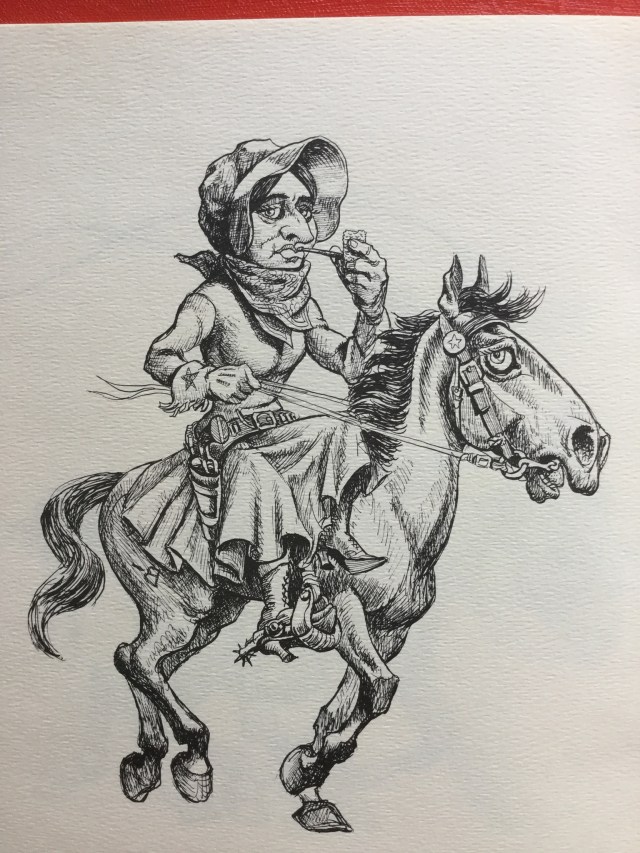
Drawing by Tom Jones.
A word is a terrible thing to lose.
Rescued Words by Wallace Stevens:
fubbed
gobbet
diaphanes
pannicles
carked
rapey
cantilena
fiscs
phylactery
princox
funest
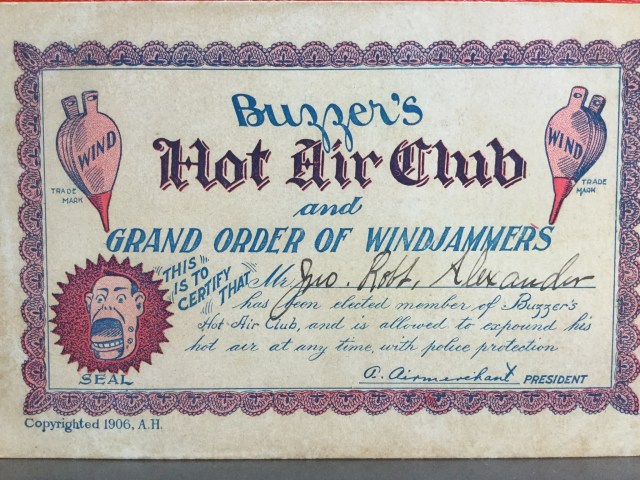
Buzzer’s Hot Air Club. 1906 post card. Copyright 2018 James Mansfield Nichols. All rights reserved.
Copyright 2018 James Mansfield Nichols. All rights reserved.
THE BOOK OF DON’T
Waste not.
Want not.
Kill not.
Lust not.
Rage not.
Curse not.
Gawk not.
Binge not.
Lie not.
Lay not.
THE BOOK OF DO
Do not.
(Copyright 2018 James Mansfield Nichols. All rights reserved.)
 EthicalDative
PLOG
PLOG – Poetry Log
(Started 25 April 2011)
These are the flags: Code Mauve, Code Beige, Code Gray.
Code Mauve: I can understand the poem’s language and can make sense of what the language describes or asserts. This can produce pleasure and excitement, or not.
Code Beige: I can understand the poem’s language but cannot make sense of what it describes or asserts. Pleasure or excitement may still occur, though less likely.
Code Gray: I can’t get to first base in understanding what the poem is saying or how it’s saying it. Obscurity rules. Fleeting pleasure and excitement aren’t out of the question, but indifference may crowd them out.
Many poems seem to have a flow that involves (1) Hook; (2) Complication; (3) Resolution. Or at least some do. Or should. It means the poem starts in some way that’s comprehensible, or appears to be, spins out into darkness, then comes round to a petering out that itself seems inconclusive. Of course a petering out isn’t a climax, is it?
SPECIMENS
William Logan, “Mysteries of the Armchair”, The New Yorker (Dec. 6, 2010), p. 66.
Code: Beige
News of the world lay in the rain.
Maple leaves fell, pre-foxed,
As if stored for decades on library shelves.
I had to look up “foxed” since the only meaning I could think of, “deceived,” didn’t work. It refers to the yellowish-brown staining, as by age, of the paper of old books or prints. Maple leaves lying in the rain are compared to discolored old books. Perhaps they carry information, like books – news of the world. It’s not old information, but old-seeming, like pre-aged jeans. The leaves look old before their time. I wonder about this pre-foxing of leaves and why it matters.
The horse chestnuts had been oiled
their waxy polish glowing
like the Madonna in the Portuguese church
up the harbor. Immaculate, without sin,
by winter they burned with mildew.
Wet nuts on the ground are shiny as if oiled. A much-polished figure of the Madonna in that church by the harbor has a similar shininess to it. This comparison is easy. But suddenly the chestnuts are given the attributes of the Virgin – immaculate, without sin – and said to “burn” with mildew. Something snaps here for me. Is there something about horse chestnuts that I need to know? (I’ve never seen one.) If they are attacked by mildew does it [PLOG ends]
(Copyright 2018 James Mansfield Nichols. All rights reserved.)