‘A Spume of Green or a Blood-Red Fog’

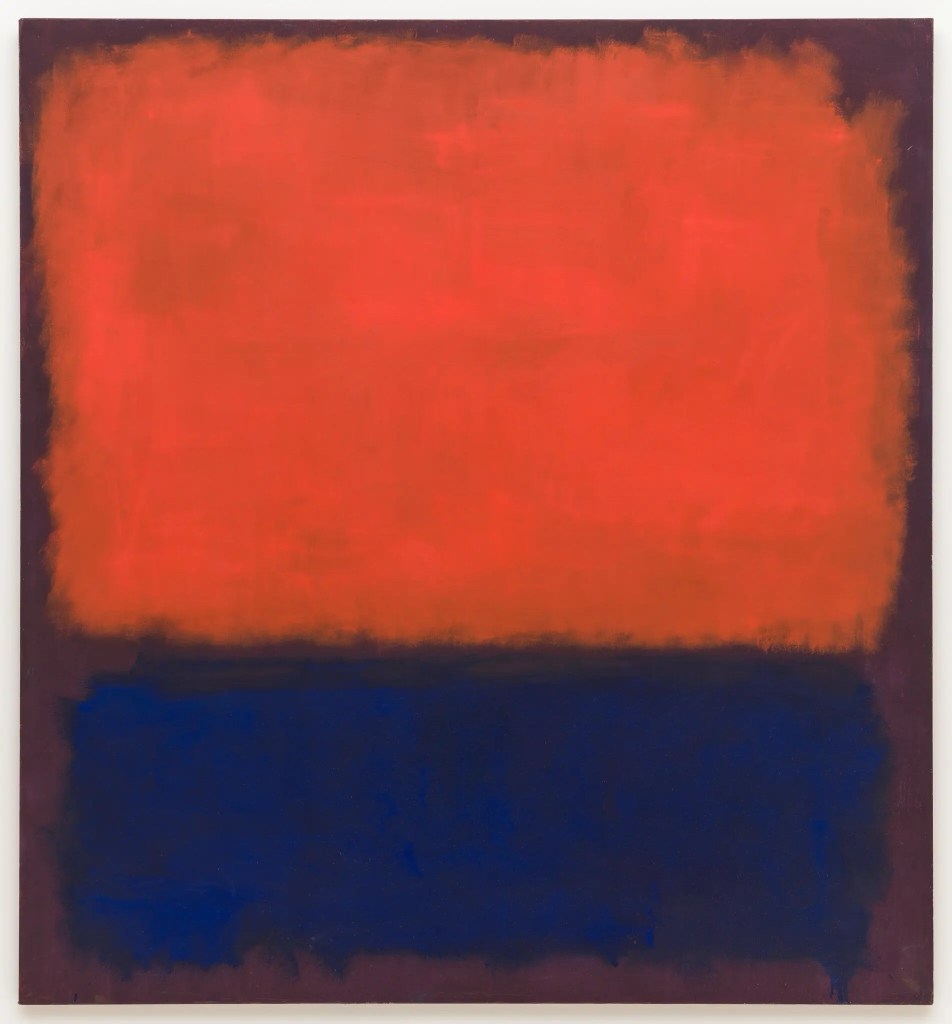
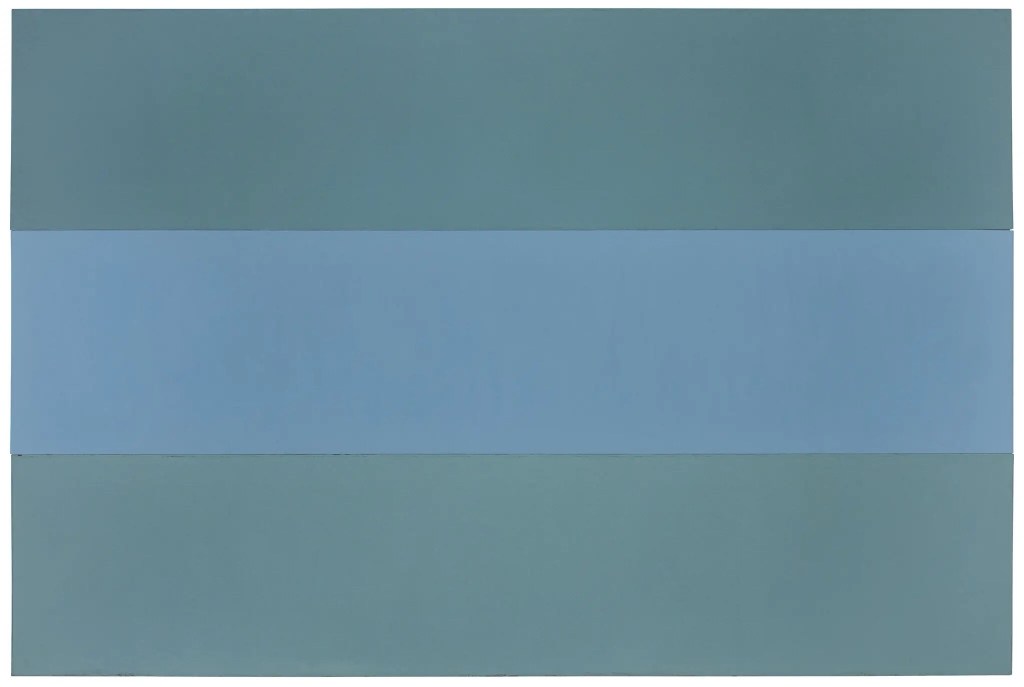
Mark Rothko’s “No. 14” (1960) at the Fondation Louis Vuitton in Paris. Credit… Kate Rothko Prizel and Christopher Rothko/Artists Rights Society (ARS), New York. [New York Times caption and illustration]

[Rothko] modeled a commitment to abstraction that charged at the hardest questions of life and art through refusal of the easy path… [He] never thought of [his paintings] as peaceable. “Behind the color lies the cataclysm,” he said in 1959 — a citation that rarely makes the auction preview catalogs.

(Jason Farago)

Abstract painting seems an excellent subject on which to apply Susan Sontag’s stricture against looking for hidden meanings in works of art and literature (Against Interpretation). Jason Farago reported late last year on a Mark Rothko retrospective at the Fondation Louis Vuitton in Paris. Farago is far from belittling Rothko’s oeuvre, but he does treat it at arm’s length.

For all that, may I grumble for a moment? I can coolly appreciate the artist’s modulations of color; I’m not a philistine. I have a sly admiration for how he imparted the highest seriousness to a few blurry stains. But there is a repetitiousness to this much Rothko, and a fair bit of pomposity to its metaphysical claims.

Installation view of the Mark Rothko exhibition at the Fondation Louis Vuitton. From left, “No. 13 (White, Red on Yellow),” 1958; “No. 9 / No. 5 / No. 18,” 1952; “Green on Blue (Earth-Green and White),” 1956; “Untitled,” 1955. Credit… Kate Rothko Prizel and Christopher Rothko/Artists Rights Society (ARS), New York. [New York Times caption and illustration]

“I’m only interested in expressing basic human emotions — tragedy, ecstasy, doom, and so on,” Rothko said in 1957, denying any interest in the mechanics of abstraction or color. It was another aggrandizement, but maybe I should stop being such a hardhearted formalist and take him at his word.

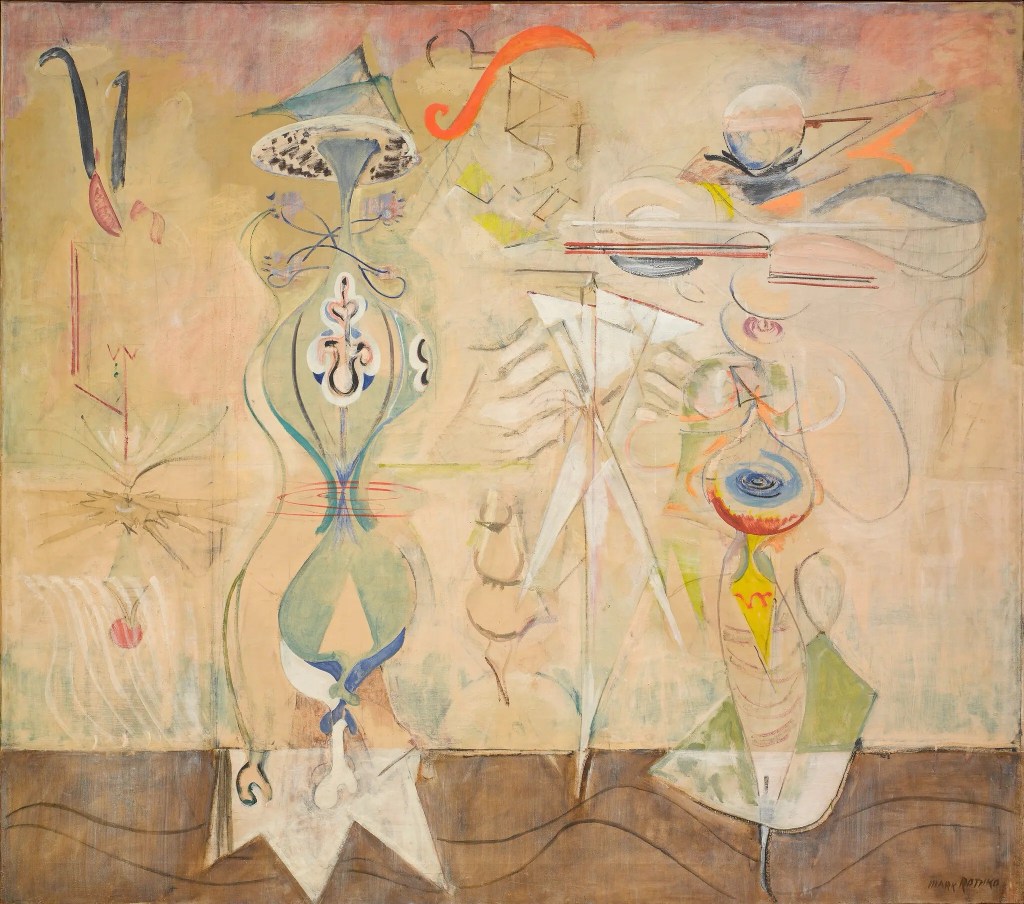
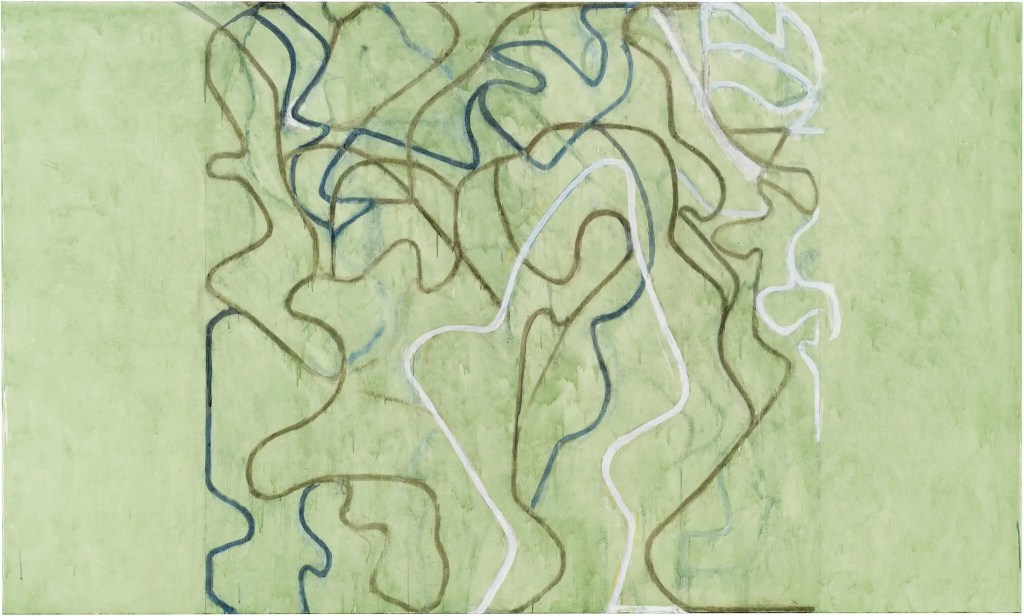
“Slow Swirl at the Edge of the Sea,” a Rothko painting from 1944. Credit… Kate Rothko Prizel and Christopher Rothko/Artists Rights Society (ARS), New York; via Museum of Modern Art, New York. [New York Times caption and illustration]

Awe, love, fear, faith, emptiness, immanence, infinity, eternity: Are these not the whole reason we bother with form in the first place? On most days I find it faintly ridiculous to try to locate such grand themes in a spume of green or a blood-red fog. On other days, days like now, I find it ridiculous to get through life without them.

(Jason Farago, “Mark Rothko at Full Scale, and in Half Light,” New York Times, 10-25-23)

(c) 2024 JMN — EthicalDative. All rights reserved

Posted in Commentary, Quotations | Tagged , , | 5 Comments

Gospel of the Undies

“Lord, help us to realize that our nation is at a tipping point, that people on the left literally hate you. They hate your word. They, many times, hate our country.”
(From opening “prayer” at a primary rally)

Phrases registered from Sunday sermons by a woolgathering kid float in recollection like exotic birdcalls:

We’re a stained species born of stain and prone to staining. Brethren, therefore I say unto you, verily whosoever… something, something… drink this blood… suffer the little children to come… slaughter a heifer… cast the first stone… we launder our shorts in the same gray waters…

Sunday school lessons stayed in church but civics class followed me home. Good citizenship had legs. I wanted to be a diplomat for the USA who could speak foreign languages! Corny but still compelling. The ideal of civic engagement sounds goody two-shoes at the moment. Civic heresy is moving its slow thighs. Its aeneators blow the call from their bucinas: Hate! Thricely blared in three short sentences — a trinity.

I’m tempted to repulse the man’s septic oration with contrary words, but proffering him democratic brotherly love seems the better course.

(c) 2024 JMN — EthicalDative. All rights reserved
Posted in Commentary, Quotations | Tagged , , | 5 Comments

The High Window Reviews: Jonathan Timbers on Andrew Wynn Owen

***** Adopting the dialogic form between conflicting parts of the self that Anthony Burgess experimented with in his fantasia, Mozart and the …

The High Window Reviews: Jonathan Timbers on Andrew Wynn Owen

This review by Jonathan Timbers sets off many alarms in my head concerning abuses I commit in my own little productions: a tendency to overwrite and to mistake cleverness for profundity.

Posted in Commentary | Leave a comment

Brice Marden Believed Looking at Paintings Could Be Transporting

Again and again, he showed that art from any time or culture was contemporary and alive, if it offered artists something they could use.

(Roberta Smith)

Brice Marden died in August 2023, aged 84. The illustration that concludes Roberta Smith’s tribute, a painting she describes as “bookending Marden’s 50-year career,” made me think of Mark Twain’s phrase about Wagner’s music (“better than it sounds”). Was Marsden’s work better than it looked?

[…] “Moss Sutra With the Seasons,” 2010 –15 […] Credit… 2023 Brice Marden/Artists Rights Society (ARS), New York., via Glenstone Museum. [New York Times caption and illustration]

I view abstract painting readily, however, and by then I had seen samples of the earlier work, which follow below.

In the mid 1960s, at the height of the painting-is-dead delusion, Brice Marden […] was making reductive monochrome works — horizontal and vertical canvases in a range of subdued tones of oil paint thickened with melted beeswax. […] He talked, like a traditional painter, of the importance of light and nature and reverentially considered the rectangle one of the great human inventions.

“Grove Group V” (1973-76) one of the first paintings in which Marden combined more than two horizontal panels. […] Credit… 2023 Brice Marden/Artists Rights Society (ARS), New York. via Brice Marden and Gagosian. [New York Times caption and illustration]

Smith’s descriptions of Marden’s process are bracingly low key. For example, Marden “[built] on his monochromes at first by adding panels and then by making marks.” In a zone of practice whose essence is making marks, whatever “inspired” a painting seems of little moment. That feels right.

“Thira” (1979–80), one of Marden’s last oil-and-wax panel paintings, uses 18 of them assembled in three parts. […] Credit… 2023 Brice Marden/Artists Rights Society (ARS),New York.via Brice Marden and Gagosian. [New York Times caption and illustration]

Marden sketched in a small early notebook which he gave the lugubrious title “Suicide Notes.” Smith clarifies that “he saw his small scratchy ink drawings and their tentative attempts at mark-making as ‘left behind’ (as with a suicide note) — he could not develop them at the time.”

A small ink drawing from Marden’s “Suicide Notes,” (1972), shows an image that resembles both a window and a painted canvas. Credit… Brice Marden/Artists Rights Society (ARS), New York via Gagosian.

Other inspirations reflecting travels would include Greek sculpture and architecture; Indian sculpture and Japanese and Chinese calligraphy; and also Chinese landscape painting and scholar’s rocks.

“Elevation,” 2018–19, a painting in which calligraphic lines of color flatten the surface and define a central roadmap-like area. Credit… 2023 Brice Marden/Artists Rights Society (ARS), New York., via Gagosian. [New York Times caption and illustration]

Wikipedia tells me scholar’s rocks are rocks traditionally appreciated by Chinese scholars. Sometimes language and truth are congruent!

Smith poses Brice Marden’s legacy as a refusal “to accept the narrowness of modernism.” That’s over my head in terms of what I know about art. But she characterizes the refusal as “quietly intractable, constantly moving, looking and learning” — words I do understand.

(c) 2024 JMN — EthicalDative. All rights reserved
Posted in Commentary, Quotations | Tagged , , | 5 Comments

Notes on Process

Detail from one of my crappier paintings, oil on canvas, 30 x 30 in. (JMN 2020). It meant to be a goodnatured satire of a young woman’s delight in her semiautomatic, sprung from an anecdote told me by a woman from Houston who discharged an AR-15 on a tree. It toppled the tree! she said. Her face resembled the one I tried to paint. My painting never gelled. It’s just clumsy and garish.

When I indite a scrap of doggerel
I launch five iambs on a fancy verb.

So. Post launch, it’s a fight to go all pinche. Listen to the warm; daub raunch on the prissy; cut the crap into the shape of a shrug. It’s not jujitsu: if you can aggravate, allude, avoid adverbs, you can doggerel. Tone is paramount. Suffer for it. Verbiage is the rim of a stemmed glass. Fingering that edge will incite a harmonic. Blow on it. Tweeze gormless, lean hard on beat. Jive maybe, but be ready to eat it. Strew literary scat thin; stink, don’t reek. Speechy but tight; nasty nice — remember your target bleeds into the demographic you’re bombing.

Super-important: Fuck with the predictive abba-dabba of your machine (you know whoops I monkey — the suggestion mammal): kick the algae rooter in the proverbials. You’re in a world of herpes if it sees you combing.

On form factor, care less: break your lines hard, go light on punctuation. Lowercase, uppercase, who cares, i don’t. Sow doubt, sew sinew, so shall you rip. Semblance over substance except after essence spells cred. This above all: know nothing you invent will be original. Just go there.

(c) 2024 JMN — EthicalDative. All rights reserved

Posted in Anthology | Tagged , , | 2 Comments

Old Plantocracy and Retrofuturism

In this telling, art is a global and porous affair. And far-flung provinces serve as entrepôts to and from the vanguard — not just detours to be “represented” like Nashville hot chicken in the flavor portfolio of Pringles.

(Walker Mimms)

I clipped this article on November 30, 2023, and only now have absorbed it thoroughly. It’s more engrossing even than I had anticipated, which has me echoing its illustrations with greater abandon than usual. The article is by Walker Mimms, ‘Southern/Modern’: Rediscovering the Radical Art Below the Mason-Dixon Line,” New York Times, 11-30-23. Here are the particulars about the exhibition it references:

Southern/Modern
Through Dec. 10 [2023], Georgia Museum of Art, 90 Carlton Street, Athens, Ga., (706) 542-4662; georgiamuseum.org. The show will travel to the Frist Art Museum (Jan. 26, 2024, through April 28), 919 Broadway, Nashville, Tenn., (615) 244-3340; fristartmuseum.org.

***

On John Kelly Fitzpatrick’s “Negro Baptising”:

The lobes of cyan and mud-green… jelly into a sunny riverbend. Two parishioners are about to be dunked […] A tall bridge traces the inner margins of the canvas […] It’s a framing device George Bellows and other urbans employed to remind us where we, the viewers, stand — that is, outside the action.

[…] John Kelly Fitzpatrick’s “Negro Baptising,” 1930 […] Credit… Montgomery Museum of Fine Arts. [New York Times caption and illustration]

On Hale Woodruff’s “Southland”:

[…] Woodruff renders the actual painted earth in tones of salmon and sherbet — singing, iridescent hues that negate all the death. It’s a Rorschach test: do you see a wasteland, or a vibrant painterly possibility?

Hale Woodruff, “Southland,” 1936 […] Credit.. Estate of Hale Woodruff/Licensed by VAGA at Artists Rights Society (ARS), NY; via Amistad Research Center, New Orleans, LA. [New York Times caption and illustration]

On the “watercolor satire” of Homer Ellertson:

In his suavely executed [painting] a Goodyear service station has set up shop in the front yard of a plantation home. The sepia tone of this work feels retrofuturist, as if we’re glimpsing some coming destiny from an even later date.

Homer Ellertson’s watercolor satire, “The Dean House, Spartanburg, S.C.,” circa 1932 […] Credit… The Johnson Collection, Spartanburg, S.C. [New York Times caption and illustration]

On James A. Porter’s “When the Klan Passes By”:

[Porter] uses dark but thin brushloads to convey, through the averted eyes of the Black family in the foreground, the private consequences of race terrorism.

James A. Porter, “When the Klan Passes By,” circa 1939. From Southern/Modern […] Credit… via Michael Rosenfeld Gallery, New York. [New York Times caption and illustration]

On Elaine de Kooning’s “Black Mountain #6”:

To the Big Apple, graduates of Black Mountain College, in North Carolina, returned like winged pollinators to a hive. (Representing the Black Mountain contingent here is an early jigsaw-paned composition by one graduate, Elaine de Kooning. […])

Elaine de Kooning, “Black Mountain #6,” 1948, enamel on paper […] Credit… The Heckscher Museum of Art, Huntington, N.Y. [New York Times caption and illustration]

Here’s Mimms’s memorable summation:

More than Agrarian conservatism, […] the painters in this show echo what the historian C. Vann Woodward later called the “irony of Southern history”: the fact that, as America dominated the global stage from the Monroe Doctrine [1823] to World War II, the southeastern quadrant of the country persisted in a long line of self-destructive, embarrassing regressions, from a feudal regime to a secession attempt to an apartheid state.

(c) 2024 JMN — EthicalDative. All rights reserved
Posted in Quotations | Tagged , , | 4 Comments

‘Blaise Cendrars (1887-1961): Poetry Is Everything’

A section of “The Prose of the Trans-Siberian,” which Cendrars and Delaunay called “the first simultaneous book.” Credit… Blaise Cendrars/Succession Cendrars/Pracusa 20230412; via The Morgan Library & Museum. [New York Times caption]

This piece clipped back in August 2023 reminded me of my youthful infatuation with the School of Paris, which included the Delaunays, Sonia and Robert, as well as Fernand Léger. The article’s appeal lies as well in the matchup of poetry and painting that it treats of. My title is the title of the show held at the Morgan Library & Museum. Jason Farago describes it as “a concentrated pop of free-spirited trans-Atlantic modernity, alive with rich color and typographical pyrotechnics.”

A spread from Blaise Cendrars’s 1918 book, “J’ai tué” (“I Have Killed”), with illustrations by Fernand Léger. Credit… Blaise Cendrars/Succession Cendrars/Artists Rights Society (ARS), New York/ADAGP, Paris; via The Morgan Library & Museum. [New York Times caption]

I did not know that Blaise Cendrars was Swiss, not French, nor that he was born Frédéric-Louis Sauser. He lost his right arm in the Second Battle of Champagne in 1915. Convalescing, he taught himself to write with his left hand and proceeded to engage in other landmark collaborations with 20th-century artists. It hits home when Farago says Cendrars was a writer “who saw his time disrupted and disrupted his style in turn, and who models today how to live up to upheaval [my bolding].”

(Jason Farago, “Blaise Cendrars at the Morgan: A Modern Match of Poetry and Painting,” New York Times, 8-3-23)

(c) 2024 JMN — EthicalDative. All rights reserved

Posted in Commentary | Tagged , | 4 Comments

Just Say Right, It’s Only Weather

As long as the nation’s fleet of private jets can take to the skies there’s no call to whine about so-called climate (the Dems’ name for weather). There’s a right way to think about it, just do a thought experiment. Imagine the Rio Grande frozen by some flukish Arctic blip. Poison blood can just walk across the ice straight into Texas — steal your Evinrude, peep at your wife, whatever. Crazy, right?

First of all, flukes happen. Welcome to life as we know it. Old Mother Nature can be uppity — she’s a woman! But there’s a come-to-daddy moment when the chips are down, and that’s when the private jets go airborne, from Boca Chica to Belarus, from Dallas to Davos. They carry the right fellas doing the right thing in the right places for the right people to make the weather great again.

As long as gushers outnumber dusters, wealth is protected, the lobby’s good-’n-greased, the dark money flows, and there’s a firm hand on the till, the world can count on right guidance in all weathers. You can take that to wherever you hide your stash, pardner.

(c) 2024 JMN — EthicalDative. All rights reserved
Posted in Anthology, Commentary | Tagged | 1 Comment

Epistemic Hubris: Unwarranted Certainty (About Complex Issues)

Holly Warburton [New York Times illustration and credit for Maggie Jackson’s article “How to Thrive in an Uncertain World, 1-13-24].

Greek words are a nerd’s downfall. I’m a nerd, therefore felled by epistemic hubris. Whenever I encounter “epistemic,” as in Maggie Jackson’s essay, I have to mentally re-solder its connection to epistemology, which I barely retain has to do with what we can know.

Jackson’s paraphrase for epistemic hubris is “unwarranted certainty about complex policy issues.” She cites gun control as one such issue. That issue is common as dirt, which triggers three questions:

(1) Doesn’t every issue involve “policy” of some kind, private or public? (A policy of mine is to stifle a belch after sipping a fizzy beverage.)
(2) What’s an even thornier complex issue than gun control?
(3) What’s one non-complex issue about which certainty is warranted?

As I drove her home to Pecos from Odessa in the late ‘90s, my elderly aunt said to me, “I believe with all my heart that when the end times come every person who ever lived will be resurrected to judgment.” She was devout Church of Christ. I’m lapsed Disciple of Christ. Christ figured divergently in our lives, hers and mine.

Earlier that day my aunt and I had stood holding hands and weeping while her brother, my uncle, breathed his last in the hospital. Her affirmation came from out of the blue as the sere West Texas plains slipped past our silent selves on the empty highway. I nodded with a dutiful nephew’s noncommittal respectfulness.

The answers are: (1) Yes. (2) Life after death. (3) There is none.

(c) 2024 JMN — EthicalDative. All rights reserved

Posted in Anthology, Commentary | Tagged , , | 8 Comments

Robert Andrew Parker (1927-2023): ‘Susceptibility to Happiness’

The artist and illustrator Robert Andrew Parker in 2017. He worked into his 90s even though his vision was diminished by macular degeneration. Credit… Leo Sorel. [New York Times caption]

What’s not to like about an artist-illustrator who partnered with poets and loved jazz? Parker played drums in a band called Jive by Five and is survived by five sons, all of whom play drums professionally. (One is an artist.)

“Robert Parker is one of the most accurate and at the same time most unliteral of painters,” [Marianne Moore] wrote in Arts magazine [1958]. “He combines the mystical and the actual, working both in an abstract and realistic way.” In praising a Parker watercolor of a dog, she added, “A cursive ease in the lines suggests a Rembrandt-like relish for the implement in hand; better yet, there is a look of emotion synonymous with susceptibility to happiness.”

Mr. Parker wrote and illustrated the 2008 children’s book “Piano Starts Here: The Young Art Tatum.” Credit… via Rachel Walls Fine Art. [New York Times caption]

(Richard Sandomir, “Robert Andrew Parker, 96, Dies; Prolific Magazine and Book Illustrator,” New York Times, 1-12-24)

(c) 2023 JMN — EthicalDative. All rights reserved

Posted in Commentary, Quotations | Tagged , , , | 3 Comments