When I write, I say words in my mind. I’m pretty sure I can type words as fast as I can think them. Sometimes it seems I’ve typed them even faster than that!
I wash and slice an organic Ambrosia apple for breakfast. It’s pretty, though it won’t be tree-sweet. I notice how it has so much yellow mixed with the red. I think, I ought to paint one of these.
On the speakers, improbable flurries of notes issue from Dexter Gordon’s horn. How do jazz artists do that — paint the air with neon sound?
Wait, he’s blowing statements out his instrument the way I blow them out my keyboard! The dexterity’s so internalized, no conscious effort intervenes.
Sweet. We have stuff in common, Dexter and me. He was a saxophonist. I’m a typist.
“Jagtime Rag,” oil and acrylic on cardboard, 7 x 9 in. (JMN 2024).
Like the King James Bible for Judaism and Christianity, the Holy Quran is for Islam a monument to luminous language in a spiritual setting. As a student of Arabic I study Quranic texts to strengthen my grasp of the language and gain inklings as to its culture. The venture has sparked a desire on my part to sample the scriptures of other faiths, such as the Book of Mormon, as well as writings that are foundational for Hindus, Buddhists, Native Americans, and communities of belief I may not even be aware of.
The above prefaces my registering here an associative episode in my reading and contemplative life of the sort this blog is more or less built for. It’s unruly enough that I feel pressed to assert it’s devoid of irony. In a nutshell, the psychic blip I’m exercised by is this: Verse 3:78 of the Quran made me think of JD Vance.
Here’s my own English for the verse, as literal as I can make it: “And truly among them there is a group who contort their tongues with the Book so that you think it to be from the Book, and it is not from the Book, and they say it is from God, and it is not from God, and they speak the lie about God, and they know it.” (My emphasis. See note below.)
JD Vance said the following on September 15, 2024: “If I have to create stories so that the American media actually pays attention to the suffering of the American people, then that’s what I’m going to do…”
There’s nothing objective about juxtaposing these two utterances as if one illuminated the other. What it does is document an intempestif belch from the parlous mass of associative gases which rotates in my particular cognitive firmament. Vance’s admission that he will make things up to get attention from the media is unsurprising on top of appalling. It’s an end stage in the metastisizing cancer that started with Trump’s “fake news,” advanced through Kellyanne Conway’s “alternative facts,” and now reaches toxic bloom in Vance’s “created stories.” They speak the lie… and they know it. Vance’s malignant fictions predict organ failure for the body politic in the mold of Viktor Orbán’s Hungary.
Note I don’t pretend remotely to capture in my paraphrase the essential meaning of the verse from a theological, devotional or historical standpoint. I stick close to the words themselves, with respect and deference, to the end that I be able to parse their grammatical relationships and ascertain what they state in elemental fashion, and thus be informed and gain insight overall into the linguistic structures of this glorious corpus of expression which underpins the modern literary language to this very day. As a scholarly sidekick for my Quran reading I keep at hand the published Spanish translation of my mentor Julio Cortés: El Corán, Editora Nacional, Madrid, 1979. It figures among the translations into many languages listed at www.quran.com, and is useful for its notes as well as for its rendering of the text. Here is Cortés’s reading of verse 3:78: Algunos de ellos* trabucan* con sus lenguas la recitación de la Escritura para que creáis que está en la Escritura lo que no está en la Escritura, diciendo que viene de Dios, siendo así que no viene de Dios. Mienten contra Dios a sabiendas.
Flaming June. Frederic Lord Leighton. 1895. Photograph: SJArt/Alamy. [Guardian caption and illustration]
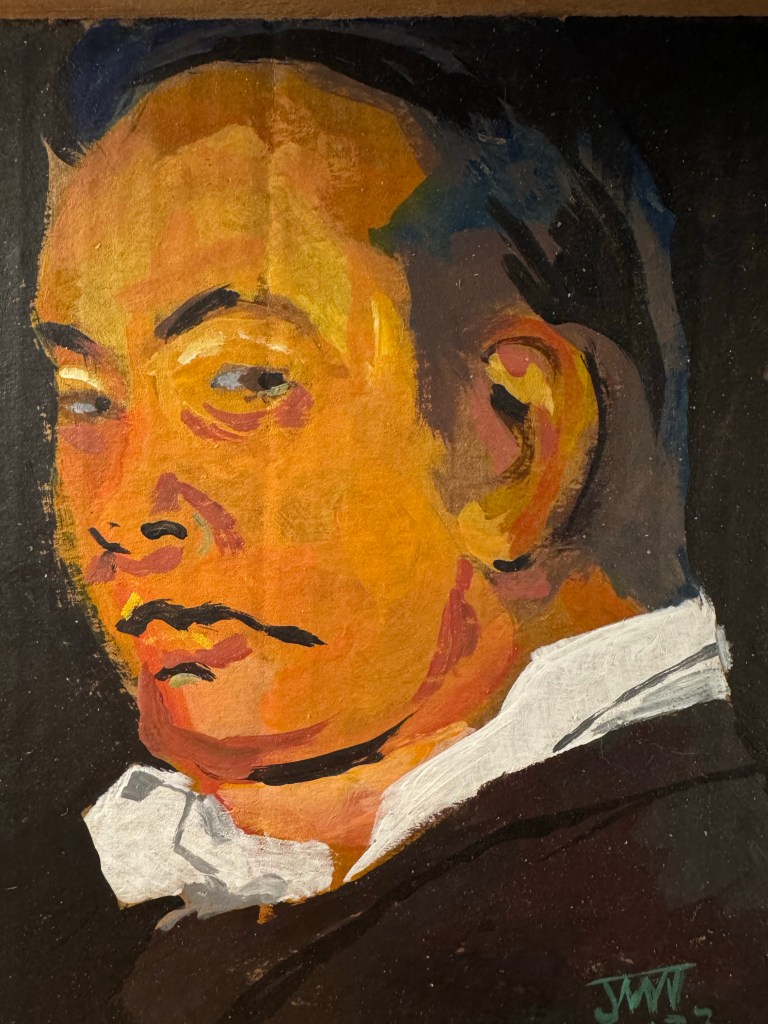
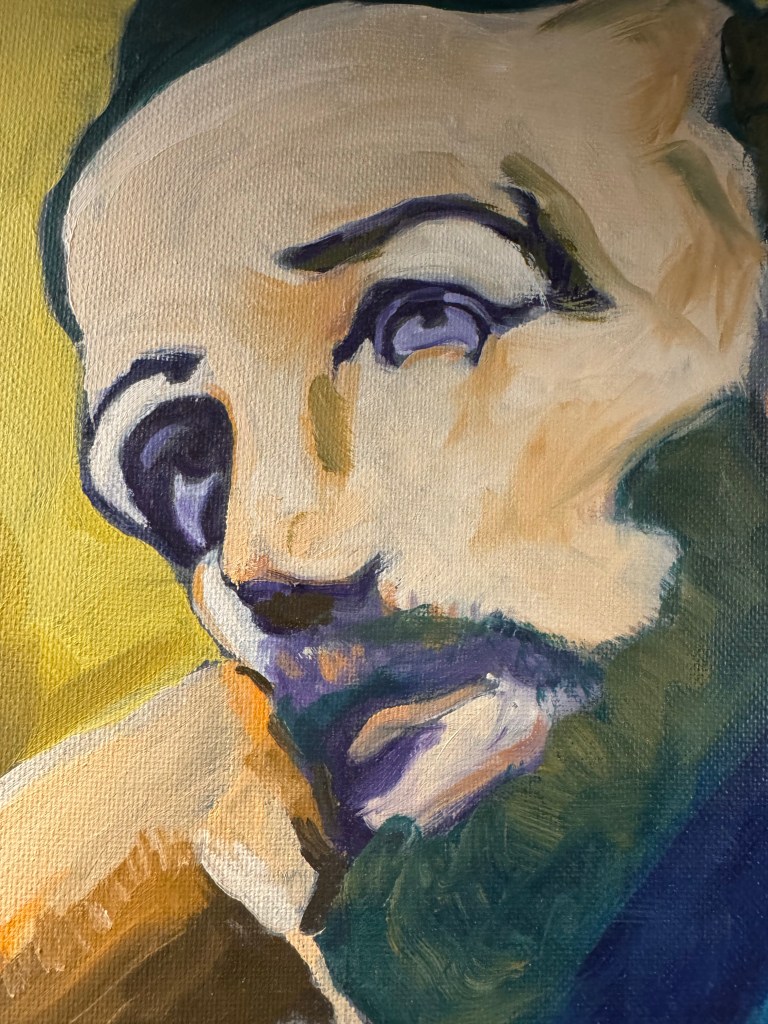
It’s a tricky business this amateurism. Progress consists in putting a non-realistic spin on scenes and objects. Ideally, the subject should be rigorously interrogated, stripped to its essences, warped or scuffed up past anodyne mimesis. Seen, not depicted. Stamped with affect, changed by observation like quarks. Marks are made, goddamn it!
As a viewer of art I’ve admired Chardin, Gauguin, Klee, Kandinsky, Mondrian. Winslow Homer and Maurice Prendergast. The Ash Can painters (Bellows… who are the others?). Jasper Johns. Why does my practice resemble that of a costive fanboy of Frederic Leighton?
Looking back over the fallout of my amateurism, I realize how straitened and dessicated, stodgy and hedging, servile and obdurate, it has been — the dawdling over eyebrows, cheeks and buccal fissures. These aren’t discouraging words to myself, hear me well. They animate me to stumble toward more assertive treatments.
No need to disturb Lord Leighton in his grave. He was of his time and place. (Who isn’t?) I’ve only just met him through an article in The Guardian. Three paintings illustrate the piece.
“Flaming June.” Shown above. This cloying painting induces a visual nausée (only the French word will do). It feels like a contrivance of exotic feathers simulated in meringues and fashioned into a faux corsage for a cake decoration.
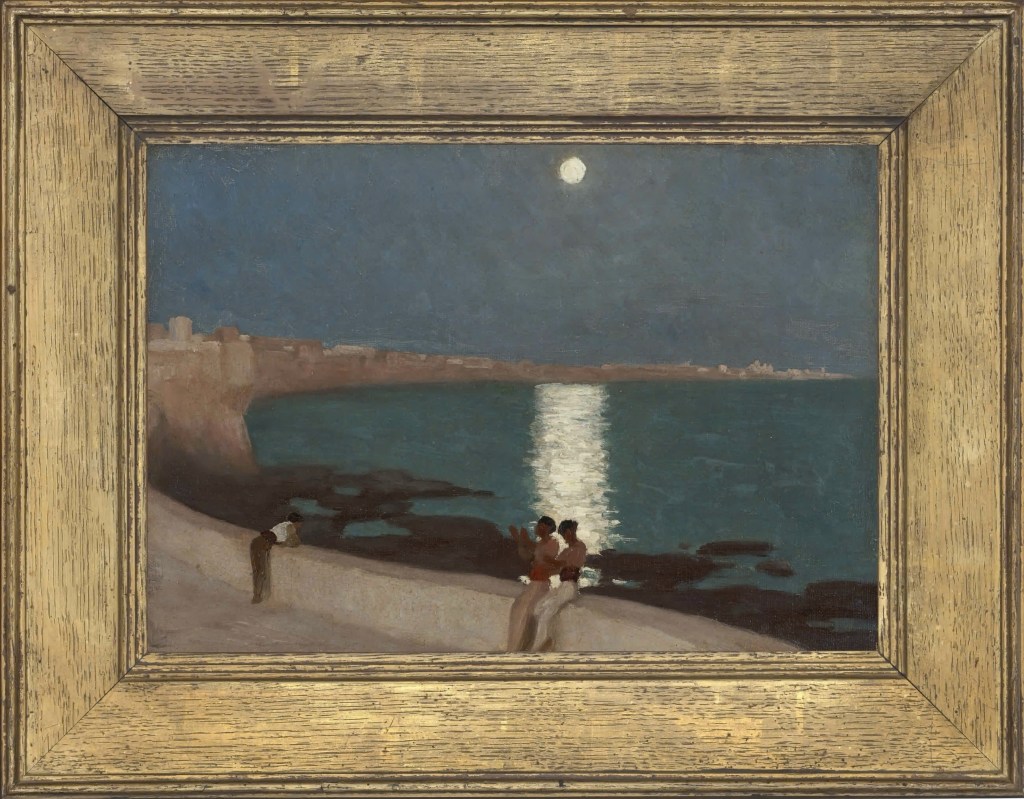
“Bay of Cadiz, Moonlight.” The swoonish title of this attractive flourish, which Leighton is said to have “adored,” gives it away. Moonbeams glistening off the swine lagoon of a Carolina pig farm are just as pretty. But to its credit, the painting isn’t flaming.
Frederic Leighton, Bay of Cadiz, Moonlight, c. 1866, will go on display this November Photograph: Image courtesy of Christie’s. [Guardian caption and illustration]
“Nocturne Blue and Gold Southampton Water.” Whistler’s watery nocturne feels more serious than Leighton’s. It helps that Whistler never painted the likes of “Flaming June.”
James McNeill Whistler. Nocturne Blue and Gold Southampton Water. 1872. Photograph: Alamy. [Guardian caption and illustration]
“Sapphire in a Ruby Setting,” Apple Pencil (JMN 2024).
DJ, my lord! The grail from which you sup runneth over, sir, with fulsomeness. By your leave I’ll tell it like it is: JD, as well, sips from a frothy cup.
DJ, JD, a mirror’s dream times two, chosen well you have, each one the other. Musk and myrrh anoint you, sir and sir — claw with which to rake, and tooth to chew!
In nineteen hundred forty-six, this land birthed a baby swathed in currency. That hero now courts Lady Liberty with touch from his exploratory hand.
Hell yes to thee, my Chief! Our Flag receive thy kiss, virgins reciprocate thy tongue! My MAGAnificent, be thee self-sung by NFT’s surpassing make-believe!
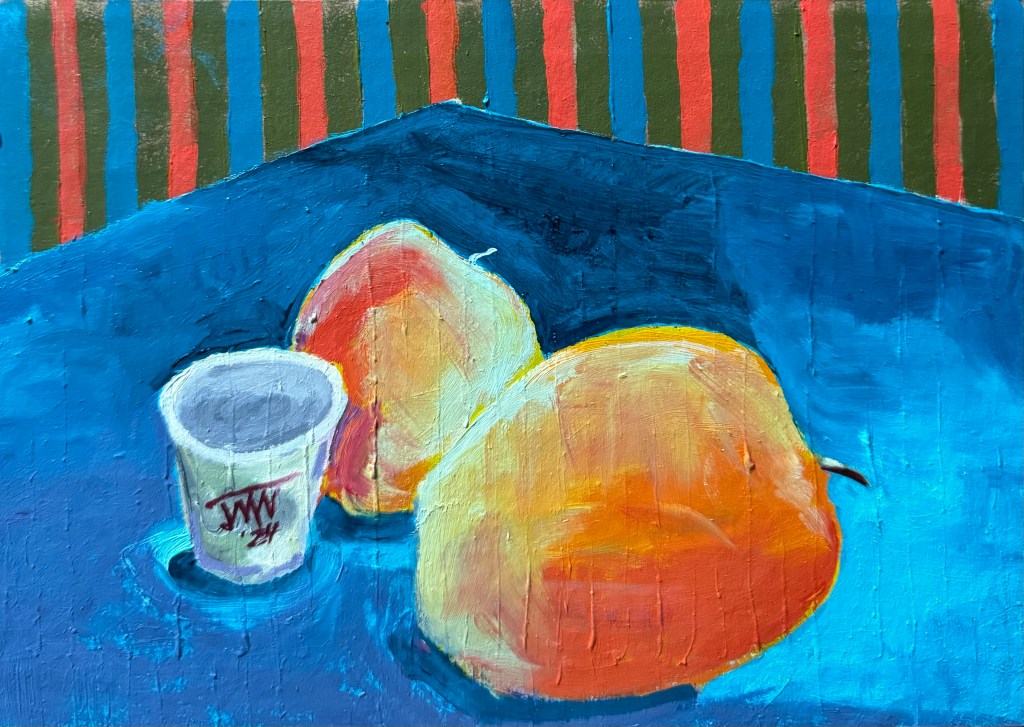
“Fruit,” oil on cardboard, 8-1/2 x 6 in. (JMN 2024).
Christian J. Collier publishes three poems in Poetry, September 2024: “God,” “Case Study” and “The Compline.” Spoken cleanly, rhythmically, hotly, they orbit around experience gleaned from the crucible of propagating life.
Formal religion can be heavy on bone and light on meat. Collier’s poems flesh out the argument with God that makes faith flicker for me as a kind of alive thing in others. The poems emit sparks of light from the human clash with a theology swaddled in hoary patristics, with the unendurable meant to be endured. Paradox’s alter ego is the Great Indefinite, the Hidden-yet-Revealed eidolon which demands abject submission on top of dogged adoration. It has to be unreal and otherworldly to cohere, if at all, in the human psyche.
I’ll write only of Collier’s “God.” It starts here:
I used to think there was only one of You before the miscarriage. Now I am not so sure. Maybe there are a number of Gods to wade through before falling at the feet of the last true one:
In an indented block, the poem cycles through a divine catwalk of temporizing avatars attached to primitivistic epithets and reductive seductions:
the jade God we pray to who does not come or answer & and the plum one who appears to offer salvation; the opal God who offers a limited extent of His kingdom and the olive one who only offers condolences; let us not forget the violet God that is bad with man because He is deeply holy.
The poem alights on the ostensibly desirable God: “We all seek the one of manna though, don’t we?” Three stanzas evoke with ambiguous edginess the God “holding all we hunger for / like butterscotch in His palms.” The speaker, traversing inky moments of mundane days and nights, dreams “with eyes open of goading Him into halting my child’s rest, / guiding his or her tiny light close to the brushfire / flickering in my breath.”
Goading Him! The verb is explosive. Indefinite binary “his or her”; light that’s “tiny”; anomalous “halting” of a child’s “rest”; these are stinging formulations. The rest in question is death. An unrealized life form is being sucked back into the impossibly capacious bosom whence it came, or whatever. Where are “mercy” and “justice” in this sorry transaction? The poem voices a despairing piety that seethes to rescue an imperiously snatched entity from “that God.” Here’s the ending:
That God? That great and swollen orange storm? That’s the God haunting me. The God who keeps His distance. The God whose star-draped hands I envy. They come at day’s end to tuck my baby, my ember, into its infinite, feathered bed.
“My ember” calls back piercingly to the “brushfire flickering in my breath.” I’m rarely reached as acutely as this by poetry in which faith and grief tangle with such expressive fury.
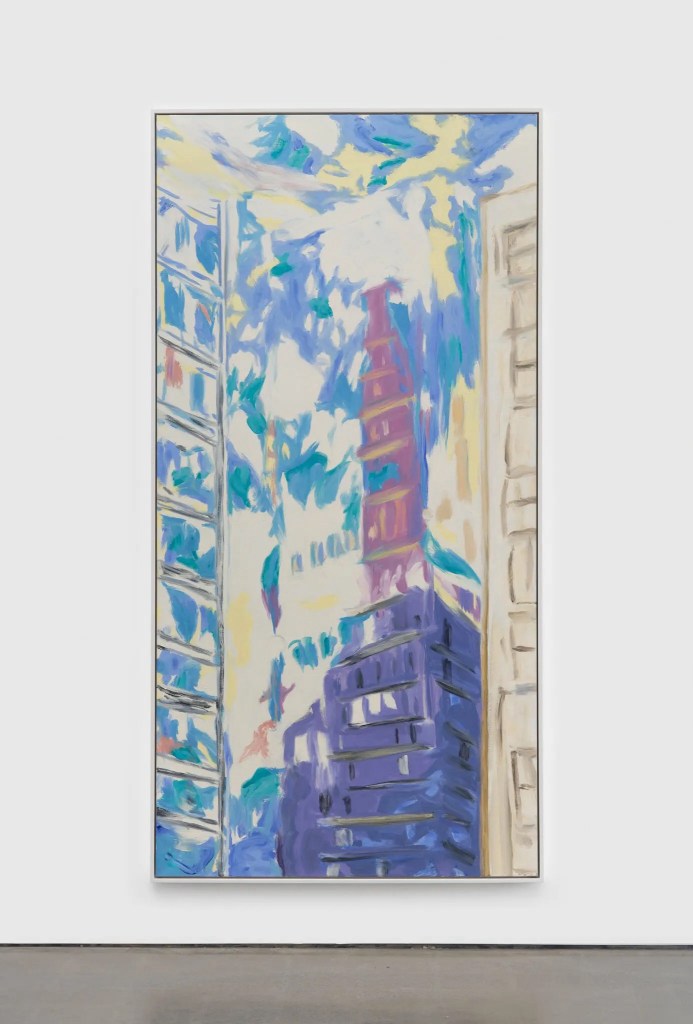
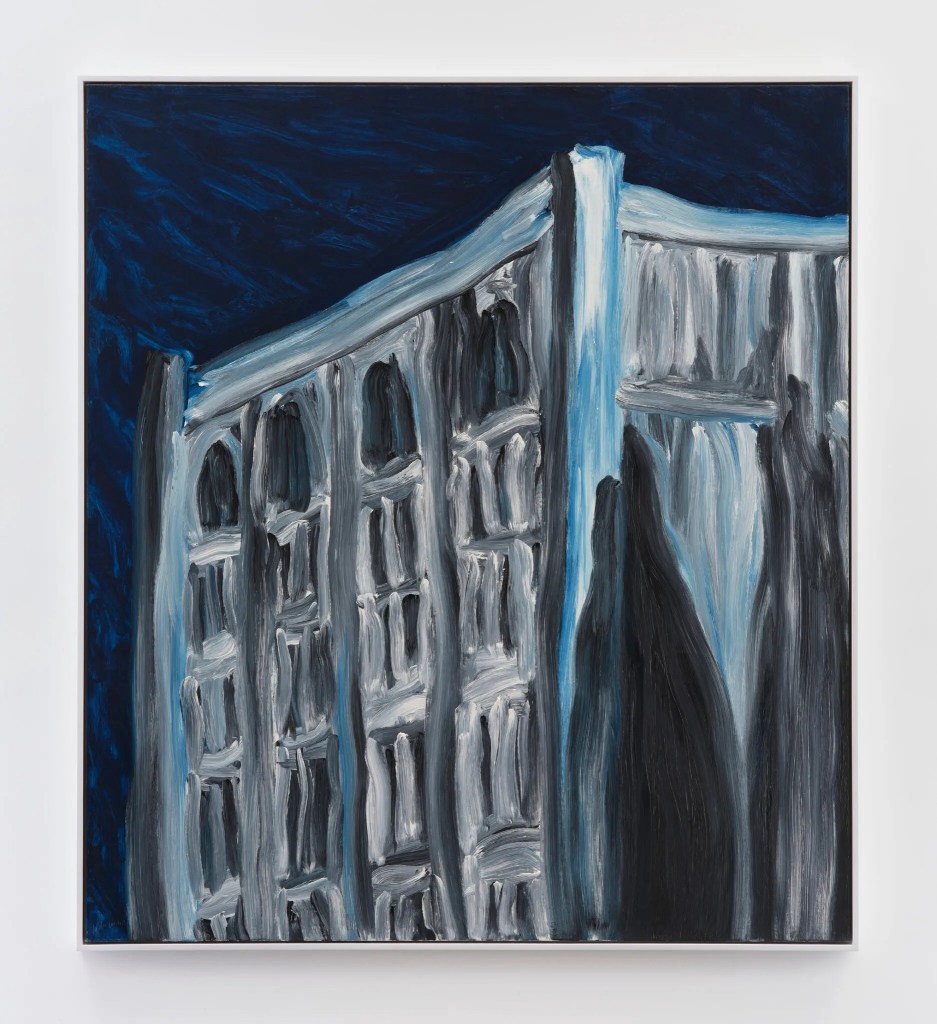
Martha Diamond’s “New York With Purple No. 3” (2000), oil on linen, at the David Kordansky Gallery in Los Angeles[…] Credit… Martha Diamond Trust, via David Kordansky Gallery. [New York Times caption and illustration]
She completed an oil painting in one sitting, often mixing colors on the surface of the canvas.
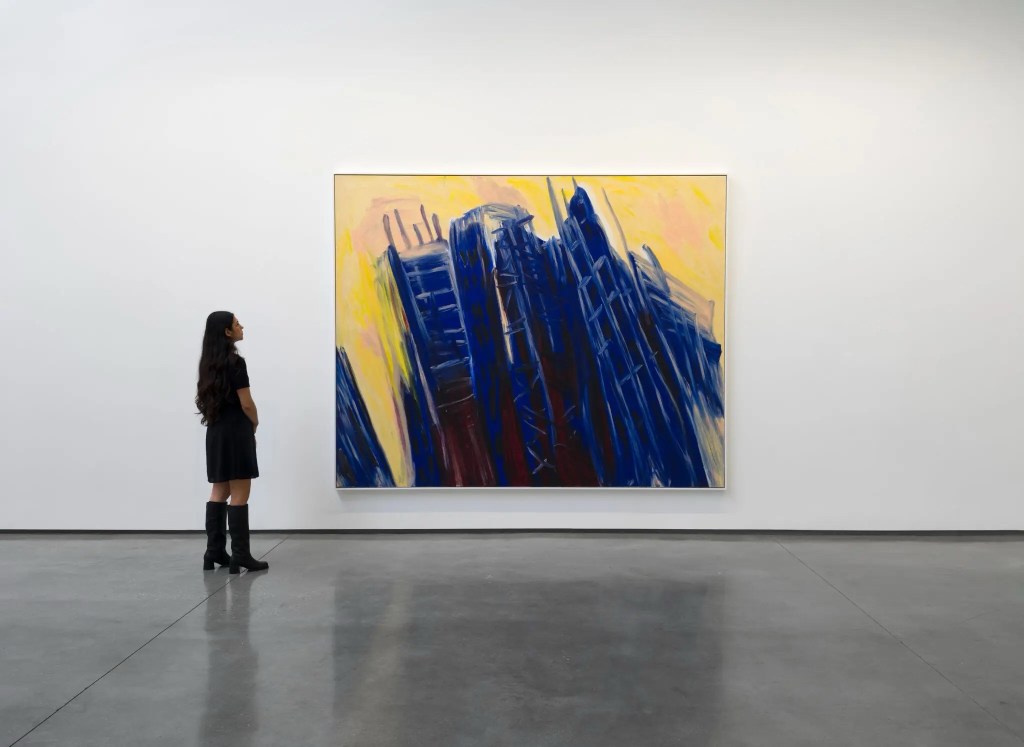
Martha Diamond’s approach to painting, and her execution, delight me. I dream of achieving something even approximating her studied generality in my own practice. Her subject matter was New York City architecture. I relish the critic’s observation that Diamond wasn’t concerned with “assiduous documentation of the built environment,” but rather with conveying how it felt to her.
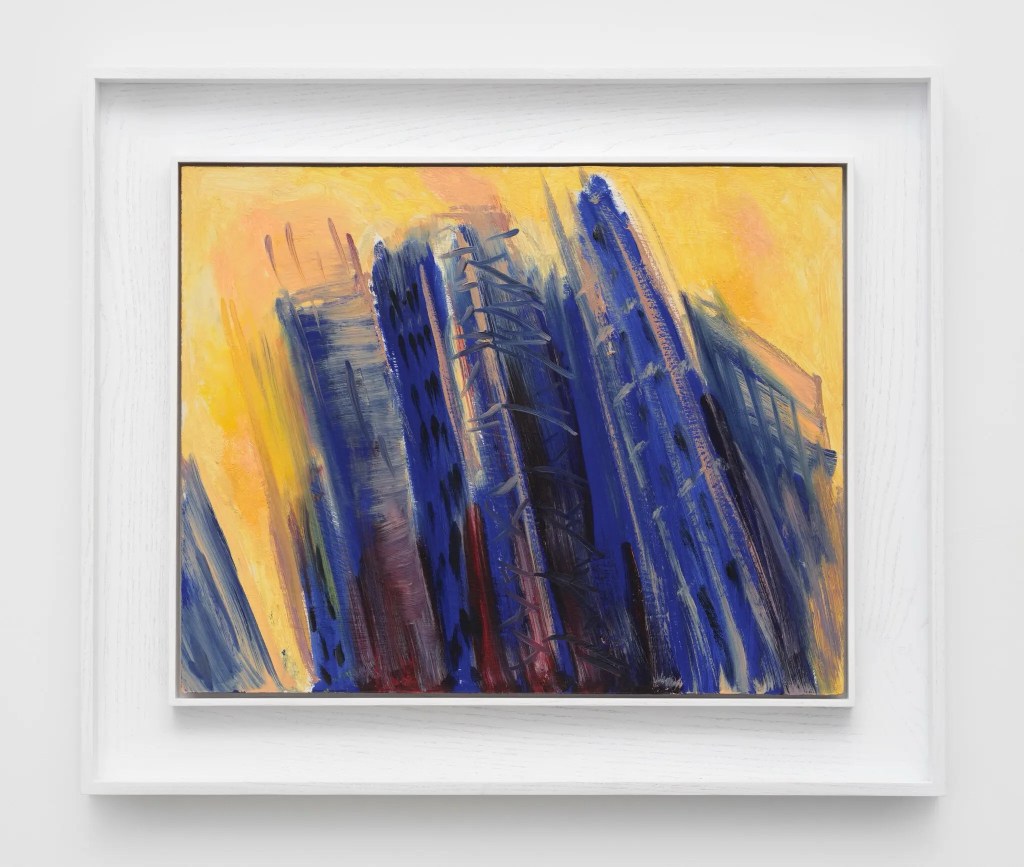
Her small studies — preparatory exercises for the large-scale works that follow — are tightly organized, keyhole views onto the grandeur of the city; most are on Masonite boards around 16 or 20 inches tall.
“Study for Yellow Sky,” 1986. Diamond’s methodical studies were consistent with her much larger pieces. Credit… Martha Diamond Trust, via David Kordansky Gallery. [New York Times caption and illustration]
Here’s the 10-foot-wide painting resulting from “Study for Yellow Sky” (above):
Installation view of “Martha Diamond: Skin of the City.” The painting, with its peachy color, dominates the main gallery. Credit… Jeff McLane, via David Kordansky Gallery. [New York Times caption and illustration]
Underestimating Diamond is a trap for careless viewers. Even when her paintings look casual, or simple, she is solving complex problems. Take the large, squat “Highway,” a seemingly straightforward painting that did not particularly grab me on first appraisal. In time, I understood how Diamond had felt her way around this massive white building, reconstructing it section by section in her wobbly, wide strokes. (She notoriously used only her left hand to paint, because, she once explained, “it’s connected to the part of the brain that sees space, volume, and probably colors better.”) It’s the kind of building one takes for granted; Diamond helps us to see it anew.
“Highway” (1984), oil on linen. […] Credit… Martha Diamond Trust, via David Kordansky Gallery. [New York Times caption and illustration]
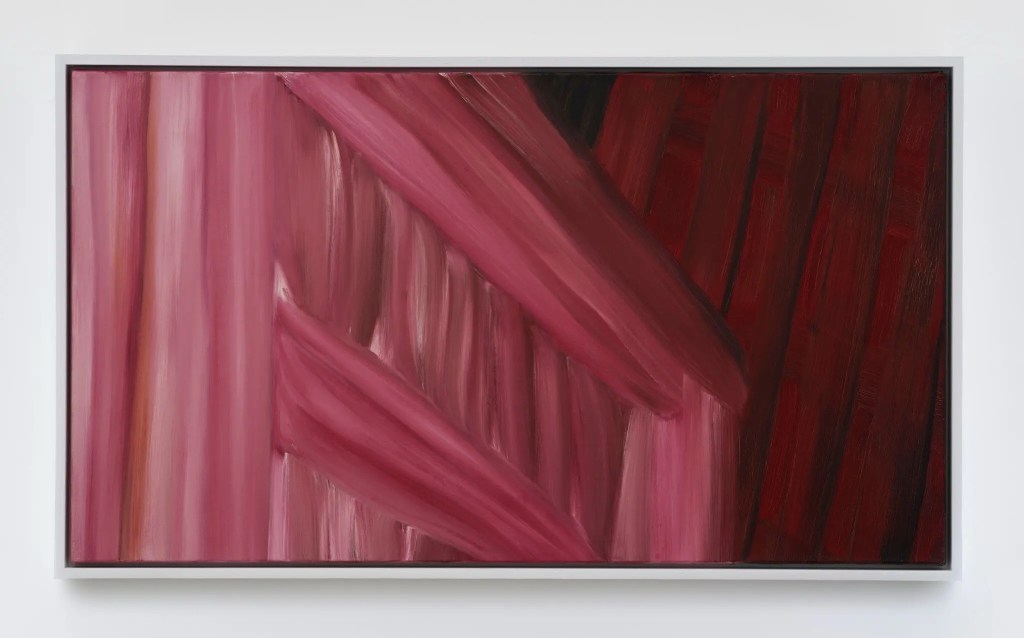
Diamond reportedly made these “detail” paintings to work out how to handle particularly tricky sections of a larger composition…
Martha Diamond, “Pass (Detail),” 1981. Credit… Martha Diamond Trust, via David Kordansky Gallery. [New York Times caption and illustration]
(Jonathan Griffin, “In Martha Diamond’s Art, She Took Manhattan,” New York Times, 4-11-24)
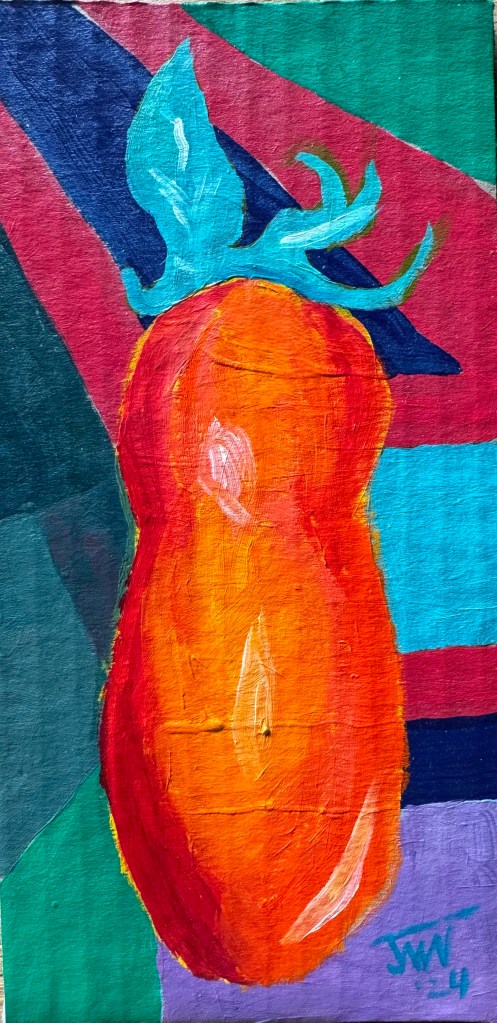
“Semblance of a Pepper,” oil on cardboard, 5 x 7 in. (JMN 2024).
I heard that Iris Murdoch said (or wrote), “Everything that comforts is fake.”
Then I read:
According to the best theories available, matter — everything we can see and feel in the universe — should not exist. Every particle of matter comes into being with a doppelgänger, a particle of antimatter (or “antiparticle”) with equal but opposite properties like charge and spin. Whenever a particle and its antiparticle meet, they annihilate each other. Particles and antiparticles can be made in equal measure, but they eventually find and destroy one another, leaving behind nothing. (Joseph Howlett, “Mining for Neutrinos, and for Cosmic Answers,” New York Times, 9-5-24)
I remembered that Simone Weil said everything we think of as a “human right” (life, liberty, equality, peace, etc.) can be taken away from us. The only inalienable ground we stand upon is awareness of the suffering of others.
Early that same day (Sept. 5, 2024, eighth anniversary of my mother’s death), I saw a cartoon by Gary Lawson. Two portly scientists in white coats, backs to the viewer, stare at a chalkboard filled with equations. In the caption, one of them says, “No doubt about it, Ellington—we’ve mathematically expressed the purpose of the universe. God, how I love the thrill of scientific discovery!” The result of the welter of calculations filling the chalkboard is zero.
Where these several strands lead me is to take issue with Iris Murdoch. Laughter comforts, and is real.
Johnson’s portrait of the cultural theorist Stuart Hall, who died in 2014, sits above her desk. He was an inspiration for and supporter of the Blk Arts Group. Credit… Ekua King.
“I tend to just make a mess.”
(Claudette Johnson)
Artist-blogger OutsideAuthority’s mention of an exhibition of work by Claudette Johnson in Birmingham (England) caused me to discover an article about Johnson’s first solo show in New York last year. These excerpts are from the article.
“When I was younger, I chose pastels as my main medium because they were so quick. I didn’t have to wait for the paint to dry.”
In 2021, Johnson began experimenting with oil paints. She said, “It brings me outside of my comfort zone.” Also, that in her life-size drawings of Black sitters her focus wasn’t on “creating perfect likeness but on capturing a feeling or a presence… Often the heads are cut off, or parts of them are missing, as if you just bumped into the person.”
Johnson often uses bold reds, yellows and blues as a rebellion against the gray and muted palette she loosely associates with the Bloomsbury Group, the influential 19th-century circle of British artists and writers. Credit… Ekua King.
Nowadays, I prepare a primer on the paper or the canvas and then go straight in. I don’t do preparatory sketches. I tend to just make a mess. Sometimes, it’s a lovely, charmed experience and everything’s more or less where it should be and I feel a rhythm and symmetry — and other times, it goes completely awry. [In reading this I realized how hard it is to give in and “just make a mess,” which inhibits (alas) my being a serious painter. It also reminded me of a comment by novelist George Saunders: “The holy estate of a writer is to be a little confused by what you’re doing.” A fetish for control seems to gravitate against the discipline of creativity, which is to be reckless.]
Asked when she knows when a work is done, Johnson said she doesn’t always know. I like her comment that she realizes that “at the point I keep making changes to a work, I need to make a new work.”
Here’s the last question in the interview, and Claudette Johnson’s answer (the link is worth clicking):
What’s your favorite artwork by someone else?
Rembrandt’s “Young Woman Sleeping” (c. 1654). It does everything I want my drawings to do.
(Kadish Morris, “An Artist Returns After a ‘Long Wilderness’,” New York Times, 3-9-23)


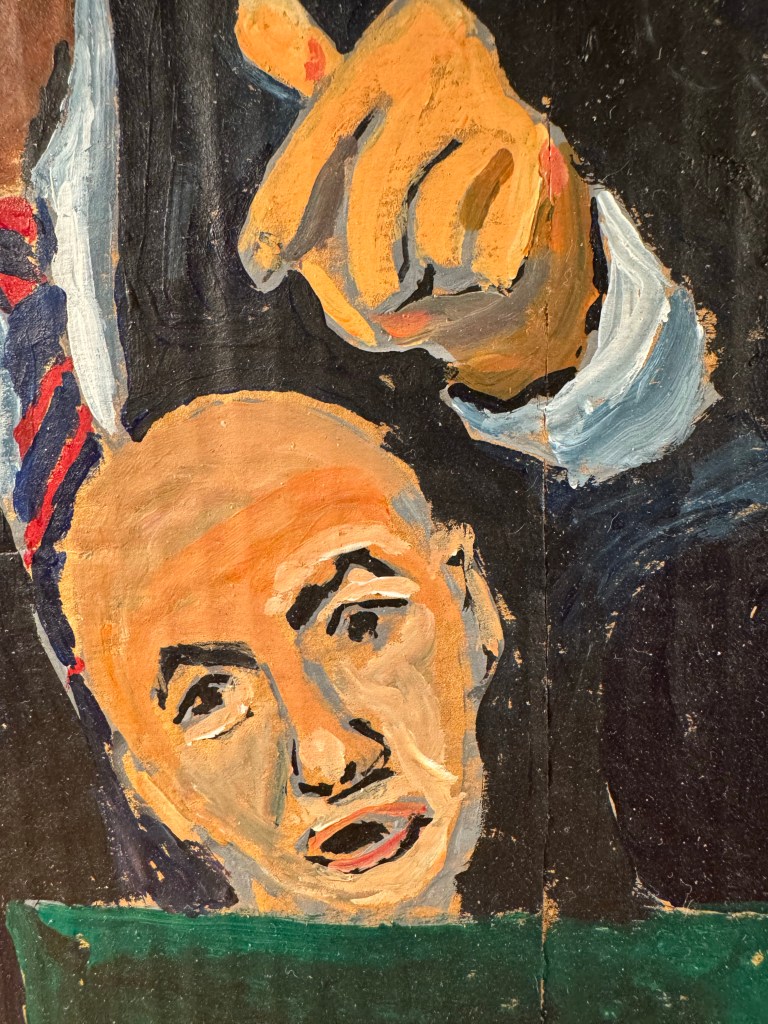

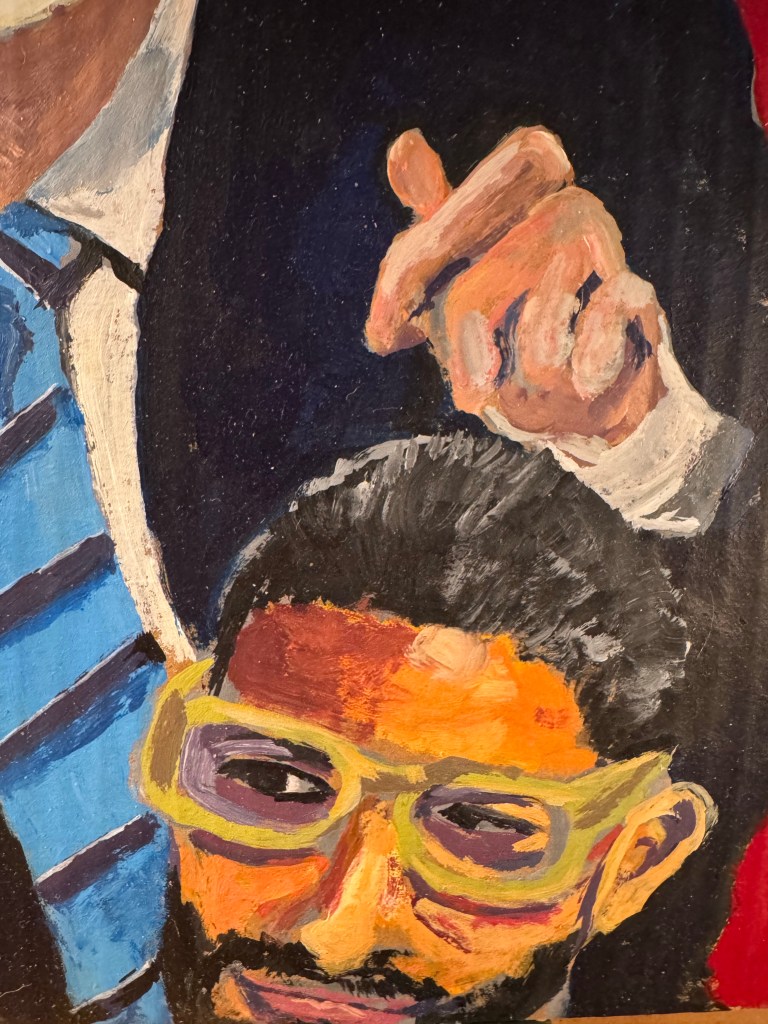
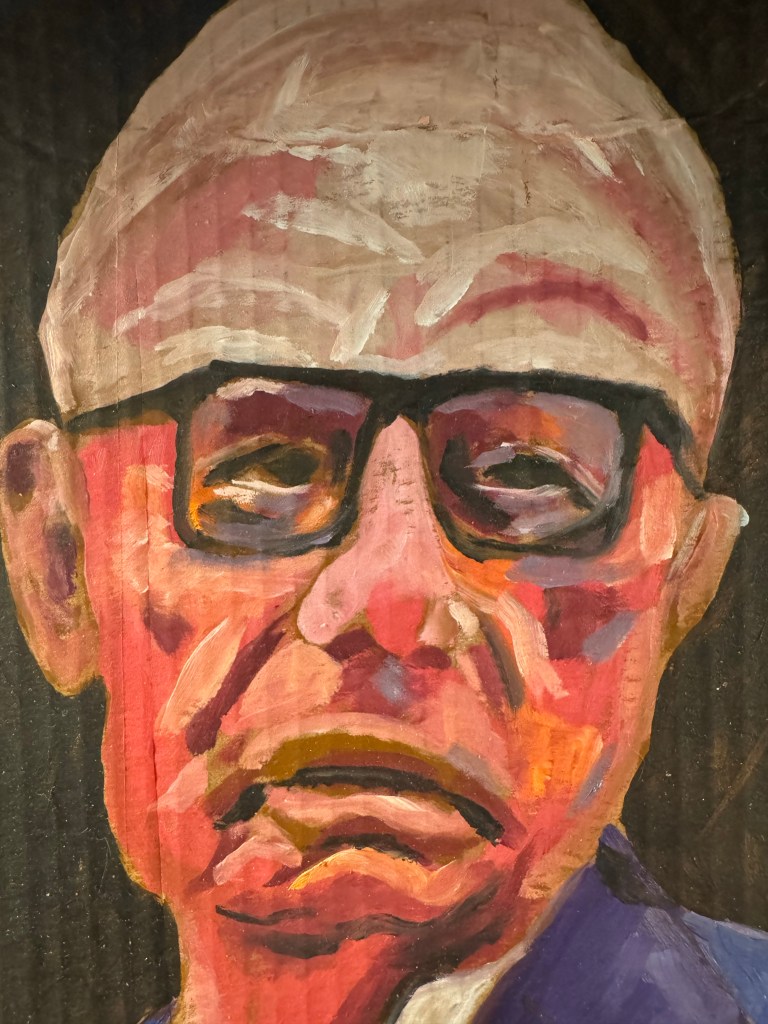








Quran 3:78 —> Vance
“Jagtime Rag,” oil and acrylic on cardboard, 7 x 9 in. (JMN 2024).
Like the King James Bible for Judaism and Christianity, the Holy Quran is for Islam a monument to luminous language in a spiritual setting. As a student of Arabic I study Quranic texts to strengthen my grasp of the language and gain inklings as to its culture. The venture has sparked a desire on my part to sample the scriptures of other faiths, such as the Book of Mormon, as well as writings that are foundational for Hindus, Buddhists, Native Americans, and communities of belief I may not even be aware of.
The above prefaces my registering here an associative episode in my reading and contemplative life of the sort this blog is more or less built for. It’s unruly enough that I feel pressed to assert it’s devoid of irony. In a nutshell, the psychic blip I’m exercised by is this: Verse 3:78 of the Quran made me think of JD Vance.
Here’s my own English for the verse, as literal as I can make it: “And truly among them there is a group who contort their tongues with the Book so that you think it to be from the Book, and it is not from the Book, and they say it is from God, and it is not from God, and they speak the lie about God, and they know it.” (My emphasis. See note below.)
JD Vance said the following on September 15, 2024: “If I have to create stories so that the American media actually pays attention to the suffering of the American people, then that’s what I’m going to do…”
There’s nothing objective about juxtaposing these two utterances as if one illuminated the other. What it does is document an intempestif belch from the parlous mass of associative gases which rotates in my particular cognitive firmament. Vance’s admission that he will make things up to get attention from the media is unsurprising on top of appalling. It’s an end stage in the metastisizing cancer that started with Trump’s “fake news,” advanced through Kellyanne Conway’s “alternative facts,” and now reaches toxic bloom in Vance’s “created stories.” They speak the lie… and they know it. Vance’s malignant fictions predict organ failure for the body politic in the mold of Viktor Orbán’s Hungary.
Note
I don’t pretend remotely to capture in my paraphrase the essential meaning of the verse from a theological, devotional or historical standpoint. I stick close to the words themselves, with respect and deference, to the end that I be able to parse their grammatical relationships and ascertain what they state in elemental fashion, and thus be informed and gain insight overall into the linguistic structures of this glorious corpus of expression which underpins the modern literary language to this very day. As a scholarly sidekick for my Quran reading I keep at hand the published Spanish translation of my mentor Julio Cortés: El Corán, Editora Nacional, Madrid, 1979. It figures among the translations into many languages listed at www.quran.com, and is useful for its notes as well as for its rendering of the text. Here is Cortés’s reading of verse 3:78: Algunos de ellos* trabucan* con sus lenguas la recitación de la Escritura para que creáis que está en la Escritura lo que no está en la Escritura, diciendo que viene de Dios, siendo así que no viene de Dios. Mienten contra Dios a sabiendas.
(c) 2024 JMN — EthicalDative. All rights reserved