Excerpts are from the poem “A Future History” by Suzi L. Garcia (Poetry, March 2020).
A muster of peacocks show off their tails, but instead of feathers, knives.
This line introduces me to “muster,” a collective noun applied to peacocks. It treats “muster” as plural: “a muster… show off their tails.” Going the American way by treating the collective as singular leads to “A muster of peacocks shows off its tails.” It has by-the-book rigor, but is slightly odd, suggesting a singular creature called a “muster of peacocks” (like “master of ceremonies”) that has multiple tails.
An enemy feints indifference and keeps their distance, places me on a fool’s throne. They underestimate me —
This line takes number fluidity further. A possible collective noun, “enemy,” is treated as singular (“feints,” “keeps,” “places”) and plural (“their”) in the same breath, then morphs full-on plural in the next sentence: “They underestimate.”
Number fluidity embraces gender fluidity under the covers here. Applying a consistent protocol to the collective noun could have two possible outcomes:
(1) “An enemy feints indifference and keeps (his/her/its) distance, places me on a fool’s throne. (He/She/It) underestimates me…”
(2) “An enemy feint indifference and keep their distance, place me on a fool’s throne. They underestimate me…”
The poem speaks by ear, not by book, and neither outcome is what it chose because stark clarity is not what it wants. The speaker wants to skirt the genderizing of his or her enemy, and fudging grammatical number is the expedient. Gender elision is the mother of number fluidity.
That leaves “feints” trying to be transitive in “feints indifference.” In my view this bit of rogue usage squanders license for questionable gain.
When noun “feint” moonlights as a verb it’s intransitive, meaning you don’t feint something (such as “indifference”), only somehow (such as “cunningly”). The case for going fluid here eludes me, and I long for “feigns indifference.” Even in a quarterback feint, the decoy move is “faked,” not “feinted.” And sonically, where poetry has much of its being, “feints” and “feigns” are almost joined at the hip.
1913, Liljenquist Family collection, Library of Congress. Illustrates the NYTimes article.
This photo captures a moment when a ritual handshake marked a pause in our Civil War.
The Virginia Monument… marks the departure point of Pickett’s Charge, an ill-fated assault launched 157 years ago on July 3 on the final afternoon of that three-day battle. The monument, which depicts a mounted Robert E. Lee on a pedestal surrounded by seven Confederate soldiers, was started in 1913 to coincide with the 50th anniversary of the battle… On the afternoon of that July 3,… old Northern and Southern soldiers gathered at a low stone wall called the “Bloody Angle,” where Pickett lost 3,000 men. The soldiers shook hands across the wall…
Ackerman, author of this piece, is a veteran of combat service in Iraq. His conclusion seems to me to imply a useful distinction between history and hagiography.
A Confederate monument removal process that respects graveyards and battlefields and acknowledges them as monuments to the dead to be visited by the living, is the quickest way to eradicate painful Confederate symbolism from our public spaces and reconcile the country.
(Elliot Ackerman, “The Confederate Monuments We Shouldn’t Tear Down,” NYTimes, 6-7-20)
Mr. Anaya’s novel “Bless Me, Ultima,” published in 1972, was banned in many school districts for its profanity and what critics saw as an anti-Catholic message. The censorship efforts boosted both the book’s sales and Mr. Anaya’s reputation.
“Bless Me, Ultima” repeatedly drew the ire of censors, who cited what they viewed as foul language and anti-Catholic messaging… The book was banned in California, Colorado and… New Mexico. In 1981, the school board in Bloomfield, N.M., burned copies of “Bless Me, Ultima,” according to a news report in The Albuquerque Journal… In 2012, the state of Arizona forced teachers in Tucson to ban the book and dismantle Mexican-American studies programs, part of a nativist push to curb immigration and limit the influence of Latinos….
The author Rudolfo Anaya at his home in Albuquerque in 2011. He was a leading figure in the literary movement forged by Chicanos in the 1970s. Credit… Morgan Petroski/The Albuquerque Journal, via Associated Press.
… “Bless Me, Ultima” endured as Mr. Anaya’s best-known book, adapted into a play, an opera and a 2013 feature film… Mr. Anaya followed “Bless Me, Ultima” with “Heart of Aztlán” (1976) and “Tortuga” (1979), completing a trilogy about Chicano identity and empowerment.
He also wrote a mystery series featuring the Chicano detective Sonny Baca; children’s books including “Farolitos for Abuelo” (1998); travel chronicles like “A Chicano in China” (1986); and story collections including “The Silence of the Llano” (1982).
(Simon Romero, “Rudolfo Anaya, a Father of Chicano Literature, Dies at 82,” NYTimes, 7-3-20)
In the March René Char (1907 — 1988) (Translated from the French by JMN)
These incessant and phosphorescent streaks of death upon self that we read in the eyes of those who love us, without wanting to conceal them from them.
Must one distinguish between a hideous death and a death prepared by the hand of genius? Between death with a beast face and death with a death face?
We can live only in the gap, exactly on the hermetic dividing line between shadow and light. But we are irresistibly thrown forward. All of our person lends aid and vertigo to this push.
Poetry is both word and unspoken desperate provocation from our demanding-self for the coming of a reality that will be without competitor. One that is rot-proof. Not imperishable; for it runs the risks of all. But the only one that visibly triumphs over material death. Such is Beauty, deep-sea Beauty, appearing from the first times of our heart, sometimes pitiably conscious, sometimes luminously aware.
That which augments my sympathy, that which I love, sometimes causes me nearly as much pain as what I turn away from, resisting, in the mystery of my heart: veiled primers for a tear.
The only signature at the bottom of the blank life, poetry writes it. And always appearing between our broken heart and the cascade.
For dawn, disgrace is the coming day; for dusk it’s the engulfing night. There once were people of the dawn. At this falling hour, perhaps we are they. But why crested like larks?
***
French Text
Dans la Marche
Ces incessantes et phosphorescentes traînées de la mort sur soi que nous lisons dans les yeux de ceux qui nous aiment, sans désirer les leur dissimuler.
Faut-il distinguer entre une mort hideuse et une mort préparée de la main des génies? Entre une mort à visage de bête et une mort à visage de mort?
Nous ne pouvons vivre que dans l’entrouvert, exactement sur la ligne hermétique de partage de l’ombre et de la lumière. Mais nous sommes irrésistiblement jetés en avant. Toute notre personne prête aide et vertige à cette poussée.
La poésie est à la fois parole et provocation silencieuse, désespérée de notre être-exigeant pour la venue d’une réalité qui sera sans concurrente. Imputrescible celle-là. Impérissable, non; car elle court les dangers de tous. Mais la seule qui visiblement triomphe de la mort matérielle. Telle est la Beauté, la Beauté hauturière, apparue dès les premiers temps de notre coeur, tantôt dérisoirement conscient, tantôt lumineusement averti.
Ce qui gonfle ma sympathie, ce que j’aime, me cause bientôt presque autant de souffrance que ce dont je me détourne, en résistant, dans le mystère de mon cœur : apprêts voilés d’une larme.
La seule signature au bas de la vie blanche, c’est la poésie qui la dessine. Et toujours entre notre cœur éclaté et la cascade apparue.
Pour l’aurore, la disgrâce c’est le jour qui va venir; pour le crépuscule c’est la nuit qui engloutit. Il se trouva jadis des gens d’aurore. À cette heure de tombée, peut-être, nous voici. Mais pourquoi huppés comme des alouettes?
(WikiPoemes, Les poèmes de la littérature francophone, wikipoemes.com)
The poem is “A Future History” by Suzi L. Garcia (Poetry, March 2020).
It’s a short prose poem. For my own purposes I want to paraphrase it to suggest what I think it’s “about.” I’m not at all sure this is a legitimate shenanigan to pull on a poem; it will have to rest as a suspect one for the moment.
A muster of peacocks show off their tails, but instead of feathers, knives. And smoke where their voices should be. I breathe gray until it fills my throat, choking on tulle. On the loudspeaker, a mutation of a voiceover, a headache of endearment to remind me where I came from, smokestack cities in jungle greens. Petals are pinned in place on flowers by careful tailors, muted peals ringing in my ears. A headdress of gold and pink weighs me down, an obscene affection from country and kind…
The speaker is an honoree in a parade or festival. The event has ethnic overtones; the announcer’s affected voice and cloying words evoke the speaker’s immigrant origins in a tropical country. An elaborate costume is prepared for her, flowers pinned on (we remember the peacock “smoke” likened to tulle). Bells ring in the distance. A church? Is she a bride? A gaudy crown oppresses her; she takes it as a hackneyed insignia of her culture, a gesture of embrace that’s repulsive to her.
I have never been novel, but in the days of impending volcanos, I walk throwback, the doyenne of novices. An enemy feints indifference and keeps their distance, places me on a fool’s throne. They underestimate me — I am the same bitch in a new wig, a mutineer in a tight dress. I dig my nails into the peel of a granadilla, peel back and bite.
Here’s conjecture:
The speaker finds herself placed in a radically unfamiliar situation — parade queen? bride? — that takes her away from the real world of threatening realities and makes her feel like a relic of the past; it’s a foolish ceremony for which she is quite unprepared. A vanquished competitor for the honor she is receiving, resentful, hangs around, obviously supposing that the speaker is thrilled at being chosen for the empty accolade. The speaker, however, professes herself aggressively unimpressed by the status sought to be conferred on her, antipathetic to it. She signals her contempt for the proceeding and spirit of rebellion by savaging a piece of passion fruit with nails and teeth, perhaps glaring impudently at her adversary in the process.
I consider the first part of my paraphrase plausible but unlikely; the second part farfetched and likely even risible. The exercise itself feels like treading on hollow ground. Is this how you treat a poem? Does it matter whether or not a poem lends itself to paraphrase?
I want to keep thinking about this poem in a following post so this one will not go overlong. There are other questions about how poetry works clamoring for me to ask myself.
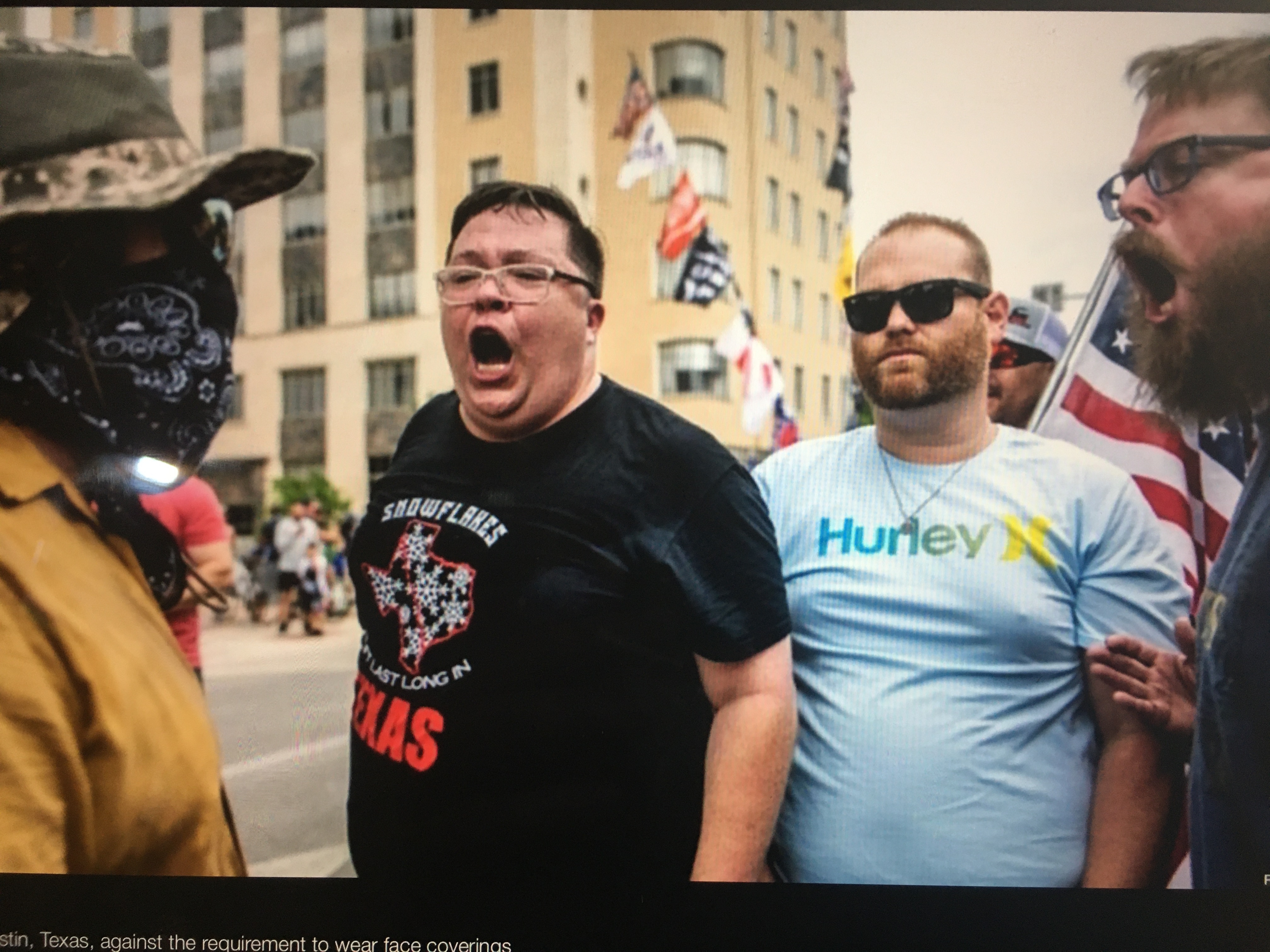
Protests were held in Austin, Texas against the requirement to wear facemasks. Photograph: BBC
On Sunday, [Texas governor] Abbott said that as many as 5,000 people a day were being diagnosed with the virus…
… Vice-president [Pence] also urged Texans to wear masks “wherever it’s indicated”, saying “we know from experience, it will slow the spread of the coronavirus”.
In the Texas state capital of Austin, a requirement to wear face coverings in some circumstances in order to help mitigate the spread of the virus led to demonstrations on the city’s streets by people objecting to the measure.
(“Coronavirus: Swift and dangerous turn in Texas, says governor,” http://www.bbc.co.uk, 6-29-20)
It doesn’t take many kisses blown to the virus, as the sturdy citizens in the photo are doing, for the virus to like-and-follow us.
“We’re on a knife edge, it’s very precarious the situation, particularly in England at the moment, and I would anticipate we would see an increase in new cases over the coming weeks.” (Sir Jeremy Farrar of SAGE)
The warning comes after Prime Minister Boris Johnson announced a major easing of England’s lockdown restrictions, to help to reopen the economy…
Earlier, the PM told the Mail on Sunday that if the virus was a “lightning flash”, the UK is about to have the “thunderclap of economic consequences”.
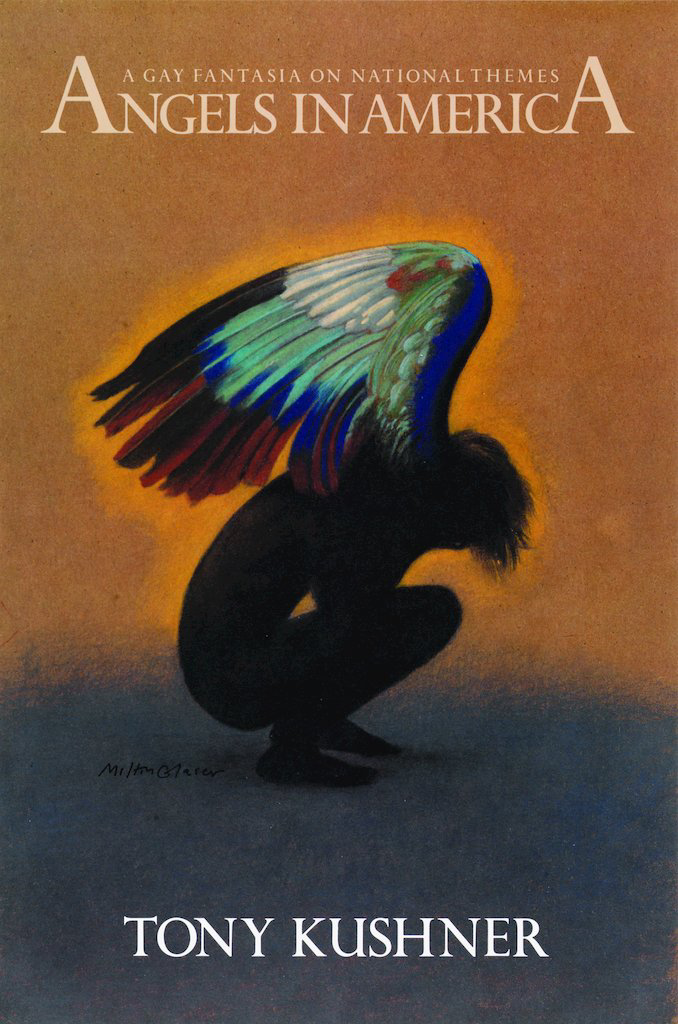
Milton Glaser is dead at 91. His life and work are exhilarating.
Nearly six million posters featuring Mr. Glaser’s psychedelic Bob Dylan design made their way into homes across the world. Credit… Milton Glaser.
For the Dylan poster, a promotional piece included in the 1967 album “Bob Dylan’s Greatest Hits,” he created a simple outline of the singer’s head, based on a black-and-white self-portrait silhouette by Marcel Duchamp, and added thick, wavy bands of color for the hair, forms he imported from Islamic art.
Mr. Glaser designed more than 400 posters in his career, including this one for the prize-winning play “Angels in America.” Credit… Milton Glaser.
… [Glaser] studied etching with the still-life painter Giorgio Morandi and, in the time-honored way, drew from plaster casts. The experience left him a fervent believer in the discipline of drawing and an enemy of found images and collage in design work.
“A designer who must rely on cutouts and rearranging to create effects, who cannot achieve the specific image or idea he wants by drawing, is in trouble,” he told the magazine Graphis in 1960.
(William Grimes, “Milton Glaser, Master Designer of ‘I ♥ NY’ Logo, Is Dead at 91,” NYTimes, 6-26-20)







Handshake
This photo captures a moment when a ritual handshake marked a pause in our Civil War.
The Virginia Monument… marks the departure point of Pickett’s Charge, an ill-fated assault launched 157 years ago on July 3 on the final afternoon of that three-day battle. The monument, which depicts a mounted Robert E. Lee on a pedestal surrounded by seven Confederate soldiers, was started in 1913 to coincide with the 50th anniversary of the battle… On the afternoon of that July 3,… old Northern and Southern soldiers gathered at a low stone wall called the “Bloody Angle,” where Pickett lost 3,000 men. The soldiers shook hands across the wall…
Ackerman, author of this piece, is a veteran of combat service in Iraq. His conclusion seems to me to imply a useful distinction between history and hagiography.
A Confederate monument removal process that respects graveyards and battlefields and acknowledges them as monuments to the dead to be visited by the living, is the quickest way to eradicate painful Confederate symbolism from our public spaces and reconcile the country.
(Elliot Ackerman, “The Confederate Monuments We Shouldn’t Tear Down,” NYTimes, 6-7-20)
(c) 2020 JMN