This comment by Victoria Moul has jostled my world:
It is very difficult indeed to write lyric poetry which is both beautiful and straightforward to understand, and which also has something to say — a clear and specific message or argument. These seem like they ought to be the basic virtues of verse but it is a rare poet who can put all three together as consistently as [Edwin] Muir.
(Victoria Moul, “Horace & friends,” substack)
As a reader of contemporary poetry I had not encountered the argument she makes for the lyric in support of beauty, clarity and content. Much of the verse I read does not give itself up, if at all, to a first pass; invites if not demands revisiting; and may defy grasp or retention anyhow. This, I’ve been induced to believe, is of the nature of verse and to be expected: the saying of bright things darkly, so to speak.
There’s more. In discussing J.H. Prynne’s poetry, Victoria Moul writes the following:
Prynne’s poetry is, it’s true, exceptionally “difficult” because it is often impossible to parse in any conventional way.
Her quotation marks and reference to parsing are noteworthy. I often test verse against my capacity to winkle out in my own way what it “says” (more quotation marks!). In other words I parse it, sensing all the while that doing so goes against good practice in the view of experts.
Here’s the rest of Moul’s observation, which I find somewhat climactic:
But I find so much of Prynne’s poetry, for all its obscurity, exceptionally beautiful and unmistakably profound. The fact remains that I am more often moved to tears reading Prynne than almost any other recent poet in English.
Worse luck for me is I tend to express myself in doggerel, the more so when exercised. As doggerel will do, the product is blatantly rhythm-straitened and message-laden, salted with rhyme as if by a drunken sailor. It’s on the opposite side of where lyric shines. I’m okay with that. But for my reading life, Victoria Moul gives me much pause, as well as encouragement.
(c) 2026 JMN — EthicalDative. All rights reserved


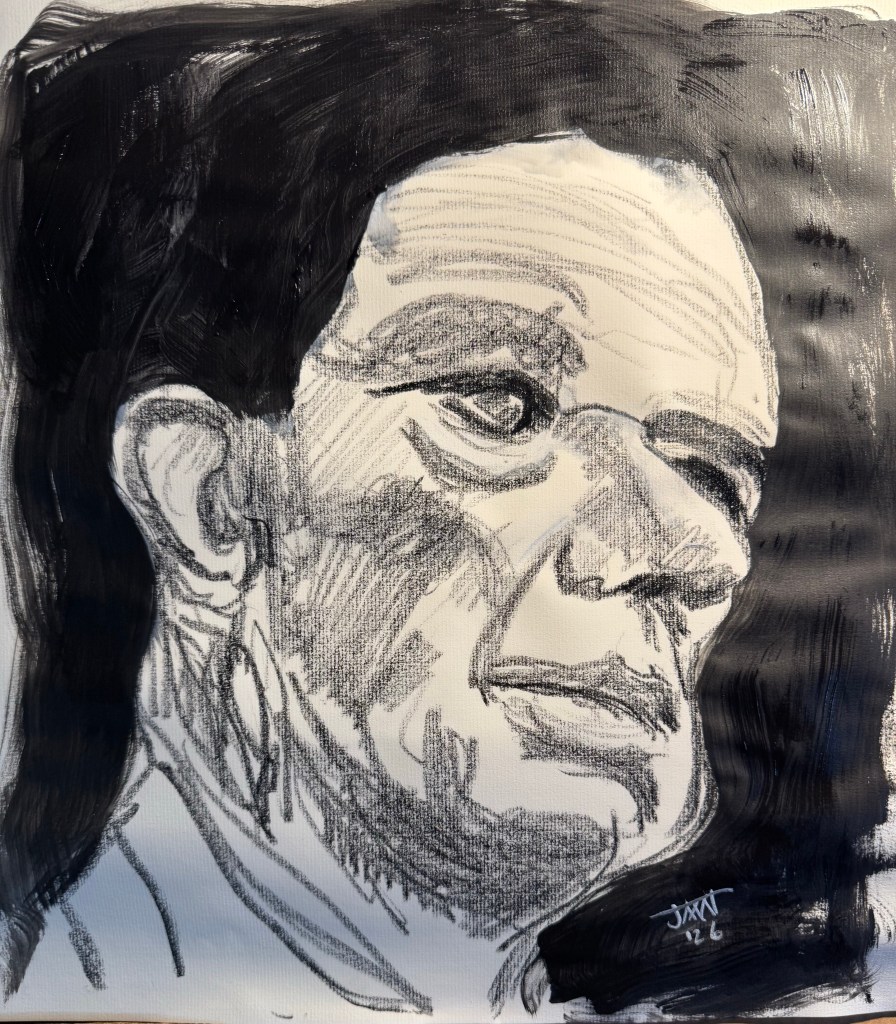
Good sketch. Thinking about the poetry quotes…
LikeLiked by 2 people
Thank you, OA!
LikeLiked by 1 person
Beauty…so hard to define (K)
LikeLiked by 1 person
I have to read more Prynne.
LikeLiked by 1 person
Me too! 🙂
LikeLike
Lovely drawing – and plenty to think about here. I do find I read and re-read your poetry, Jim and always find much to enjoy and contemplate.
LikeLiked by 2 people
That’s lovely to hear, Sue. Thanks for your generous attention.
LikeLiked by 1 person