Two bits in this opinion piece by Shmuel Rosner have an off ring, one solecistic, the other non-colloquial.
But most Israeli voters would support such move. Most of them voted for parties that support such move.
“Such” here is an adjective expressing similarity. To modify a singular noun it wants “a/an”: “such a move.” Otherwise, the noun must be plural: “such moves.”
The citation is interesting in that the structure is repeated, which means it’s likely to be intentional (an influence from Hebrew, perhaps? — the author is Israeli), and not an editorial slip. I can’t speak for Hebrew, but both Spanish and French would admit the equivalent of “such move.”
We learned that to win against a political opponent one has to have a message more profound than “everyone but him.”
“Everyone but him” is not incorrect grammatically; however, most speakers would say, “Anyone but him.” They seem to mean the same thing, though usage favors the latter.
Nevertheless, I’m given pause. So in a thought experiment I stand before a classroom and pose a question to my students. Confronted with silence, which of these do I say encouragingly with interrogative intonation to solicit an answer: “Everyone?” “Anyone?” The first invites all, the second one. I’ll go with “anyone” and take it as evidence that they’re not interchangeable.
“The medium is the message.” I don’t know what McLuhan’s ricocheting aphorism meant to him, but it emboldens me to posit grammar as the “medium” of language, and to assert that much message is encoded there for any who care to look. What you convey is embedded somewhat in how you say it. If your message matters to you, say it well.
(Quotations are from Shmuel Rosner, “The Indefatigable, Unbeatable Benjamin Netanyahu,” NYTimes, 3-3-20)
It’s been a big week for what I refer to as “Hermit Tech.” Stock in technology companies that facilitate working from home have soared in a spiraling market otherwise anxious by an impending coronavirus pandemic. [This is where I stopped reading.]
(Charlie Warzel, “When Coronavirus Quarantine Is Class Warfare,” NYTimes, 3-5-20)
The first time age was a big issue in a presidential election was back in 1840. William Henry Harrison, the Whig candidate, was 67 and his opponents referred to him as “a living mass of ruined matter.”
(Gail Collins, “The Presidency Is an Old Boys’ Club,” NYTimes, 3-4-20)
“A living mass of ruined matter” is both quaint with restraint and boldly specific in a way that gives it color and power from its far remove, especially compared to today’s squalid trash talk.
I’ve reflected on the presumptive release furnished by curses and insults, and whether they are a legitimate outlet for horror, or else a vile indulgence best risen above by persons of character and taste. Can’t decide.
Is it a crown virus weighting my synapses? I’ve been possessed of the notion that we’re each a walking microbiome, and that the embodied spew and stew of some individuals may be degenerate and feculent beyond the average, “unpresidented” if you will. The awful phrase “sewage in a suit” hatches in my head.
What’s seductive about “sewage in a suit,” besides its stark unwontedness, is the sibilant “ooh”-nicity of alliteration that grabs even the vowel by its purpose.
But finally it is cruel — the “sewage in a suit” trope. Imputing to another God’s creature a preternatural fetor is, at bottom, lower than one wants to stoop, no matter the depravity that aches for it.
“Voters of color will decide if Bernie Sanders or Joe Biden prevail.”
(Headline to an article by Steve Phillips at theguardian.com, 3-1-20)
There’s only the slightest chance that it should not be “prevails” instead of “prevail,” since the conjunction is “or,” not “and.” The headline writer has been lulled, no doubt through haste, into thinking that the two proper names in close sequence preceding the verb amount to a plural subject. The little words get no respect, to echo Rodney Dangerfield.
The slight chance I mention is in the event that the structure were subjunctive, not indicative. Subjunctive, implying conjecture and contrariness to fact (“If I were you,” etc.), is little marked in English, and most often crops up in high-flown or archaic, biblical-sounding rhetoric. I’ll conjure this example, sticking with the verb “prevail”:
“Yea, though Sanders prevail, yet if he be unbending he shall not prosper.”
Or something like that. Where I locate an analog of this syntax is in the verse from Job that says “Though he slay me, yet will I trust in him.”
I apologize for the weaseling question mark in this post’s title. That profanation is much too common in today’s clickbait journalism. And that’s the name of that tune, to quote Tony Baretta.
The president makes decisions that affect our lives, our physical safety and that of the planet, and the durability of our democracy. It follows that we should know all that we can about that person’s intelligence, temperament, knowledge, curiosity, stability, judgment, curiosity and diplomatic skill.
(Elizabeth Drew, “Why a Shortened Primary Season May Prove Disastrous,” NYTimes, 2-27-20)
For many traditional liberals, respect for difference is understood as a sacred duty. Consider, for example, Joe Biden’s warm words for his Republican colleagues, or the left’s many peons to the virtues of empathy.
(Tim Wu, “Quantifying Liberal ‘Suckerdom,’” NYTimes, 2-26-20)
Models at a Fashion Institute of Technology show wore a pair of oversize lips and blown-up “monkey” ears. Credit… Bennett Raglin/Getty Images For Fashion Institute of Technology.
Mr. Huang said the intent of his show was to explore the beauty in body parts that we don’t appreciate — a thesis that stemmed from his feeling of embarrassment about his crooked finger, which he said he always hides in public.
“The accessories used during the show were intended to be reflections of my own body features and perceptions of their enlarged proportions, which should be celebrated and embraced. They are not ugly features,” he said.
(Kimiko de Freytas-Tamura, “F.I.T. Model Refuses to Wear ‘Clearly Racist’ Accessories,” NYTimes, 2-23-19)
Illuminated skyscrapers in Heihe can be seen from almost everywhere in Blagoveschensk. Credit… Davide Monteleone for The New York Times.
… Regardless of where the virus comes from, he added, Russia has nothing to fear: “Two hundred grams of vodka will kill any virus.” (Russian Aleksandr Kozhin, who lives in Heihe, China, across the Amur River from Blagoveshchensk, Russia)
(Andrew Higgins, “On Russia-China Border, Life and Commerce Frozen by Coronavirus,” NYTimes, 2-24-20)
Amid the racks of guns at the Shot Show, many people were saying that the firearms industry should embrace a more inclusive marketing strategy, if it wants to broaden its reach. Credit… Lisa Marie Pane/Associated Press.
“What I’m not going to show is a guy, with one hand, just jacking it up in the air…” (Jeremy Flinn, of Stone Road Media marketing agency, referring to military-style rifles)
(Tiffany Hsu, “Gun Makers Battle ‘Trump Slump’ With a Softer Sales Pitch,” NYTimes, 2-23-20)
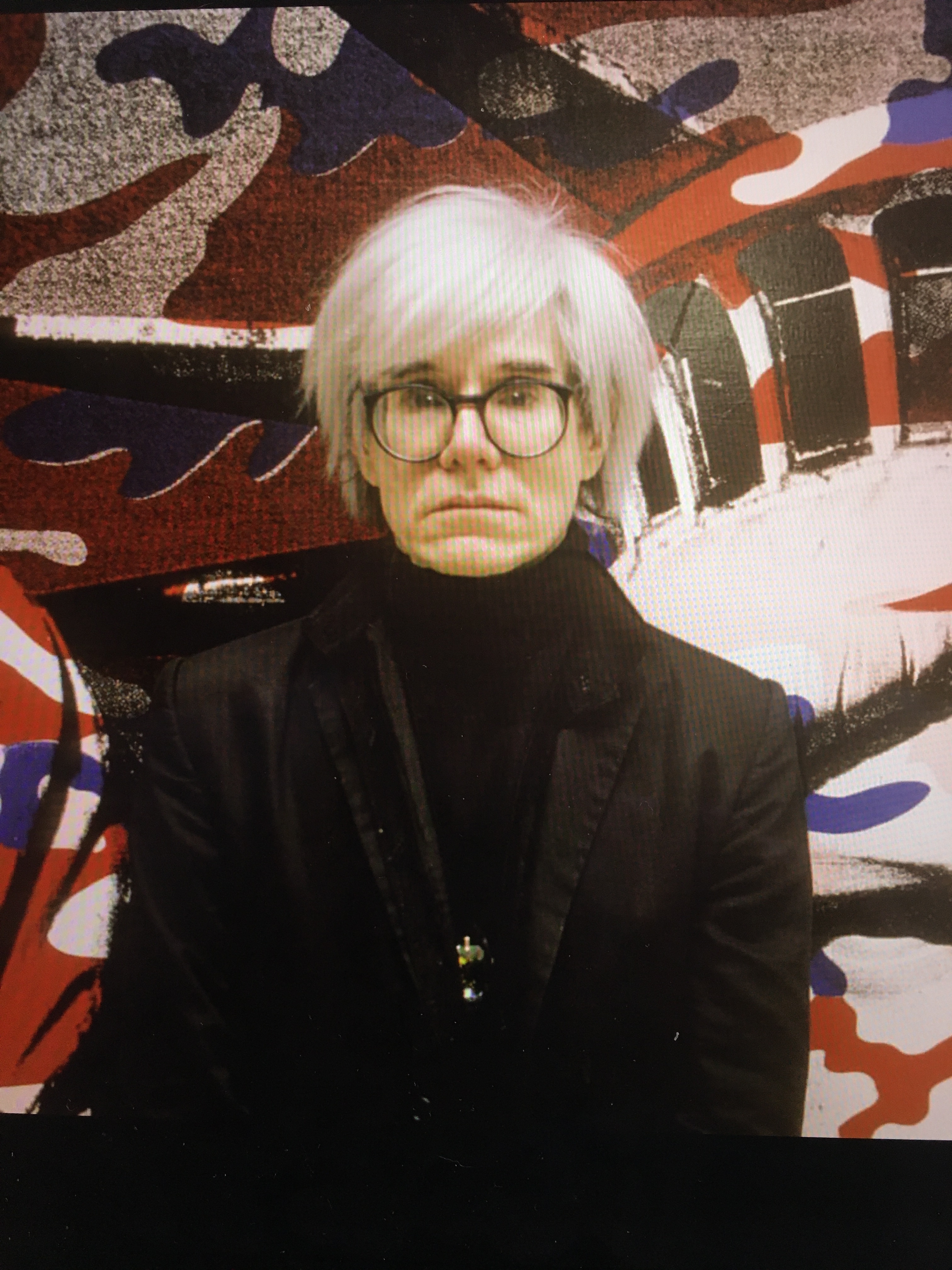
Photograph: François Lochon/Gamma-Rapho/Getty Images.
“I’m OK but I have diarrhoea.” (Said to be Warhol’s common answer to a routine “How are you?”)
(Kathyrn Hughes, “Warhol by Blake Gopnik review — sex, religion and overtaking Picasso,” theguardian.com, 2-22-20)
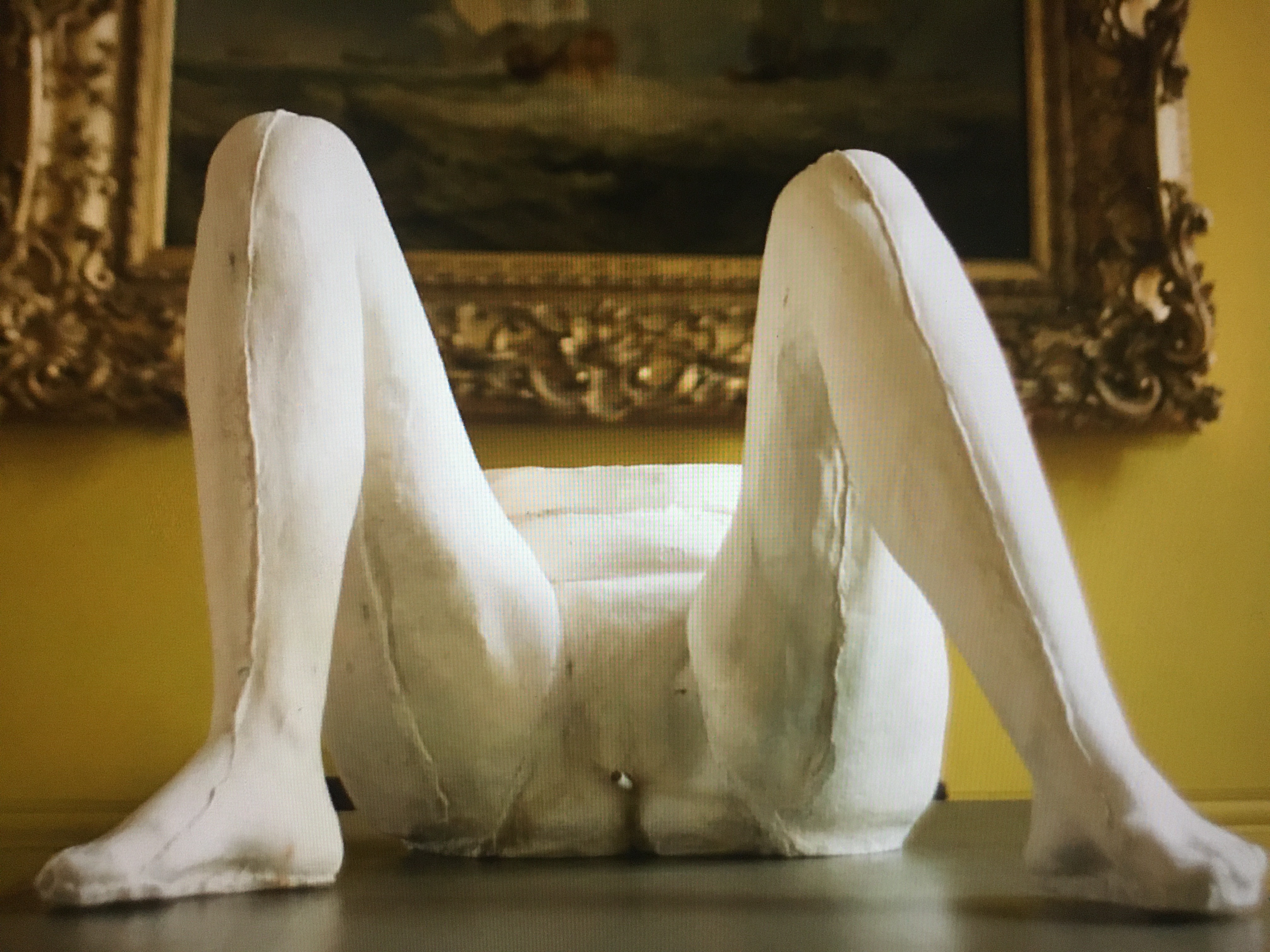
‘I lift my skirt to oppression and dishonesty’ … a cast from Sarah Lucas’s Power in Woman exhibit at the Sir John Soane’s Museum in London. Photograph: Graeme Robertson/The Guardian.
This article is about Catherine Blackledge, author of “The Story of V” (2003), which “explores the vagina from a scientific and historical perspective.” It introduces me to the word and the tradition of anasyrma — “the centuries-old gesture of lifting one’s skirt to display female genitalia and ward off evil.”
“Most parents in the UK choose to use vaginal euphemisms such as flower, tuppence, fairy, bits or front bottom… If the UK wants a new non-anatomical word, my vote is for verenda. It’s an old word for the vagina and means ‘the parts that inspire awe or respect’. Grace, gravitas and a great provenance combined.”
(Alison Flood, “‘Vagina is not a rude word’: the scientist fighting to empower women, one word at a time,” theguardian.com, 2-20-20)
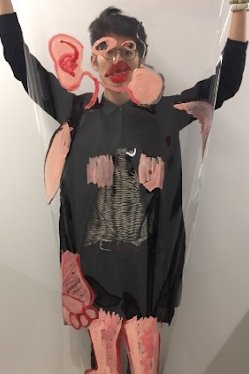
A model walks the runway wearing Junkai Huang during the Fashion Institute of Technology’s runway show how [sic] on 7 February in New York. Photograph Bennett Raglin/Getty Images for Fashion Institute of Technology.
It might be nice if schools of fashion were insulated from the culture so as to indulge in questionable tomfoolery on the runway with impunity, but it isn’t so. Every so often a mess is stepped in. Someone in charge must then wipe off their Ferragamos and exhibit contrition over unintended consequences, misperceived perceptions, intentions gone awry, etc.
Following an online outcry over the event, Joyce Brown, president of the Fashion Institute of Technology, said she recognized there was an “unfortunate and disturbing reaction to the use of exaggerated ears, lips and eyebrows… Regrettably, we failed in this instance to recognize a creative statement that could have negative consequences.”
This is the standard simulacrum of apology. It calls the reaction unfortunate and not the stimulus. “I’m sorry you’re upset by what I did” isn’t the same thing as being sorry for doing it.
A uniquely forthcoming apology was uttered by Jonathan Kyle Farmer, chair of the modern fine arts fashion design course which ran the show.
“… I now fully understand why this has happened… I take full responsibility and am committed to learning from this situation and taking steps to do better.”
(Oliver Milman, “New York fashion college apologizes for runway show criticised as ‘clearly racist’,” the guardian.com, 2-20-20)







 EthicalDative
Such Ado About Something
Two bits in this opinion piece by Shmuel Rosner have an off ring, one solecistic, the other non-colloquial.
But most Israeli voters would support such move. Most of them voted for parties that support such move.
“Such” here is an adjective expressing similarity. To modify a singular noun it wants “a/an”: “such a move.” Otherwise, the noun must be plural: “such moves.”
The citation is interesting in that the structure is repeated, which means it’s likely to be intentional (an influence from Hebrew, perhaps? — the author is Israeli), and not an editorial slip. I can’t speak for Hebrew, but both Spanish and French would admit the equivalent of “such move.”
We learned that to win against a political opponent one has to have a message more profound than “everyone but him.”
“Everyone but him” is not incorrect grammatically; however, most speakers would say, “Anyone but him.” They seem to mean the same thing, though usage favors the latter.
Nevertheless, I’m given pause. So in a thought experiment I stand before a classroom and pose a question to my students. Confronted with silence, which of these do I say encouragingly with interrogative intonation to solicit an answer: “Everyone?” “Anyone?” The first invites all, the second one. I’ll go with “anyone” and take it as evidence that they’re not interchangeable.
“The medium is the message.” I don’t know what McLuhan’s ricocheting aphorism meant to him, but it emboldens me to posit grammar as the “medium” of language, and to assert that much message is encoded there for any who care to look. What you convey is embedded somewhat in how you say it. If your message matters to you, say it well.
(Quotations are from Shmuel Rosner, “The Indefatigable, Unbeatable Benjamin Netanyahu,” NYTimes, 3-3-20)
(c) 2020 JMN