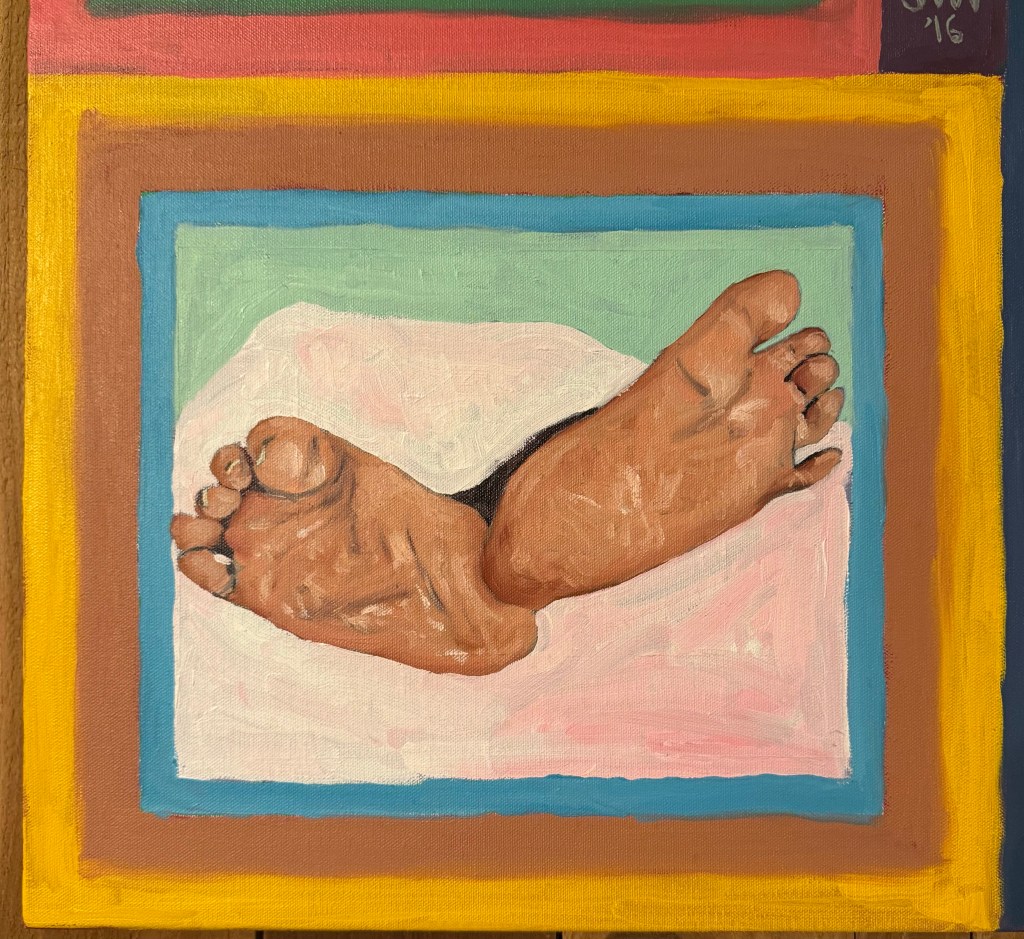
Detail, “Son and Daughter,” oil on canvas (JMN 2016).
Here’s my English reading of “Contar Cuentos” (Telling Stories), a poem written in Spanish by Azurea20 published at LA BANCARROTA DEL CIRCO on April 27, 2025.
TELLING STORIES My memory invents you, strips you naked tells itself stories, closes your eyes, obliterates your mouth, discovers verbs that are not conjugated nor partake of grammar. They keep me busy, words do. I answer my own questions, parley with the ambiguous seduction of signals. I traverse maps with a schizoid compass. I spread out the puzzle, a house guest in my winter, where I always end up when evening falls. Though time will be dissolved around all of everything and you’ll hear no more of me, it will be the day that footsteps falter and from me takes wing a petite post mortem shade.
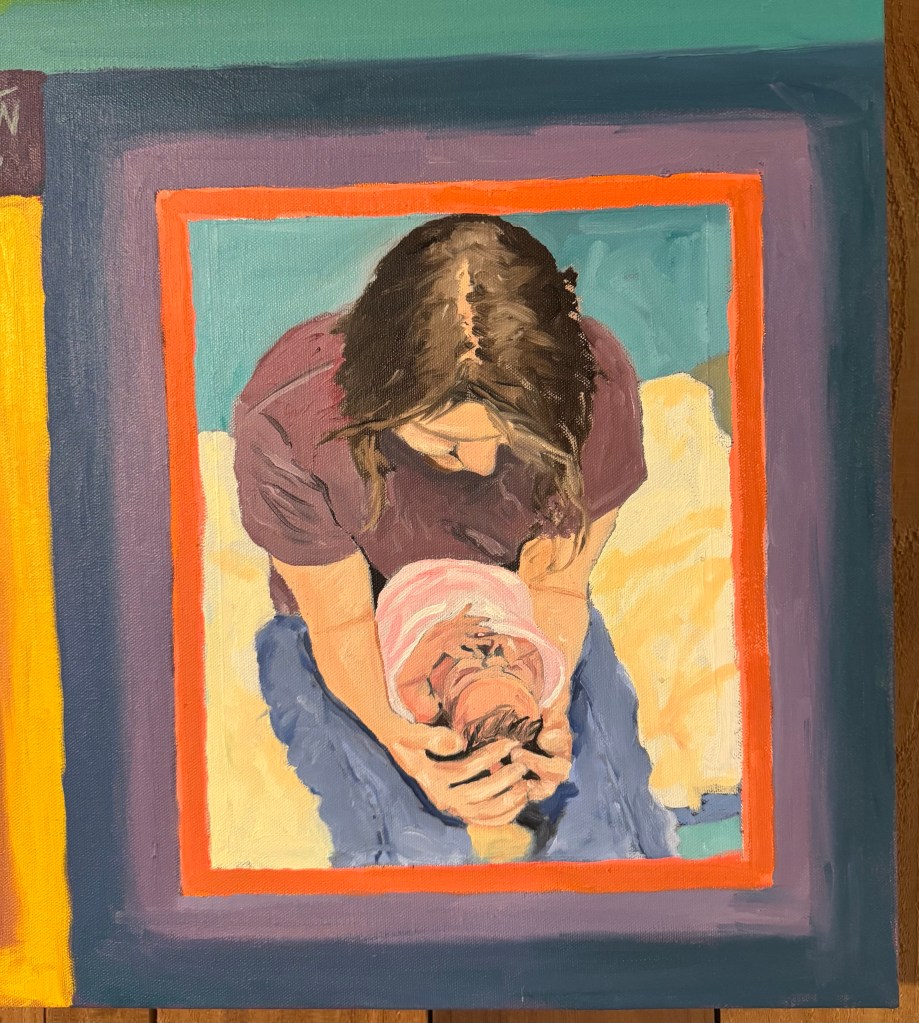
Detail, “Son and Daughter,” oil on canvas (JMN 2016).
Delving Yardbarker is the nom de guerre of the creator of “Reading Ulysses in Montana.” As with Luvgood Carp, it gives me pleasure each time I say “Delving Yardbarker.”
Sonorous, compressed, quirky, inventive, mischievous, literate, subversive, diverting, intriguing, outrageous, prolific, impudent, fearless… Which of these adjectives sticks? All of them capture something of the look and feel of Delving Yardbarker’s “Reading Ulysses in Montana.” Perhaps one I’ve left out is entertaining. That, above all, oftener than not.
Here are snippets of “Climb It, Change!”. For me, putting them in an acquired tongue concentrates the mind.
Ginger stood and lifted the stifled rifle to the top of the Eiffel Tower’s lowest setting to the right of the neighborhood watch party… Se puso Ginger de pie y levantó el rifle sofocado hasta el máximo de la configuración mínima de la Torre Eiffel justo a la derecha de la fiesta de mirones del barrio…
George said he didn’t mind as long as the fleet of empty dignitaries fluttered a fortune of mints into the storm drain of restraint… Dijo George que no le importaba con tal de que la flotilla de dignatarios vacíos hiciera caer aleteando un dineral de caramelos de menta al desagüe de control…
George stood up and helped Ginger grind the rifle against the top of the Eiffel Tower, but the snow started to fall, and the French snow globe had shattered into a number of poems that refrained from all the mornings of the world catching up with them by breakfast in light of all tomorrow’s parties… Se puso George de pie y le ayudó a Ginger friccionar el rifle contra la cima de la Torre Eiffel, pero la nieve empezó a caerse, mientras que el globo de nieve francés había estallado en un sinfín de poemas, los cuales se abstuvieron de que todas las mañanas del mundo los alcanzaran para la hora del desayuno a la luz de todas las fiestas venideras…
I know, I know. But it’s impossible to experience the untranslatable without breaking the eggs.
One of the many Philip K. Dick books that Chris Moore did cover illustrations for was “Beyond Lies the Wub: Volume One of the Collected Stories.” Credit… Chris Moore, via Art Partners. [New York Times caption and illustration]
… Mr. Moore remained steadfast in avoiding lofty posturing as a fine artist. “If someone wants a picture of a horse to illustrate their new range of lasagna,” he said in the Agency Partners interview, “then I follow the brief and produce a picture of an Italian horse.”
“Call him a master, or a titan in his sphere, and he simply won’t have it,” Stephen Gallagher wrote in the introduction to the book “Journeyman: The Art of Chris Moore,” a 2000 collaboration with the artist. “The most you’ll ever get out of him is a grudging admission of some quiet satisfaction when something in a picture comes right.”
(Alex Williams, “Chris Moore, Illustrator for Classic Sci-Fi Books, Dies at 77,” New York Times, 3-12-25)
With apologies to William Jennings Bryan, it’s called a “rug pull”:
A celebrity touts a new digital coin, prices soar and then insiders who own most of the coins pull the rug: They sell their stakes for a big profit at the expense of amateur investors who got in later.
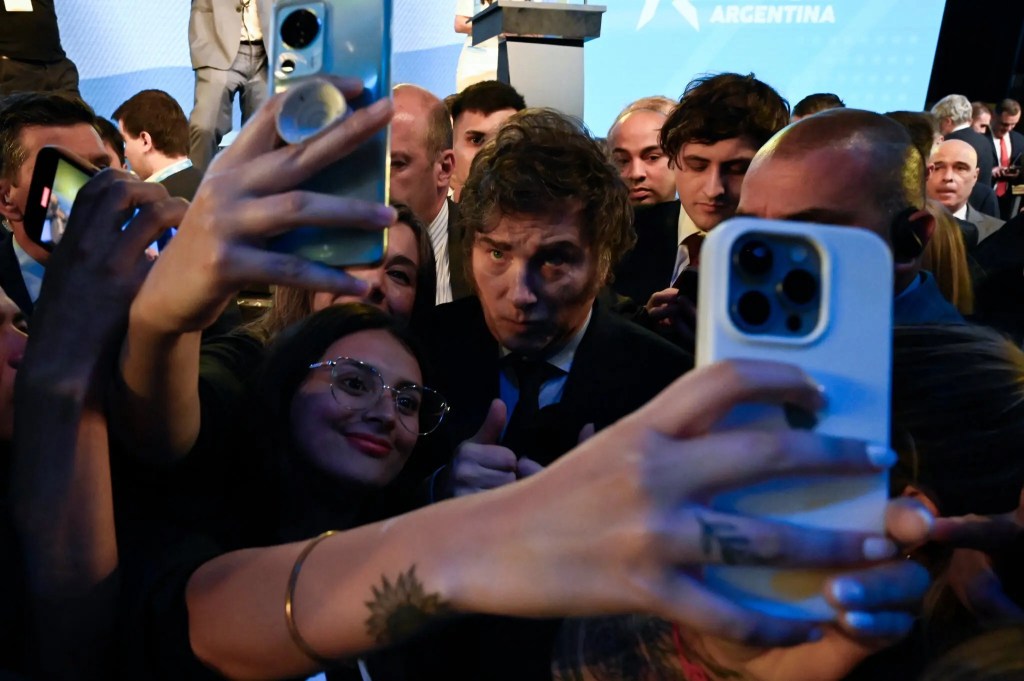
For the portraitist, ever a student of faces, President Milei’s is a study in vulpine.
[photo from New York Times illustration] [photo from New York Times illustration] (President and sister.) [from New York Times illustration]
(Jack Nicas and David Yaffe-Bellany, “Milei, $Melania and Memecoins: Unraveling Argentina’s Crypto Fiasco,” New York Times, 2-28-25)
A New Yorker cover by Ms. Simpson from 1993, her last year with the magazine. Credit…Gretchen Dow Simpson & The New Yorker. [New York Times caption and illustration]
While modest, solitary buildings were often her subject matter, Ms. Simpson’s work was not purely representational. A former commercial photographer, she applied a telephoto approach to many of her paintings, zooming in on windows, doorways or rooftops to emphasize the juxtaposed angles and intersecting lines that characterized her work, giving it the feel of abstract art.
(Alex Williams,, “Gretchen Dow Simpson, Creator of New Yorker Covers, Dies at 85,” New York Times, 4-25-25)
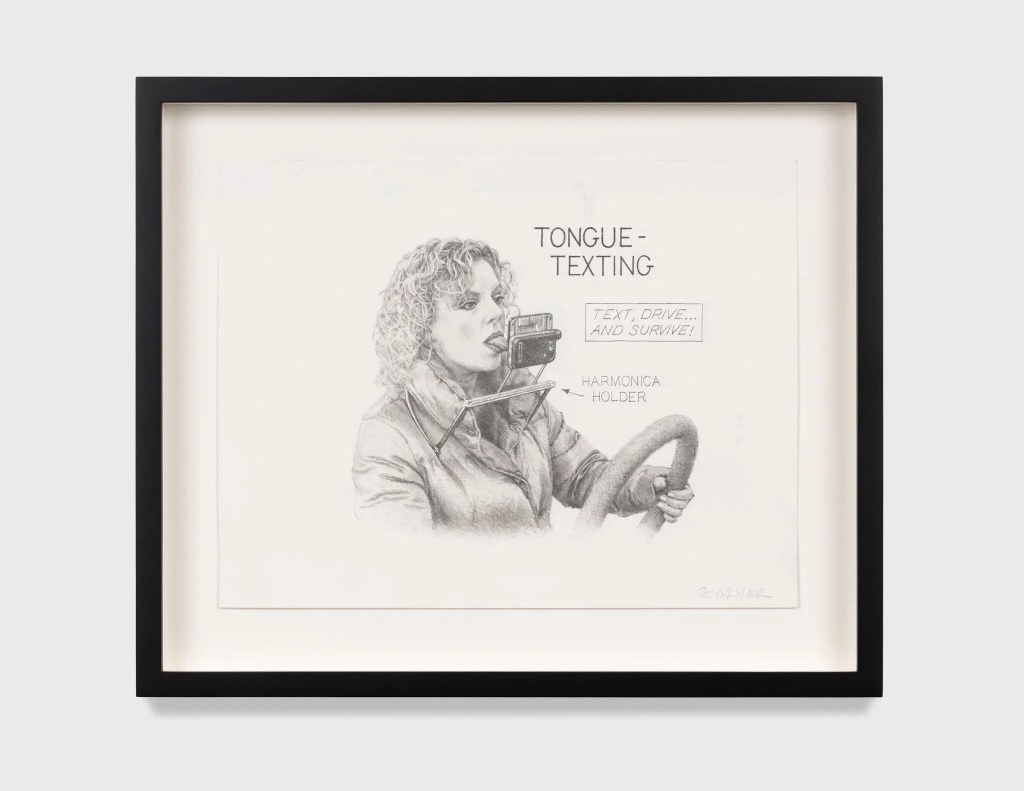
Commenting on consumerism, Ms. Garner came up with a host of flagrantly unnecessary gadgets and accessories, including “Tongue-Texting,” pencil on paper. Credit… Courtesy of the artist, Matthew Brown and STARS.
“I tried to set an example that nobody else can follow.”
(Pippa Garner)
A one-off slogan printed on her T-shirt series called “Shirtstorm” was “These Are My Remains.”
(Will Heinrich, “Pippa Garner, Conceptual Artist With a Satirical Streak, Dies at 82,” New York Times, 1-7-25)
Que la lumière soit. Et la lumière fut. Que haya luz. Y hubo luz. Let there be light. And there was light. (Photo by JMN).
Bret Stephens, conservative columnist for the New York Times, Jew raised in Mexico, fluent Spanish speaker, quotes (from memory) a poem called “God’s Grandeur” by Gerard Manley Hopkins at the end of The Conversation with Gail Collins.
In my reading I rarely seek out Hopkins any more, but when he’s put before me I’m seduced again by his jazzy prosody. The poesy theurge channeled by the English Jesuit induces contemplative frenzy in the susceptible. Am I one?
Take rhyme (please! — ha-ha!): In current verse I almost always find recurring end rhyme to be deafening and deadening as far as lifting poetry from the trenches is concerned. English is a consonantal, assonant tongue with dirty vowels and minimal morphological inflection. The language isn’t built for long stretches of ding-donging from a daft belfry. Hopkins, however, can make daft sexy. It’s to be noted from the start that all the poem’s rhymes are made from common, monosyllabic words.
The world is charged with the grandeur of God. It will flame out, like shining from shook foil; It gathers to a greatness, like the ooze of oil Crushed. […]
Messiahs are anointed (oiled) beings (Spanish untado. Arabic masīḥ, meaning wiped, clean, smooth, besides anointed.) Shining shaken from foil, betokening the flaming out of a light source, cuts the mustard as a bit of derring do in the way of simile. Enjambment takes the pressure off the incestuous rhyme of oil with foil, landing the beat on a strongly voiced adjective at a pausal juncture: Crushed. Boom! Stress that would fall on “oil” is shunted to the next line. Line 3, the one with ooze, is a solitary hexameter.
Why do men then now not reck his rod? Generations have trod, have trod, have trod;
“Then now” — conjunction next to adverb: The feisty collocation manages to connote epochal habituation, an unending history of not reckoning with the Boss, not following His Rules. Hopkins triples down on the rod-trod pairing — more kissing cousin coupling! Far from shifting stress off the rhyme, he compels attention to it with tolling repetition, conveying again the feel of endless traipsing and trampling, wallowing in waywardness. Everyone has strayed, does stray, will stray. There follows a rampage of rhyme and half-rhyme alloyed with alliteration.
And all is seared with trade; bleared, smeared with toil; And wears man’s smudge and shares man’s smell: the soil Is bare now, nor can foot feel, being shod. And for all this, nature is never spent;
And for all that, Mother Earth, at least, is thriving, evergreen, never-changing. Ha-ha! The showy sequence is admirably legible, thanks in part to the kindness of punctuation. Behold this phrase without its strategic comma: “nor can foot feel being shod.”
On top of lucidity, Hopkins excels at one of the things I admire most: syntactic compression. He expels the rank man-breath from verbiage, like air burped from Tupperware. There’s a taut, tight tension in one phrase of the following line which is borderline manic. Can you spot it?
There lives the dearest freshness deep down things;
It’s in the locative adverbial phrase “deep down things.” Eliding the preposition “in” (or “within” or “inside”…) after “down” falls just shy of redlining comprehension, in keeping with how Hopkins buffs phrasing to the bare bone.
The poem ends on pious fustian exercised exclamatorily over a black-brown-brinkish-brooding-breasty thing with ah! bright wings. It has shot its fox before reaching the Holy Ghost — a fall from grace poetically, except for one trope: the world is bent. God yes — double, like the pitiable creatures in a Salvadoran hoosegow. The last word is the poet’s, blessèdly.
And though the last lights off the black West went Oh, morning, at the brown brink eastward, springs — Because the Holy Ghost over the bent World broods with warm breast and with ah! bright wings.
I do solitary battle with poetry. Yes, battle. I challenge the poem, it challenges me. Me and the poem, the two of us in mental combat.
From the former Gulf of Mexico To the shores of Zuiderzee, I have pondered verses bad and good In the air, on land and sea. (To the tune of The Marines’ Hymn)
Kidding. It’s a tussle, but I’m on poetry’s side. Also the Marines’s. Semper Fi.
No one in my acquaintance likes it. That’s OK. It’s not a social medium. Poetry doesn’t need an “audience,” a circle, a claque of cognoscenti. Poetry needs a reader. I’m that man. This farflung outpost is my station. I will defend poetry here. Something Poetry editor Adrian Matejka writes in the latest issue gladdens me:
“Miscommunication” has the Latin root “communicare,” which can mean either “common” or “shared,” and in poetry, I imagine “shared” speaks to everyone involved — both poet and reader offering their understandings and confusions in equal value.” (Poetry, May 2025)
A professional’s acknowledgment of the reader’s portion of credit and blame in making poetry happen is sweet. A poem’s signal, after all, is a vagrant wave until it meets a receiver. By the way, there’s report of a formidable poetry power in the world with which to rub shoulders and deal squarely — I speak of China.
Since the time of the Shijing (Book of Songs), which dates back to the Zhou Dynasty (c. 1046-256 BCE), poetry has served not only as an artistic form but also as a vehicle for moral guidance, emotional expression, political commentary, religious teaching, and personal reflection. It has permeated both elite and popular culture, shaping every aspect of Chinese life. (Chun Yu, “A Circle Comes Together,” Poetry, April 2025)
Let’s set our children to learning Mandarin sooner rather than later. They’ll fare better artistically, morally, emotionally, politically, religiously and personally.





 EthicalDative
‘Machismo’ Cuts the Cheese Over Yonder
Fun fact: In Great Britain they pronounce it mah-KIZ-mo. On the shores of the Gulf of
MexicoAmericaMar-a-Lago we say mah-CHEESE-mo.(c) 2025 JMN — EthicalDative. All rights reserved