I haven’t finished listening to the novel on my new Audible subscription, but I see no reason not to review it.
It’s twenty-seven Titanics of insanity steaming with breakneck slowness over an eternity of pages towards a who-knows-what species of icebergian reckoning beyond all feasible capacity of expectation.
It’s the ideal volume to be stranded on a desert island with, expiating one by one, word by word, every sin committed from cradle to grave (yes, in the metaphor you die on the island), keeping count by dropping grains of sand into a teacup salvaged from the shipwreck of life that brought you to this pass.
I don’t entirely dislike “Infinite Jest.” Read that as a positive statement in spite of its syntax. My son is a medical professional involved in mental health. I strive to recommend it to him. It has narratives he could profit from hearing. I can’t bring myself to do it. He has a life to lead, a profession to practice, and his time, unlike mine, is valuable. Saddling him with “Infinite Jest” would be like yoking him to a plough to turn 65 acres of sod for some intriguing weed-life to peek through.
I try to know as little as possible about writers’ lives. The knowledge distracts from their poems and doesn’t “explain” them any more than an alcoholic’s life “explains” his disease. The poem (or novel), and the disease, have their own voice. I know only that David Foster Wallace liked tennis and killed himself in his forties.
“Infinite Jest,” of its own accord, seems to me written by a brilliant, disturbed tennis nut possessed of suicidal ideation and an exquisitely attuned eye, ear and tongue for every species of human fallibility, deviancy, eccentricity and putridness under the sun. But and so (as he would write), not without glints of illumination, I affirm cautiously, suspiciously and hesitantly.
Will I have begrudged the time spent in hearing “Infinite Jest” read when it’s done? Nope. You can’t know the view from a jagged peak until you’ve climbed it. I anticipate the view from “Infinite Jest,” when reached, will be close to indescribable.
Here’s my anticipatory conclusion which I’ll reach when I get there: What I think of “Infinite Jest,” besides admiring its title, is neither here nor there. This novel will find those it needs to find, if and when they damn well want it and have the time. It found me, and vice versa. No complaints.
“My message to America is, first, the fact that your government is failing you, right now. Poverty is not red or blue, is not a Republican or Democrat issue. If you are in a position that you can’t feed your family… we have failed you.” — Agriculture Secretary Brooke Rollins, whose agency oversees SNAP payments “When she says, ‘We have failed you,’ she means ‘We, the Democrats,’ okay?” — Speaker Mike Johnson (Say What? Archive)
The below bulletin from the Office of Information is conjured from the imaginarium of a citizen ice-bound in the Sea of Despond off the throes of Groanland.
****************
CAGA Formed as Arm of DOGE Under Secs War and Home Pac
A COUNCIL AGAINST GOVERNMENT ACCOUNTABILITY has been formalized by the Executive Party to be headed by the Czar of DOGE under joint command of the Secretaries of War and of Homeland Pacification.
In the living room of the artist Martyn Thompson’s apartment in Sydney, Australia, a vintage mirror, a 1920s portrait, an Ivory Coast Baule stool and a Turkish wool-and-silk rug. Thompson made the ceramic vessel and the upholstery textiles. Credit… Josh Robenstone. [New York Times caption and illustration]
“I’m going to hesitate and say it’s settled into what it’s meant to be.”
I was taken with the handmade rooms in Martyn Thompson’s Sydney, Australia home. They’re atmospherically profiled in the photographs. Each shot has a painterly aura to it. The recursive grid motif that Thompson lavishes on his lair is wildly appealing.
From the beginning, he has treated the space like a living art installation, hand-painting the walls in the plant-filled dining room and connected sitting room in what’s become a leitmotif: a large-scale checkerboard, here in beige and a creamy white. In another corner of the room, anchored by a turmeric-toned Turkish rug, a wall is covered in checked wallpaper he designed in shades of warm brown, russet and yellow; it was printed from a photograph he took of one of his paintings.
In the office, a jacquard tapestry hangs over a bed dressed in textiles by Thompson. Credit… Josh Robenstone. [New York Times caption and illustration]
…chanting in unison, a mob of flightless birds, one timeless complicated psalm after another… (From “Transfiguration” by Michael Dumanis, Poetry, September 2025)
A poem reminded me of you, old friend. Judy, Judy, Judy. You came back from a summer’s Italy speaking of the Italian boys thronging street corners, half man, half beast, chanting catchy choruses, na na naaa na, na na naaa na, full-throated, insinuating.
I could tell you warmed to it, their glances the memory that would follow you in academe and spinsterhood.
Oh so inviting it would sweep you up into its arms, rescue you from the index cards of Juan Bautista.
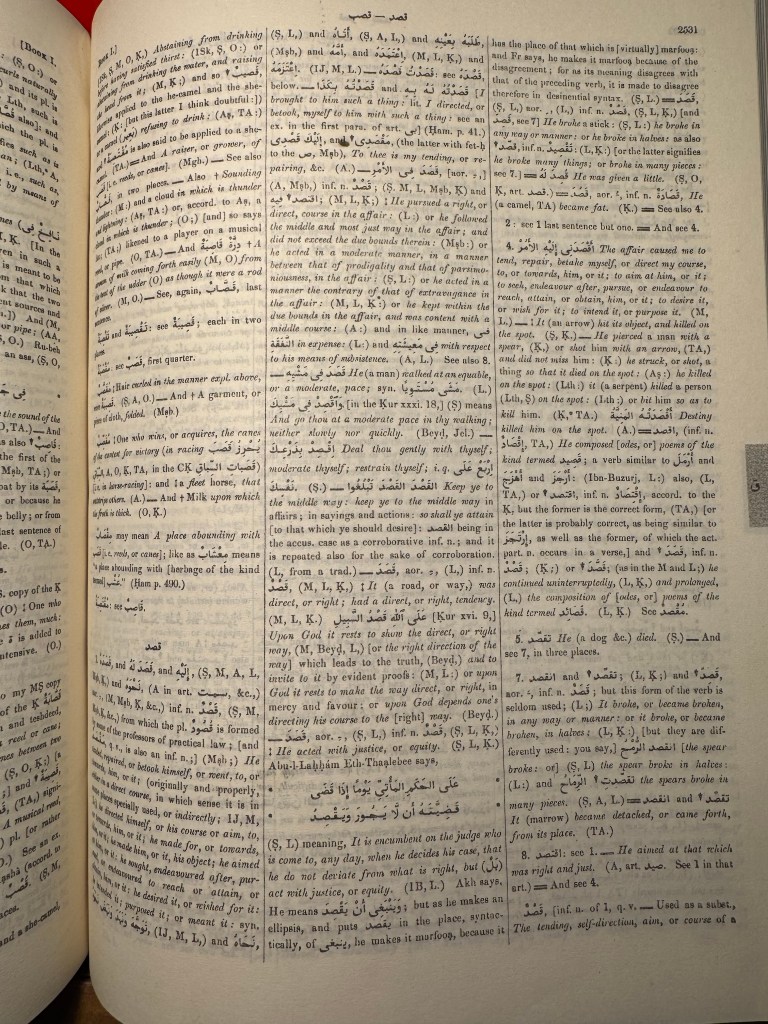
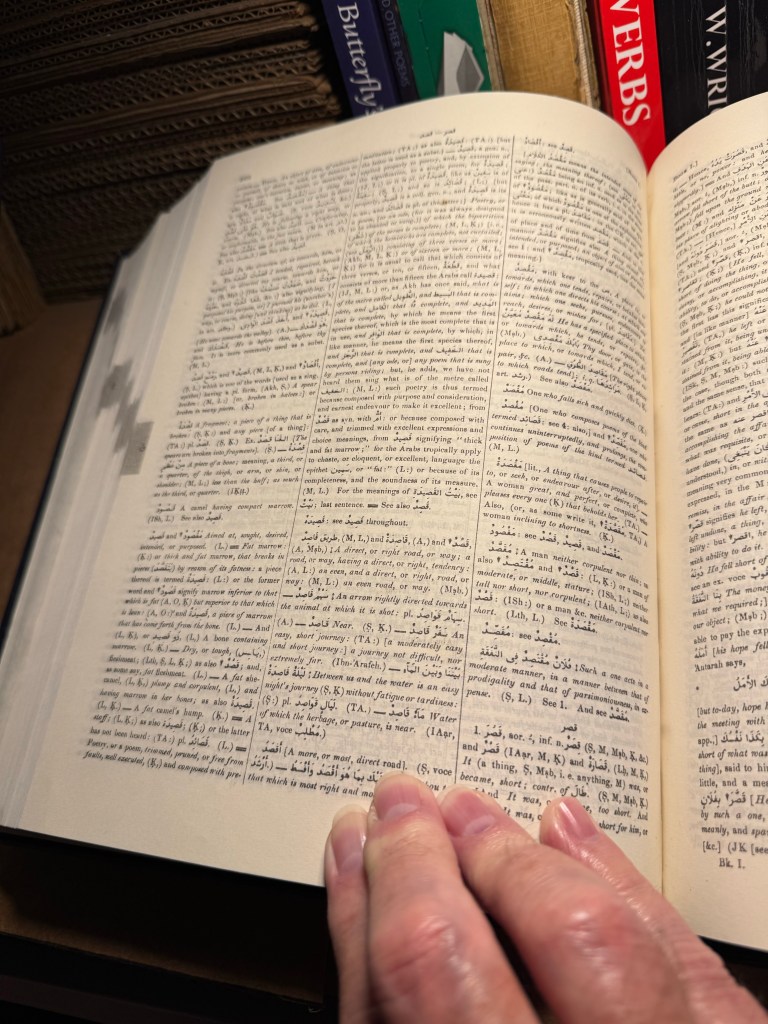
Lane’s entry for root q-ṣ-d spans two pages (1). Lane’s entry for root q-ṣ-d spans two pages (2).
(Update, Oct. 26, 2025. Some time after writing what’s below I’ve encountered Mitch Teemley’s citation of Psalm 37:23. What’s a good word for how the Quran and the Bible interact? I’ve no expertise in either, but I see signs of their being in dialogue as I go. The idea of a deity “making firm” the steps of an individual “on his or her way” — “The” Way — to enlightenment has affinity with the phrase picked apart below.)
If you make it to the end of this post and are not a student of Arabic or scripture, you are an admirably straight-ahead, honor-bright, questing reader and receive my utmost doff of cap. I’m a short-form blogger. This entry breaks the mold, but I can’t make it any less than what it is if I’m to to lay bare the very marrow of the matter.
The phrase to ponder is at the beginning of a Quranic verse. Here’s my transliteration:
Which would you have chosen? Here are the translations I monitor as I read the Arabic text (my bolding):
It rests with Allah alone to show you the Right Way, even when there are many crooked ways. Had He so willed, He would have (perforce) guided you all aright. — A. Maududi (Tafhim commentary) Allah Se charge (d’indiquer) la direction menant à la juste voie [“Allah takes charge (of indicating) the direction leading to the right way”] dont certains s’écartent pourtant. S’Il voulait, Il vous y conduirait tous. — Montada Islamic Foundation A Dios le incumbe indicar el Camino [“Upon God it is incumbent to indicate the Way”], del que algunos se desvían. Si hubiera querido, os habría dirigido a todos. — Julio Cortés, El Corán
They all alight on the notion of “showing” or “indicating” for qaṣd. I don’t find this sense satisfactorily accounted for in Wehr’s listing. Such an outcome always sets the hares running in my mind. I want to know how the experts reached their outcome, especially when they’re in agreement.
It often helps to see what the verb from which a noun derives can mean. For qaṣadaWehr lists these possible meanings:
to go or proceed straightaway, make a beeline, walk up to s.o. or s.th.; to go to see, call (on); to betake o.s., repair, go (to a place), be headed, be bound (for a place); to seek, pursue, strive, aspire, intend, have in mind; to aim; to have in view, contemplate, consider, purpose; to mean, try to say; to adopt a middle course; to be economical, frugal, thrifty, provident; to economize, save.
Here again I do not see the notion of showing and indicating satisfactorily accounted for. Wehr documents Modern Standard Arabic and solves most problems, given how conservative the language has been in its evolution from pre-Islamic times to the present. For what may be lapsed or archaic usage my last resort is the big gun: Lane’s Lexicon. Lane draws from the copious commentaries and compendiums of classic Eastern lexicographers and grammarians.
I feel I’ve really struck paydirt whenever Lane happens to cite the very verse of the Quran which I’m trying to elucidate textually. That happens to be the case here. Lane provides the following glosses of the phrase in question. (I’ve expanded its parenthetical abbreviated references to their titles as provided in the “Indications of Authorities,” p. xxxi):
Upon God it rests to show the direct, or right way, (“The Moḥkam,” El-Beydáwee’s “Exposition of the Kur-án,” The “Lisán el-‘Arab”) [or the right direction of the way] which leads to the truth, (El-Beydáwee’s “Exposition of the Kur-án”) and to invite to it by evident truths: (“The Moḥkam,” The “Lisán el-‘Arab”) or upon God it rests to make the way direct, or right, in mercy and favour: or upon God depends one’s directing his course to the [right] way. (El-Beydáwee’s “Exposition of the Kur-án”) […]
Are you still with me? I hope this sticky chase we’ve shared (remember the hares?) sheds light on my title. Have any of the proffered translations helped you understand exactly what qaṣd meant, say, to a seventh-century Arabic speaker?
Translations don’t actually or necessarily “fail”; most are useful in their way, but are often inflationary, bending in the direction of what feels like interpretive assumptions conforming to the strictures of a target language as well as to creed. This is especially true with ancient scriptures where vast temporal and cultural chasms yawn. The Montada French translation seems to me most consistently to track the Arabic in a reasonably close manner. It also manages to be graceful. Go figure! Accurate literalness is the trait I value most in a translation. My motto, for better and (!) worse, is “Not what it means, but what it says.” Is there Latin for that? Non indicare sed dicere?
Thanks for keeping me company on this little outing! Your seat is on the left. 🙂
Nothing we do has the quickness, the sureness, the deep intelligence living at peace would have.
(Denise Levertov)
I had the unique experience of being exposed to a poem orally, recited by the poet no less, and of understanding her words enough to be moved by them. Denise Levertov’s poem is called “Life at War.” It was new at this reading. She recites it from her handwritten notebook here, in 1966, starting at minute 11:35 of the video. Her tone and inflection of voice are earnestly neutral, which allows the words to stun, the delivery not distract. Her enunciation has bell-like clarity; her phrasing is deliberate, scrupulous, unforced. The periods breathe and cohere unhesitantly. For my ear and taste, Levertov’s recitation is majorly how it’s done. Respect to a master.
I’ve transcribed what I heard on the fly. There may be an error in what’s typed here, and obviously it’s not her lineation. It will be in published form somewhere. What’s a poem for? To rusticate on a page or to fly into someone’s ear? This one flew into mine. It came at me straight and hard; I had to get it down and pass it on.
LIFE AT WAR by Denise Levertov (transcribed from recitation)
The disaster’s numb within us, caught in the chest, roiling in the brain like pebbles. The feeling resembles lumps of raw dough weighing down a child’s stomach on baking day. Or Rilke said it: My heart, could I say it overflows with business? But no, as though its contents were simply balled into formless lumps. Thus do I carry it about.
The same war continues. We have breathed the grit of it in, all our lives. Our lungs are pocked with it, the mucus membrane of our dreams coated with it, the imagination filmed over with the gray filth of it.
The knowledge that humankind — delicate men whose flesh responds to a caress, whose eyes are flowers that perceive the stars, whose music excels the music of birds, whose laughter matches the laughter of dogs, whose understanding manifests designs fairer than the spider’s most intricate web — still turns without surprise, with mere regret, to the scheduled breaking open of breasts whose milk runs out over the entrails of still-alive babies, transformation of witnessing eyes to pulp fragments, implosion of skinned penises into carcass gullies.
We are the humans! Men who can make, beings so lovely we have believed one another the mirror image of a God we felt as good, who do these acts, convince ourselves it is necessary. These acts are done to our own flesh. Burned human flesh is smelling in Vietnam as I write.
Yes, this is the knowledge that jostles the space in our bodies along with all we go on knowing of joy, of love. Our nerve filaments twitch with its presence day and night. Nothing we say has not the husky phlegm of it in the saying. Nothing we do has the quickness, the sureness, the deep intelligence living at peace would have.
“We keep moving. We keep putting one foot in front of the other and wanting to be here. It takes a lot for somebody to decide they don’t want to be here… The world’s kind of painful — but God, I can’t get enough of it. I just don’t want it to end.”
He devoted a second book, “How to Write One Song” (2020), to encouraging across-the-board creativity and to offering practical suggestions to aspiring songwriters. One is simply to devote at least 20 minutes every day to working on songs, good or bad. “If you tried to write a bad song every day, you’d end up writing a good song every once in a while, you know?” he said. “I just think it’s about putting yourself in the position of being in the way of a song.”
Remembrance of Virginia Giuffre. “It takes a lot for somebody to decide they don’t want to be here.” Virginia Roberts Giuffre killed herself in April at age 41. Her posthumously published book has just appeared, titled Nobody’s Girl: Memoir of Surviving Abuse and Fighting for Justice, published by Doubleday.







Review of ‘Infinite Jest’ (Don’t Worry, I’m Jesting!)
I haven’t finished listening to the novel on my new Audible subscription, but I see no reason not to review it.
It’s twenty-seven Titanics of insanity steaming with breakneck slowness over an eternity of pages towards a who-knows-what species of icebergian reckoning beyond all feasible capacity of expectation.
It’s the ideal volume to be stranded on a desert island with, expiating one by one, word by word, every sin committed from cradle to grave (yes, in the metaphor you die on the island), keeping count by dropping grains of sand into a teacup salvaged from the shipwreck of life that brought you to this pass.
I don’t entirely dislike “Infinite Jest.” Read that as a positive statement in spite of its syntax. My son is a medical professional involved in mental health. I strive to recommend it to him. It has narratives he could profit from hearing. I can’t bring myself to do it. He has a life to lead, a profession to practice, and his time, unlike mine, is valuable. Saddling him with “Infinite Jest” would be like yoking him to a plough to turn 65 acres of sod for some intriguing weed-life to peek through.
I try to know as little as possible about writers’ lives. The knowledge distracts from their poems and doesn’t “explain” them any more than an alcoholic’s life “explains” his disease. The poem (or novel), and the disease, have their own voice. I know only that David Foster Wallace liked tennis and killed himself in his forties.
“Infinite Jest,” of its own accord, seems to me written by a brilliant, disturbed tennis nut possessed of suicidal ideation and an exquisitely attuned eye, ear and tongue for every species of human fallibility, deviancy, eccentricity and putridness under the sun. But and so (as he would write), not without glints of illumination, I affirm cautiously, suspiciously and hesitantly.
Will I have begrudged the time spent in hearing “Infinite Jest” read when it’s done? Nope. You can’t know the view from a jagged peak until you’ve climbed it. I anticipate the view from “Infinite Jest,” when reached, will be close to indescribable.
Here’s my anticipatory conclusion which I’ll reach when I get there: What I think of “Infinite Jest,” besides admiring its title, is neither here nor there. This novel will find those it needs to find, if and when they damn well want it and have the time. It found me, and vice versa. No complaints.
(c) 2025 JMN — EthicalDative. All rights reserved