
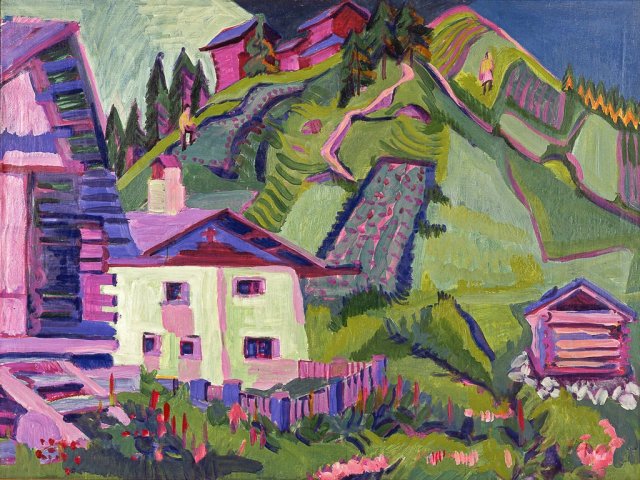
Ernst Ludwig Kirchner’s “White House in Sertig Valley,” 1926. Credit via Neuberger Museum of Art, Purchase College, State University of New York.
Roberta Smith describes Ernst Ludwig Kirchner as “the best and most versatile of the German Expressionists.”
Like many 20th-century German painters, Kirchner was twice broken, by World I, which resulted in his nervous breakdown, and the rise of Hitler, which ultimately drove him to suicide in 1938.
(Roberta Smith, “Modernism Reboots at the Museums — ‘Ernst Ludwig Kirchner’,” NYTimes, 9-13-19)
Smith mentions Kirchner’s “joltingly innovative color” and his “exuberantly jagged line.” These contributed to the “acidifying” of his images of modern life, she writes.
That captures some of what I admire in his “White House in Sertig Valley” (1926).
(c) 2019 JMN






 EthicalDative
When Is Kill Not “Over”?
Samplerman.
The illustration made me read this essay by Michelle Goldberg (“Margaret Atwood’s Dystopia, and Ours,” NYTimes, 9-14-19). On first glance, the picture’s Dairy Queen Blizzard ™ of cartoon imagery made me grumpy. Whatever it purports to symbolize, I thought, this illustration is overkill.
So I read the essay, and the illustration wasn’t. The topic is grim, but the language Goldberg unleashes is upscale and anomalously bracing. The illustration aptly evokes the cacophony she pillories.
She mentions the “salvific” potential of words.
She introduces me to a mock Latin phrase, “Nolite te bastardes carborundorum.” Like most mock language, it needs little translating.
She refers to a reality that “feels as if it’s disintegrating under the weight of digital simulacra and epistemological nihilism [my emphasis].
American journalism traditionally targets a sixth-grade reading level so as not to leave too many in the lurch. This piece, however, flouts tradition. Whereas I’m often guilty of using words as shields, Goldberg uses them as swords. They’re “elite” words, yes — but penetrative, and wielded unflinchingly.
(c) 2019 JMN