“Casually Disrespected Boundaries”

wally reinhardt

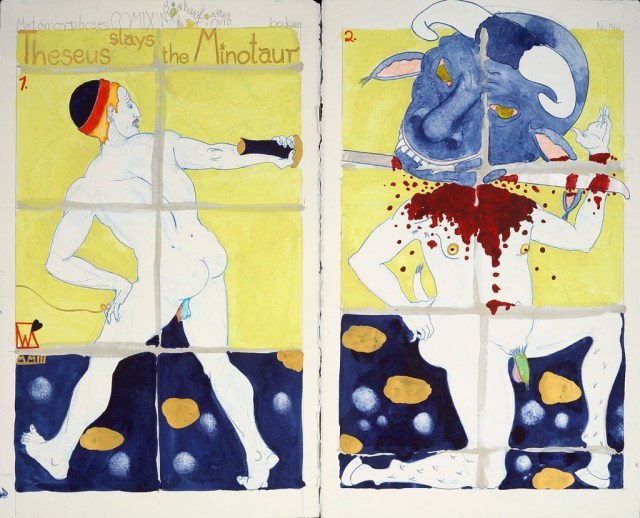
Wally Reinhardt’s “Theseus Slays the Minotaur,” from 2003, in the exhibition “Metamorphoses: Ovid According to Wally Reinhardt.” Credit via Grey Art Gallery.

While living in Rome in the 1970s, Wally Reinhardt became infatuated with Ovid’s “Metamorphoses.” I like the idea that a person with no formal background or training can disrespect boundaries while creating work that seems unstable and undependable.

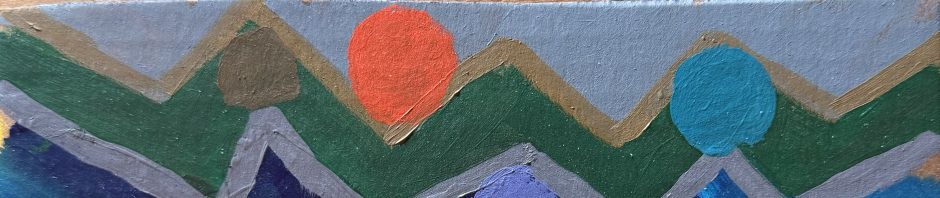
“Back in New York, in 1984, Mr. Reinhardt took up art himself with no formal background or training. Using colored pencil and gouache, he began drawing his favorite Ovidian scenes, later swapping out the gouache for watercolor… His loose-jointed, naked heroes and giants stride freely across boxes’ edges, even from page to page in polyptychs, while the colors of his stagy green hills and star-dappled indigo skies often stop just shy of their outlines.

All these casually disrespected boundaries, along with Mr. Reinhardt’s whimsical draftsmanship, make the mythological world he depicts seem very unstable — exciting, undependable. In other words, it’s all pretty sexy….”

(Will Heinrich, “What to See in New York Art Galleries Right Now [Wally Reinhardt],” NYTimes, 3-6-19)

(c) 2019 JMN.
Posted in Quotations | Tagged | Leave a comment

Bernard Gilardi

Bernard Gilardi

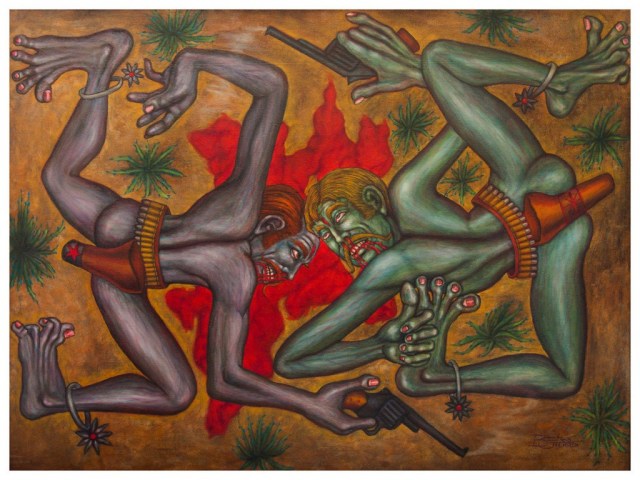
Bernard Gilardi’s “It’s a Draw,” a 1963 painting that depicts two dead, dueling men whose bodies are twisted into letter-like shapes. Credit via the Estate of Bernard Gilardi.

As an obscure, untrained, uninspired painter closeted in a shed, I get a vicarious boost reading about painters who manage to wander into visibility from the sidelines — posthumously, most often, which is not the boosting part.

“For more than 40 years, Gilardi made paintings in his Milwaukee homes, working in the attic and the basement, away from his wife and children. By day, he was a dot etcher at lithography companies; on nights and weekends, he used oil paint to conjure a playfully surreal world of bulbous, barely dressed humans cavorting with nature… Gilardi never displayed his art during his lifetime. When he died, in 2008, he left behind almost 400 paintings. His first public exhibition came two years later, at the Portrait Society Gallery in Milwaukee.”

(Jillian Steinhauer, “What to See in New York Art Galleries Right Now [Bernard Gilardi],” NYTimes, 3-6-19)

(c) 2019 JMN.

Posted in Quotations | Tagged | Leave a comment

Defamation Nation


exclamation-mark

How Australia Became the Defamation Capital of the World
A court ruling in favor of a billionaire businessman against The Sydney Morning Herald illustrates the sorry state of the country’s defamation laws.

By Louisa Lim
Ms. Lim is a senior lecturer at the Centre for Advancing Journalism at the University of Melbourne, and a former NPR and BBC correspondent based in Beijing.

(NYTimes, 3-5-19)

This article is interesting for citing language of an Australian judge in ruling that a Chinese businessman was defamed by a 2015 Sydney Morning Herald article. (The article alleged bribery of a United Nations official by the businessman, who has been a major
political donor.)

It’s one thing to look up dictionary definitions of “defamation,” but another to see how a judge defines it in a real court case. The article’s author describes Australia’s defamation laws as “oppressive and notoriously complex.”

The judge in the case ruled that the offending article “used language that was ‘imprecise, ambiguous and loose, but also sensational and derisory’.” Let’s see now, where else have I
seen that sort of language recently? Oh yes. Everywhere.

(c) 2019 JMN.

Posted in Anthology, Commentary | Tagged | Leave a comment

Crossed Out

jean-michel basquiat

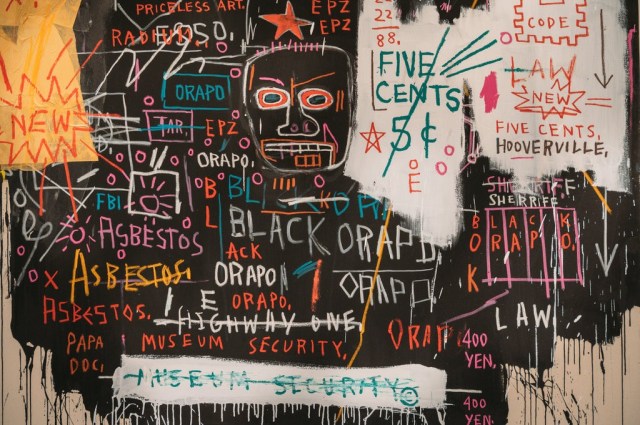
Detail of Basquiat’s text-filled “Museum Security (Broadway Meltdown),” from 1983, acrylic, oilstick and paper collage on canvas. Credit The Estate of Jean-Michel Basquiat, Licensed by Artestar, New York; via The Brant Foundation; Charlie Rubin for The New York Times.

[The Brant Foundation Art Study Center in the East Village, New York City, opens with an exhibition of nearly 70 works by Jean-Michel Basquiat created from 1980 to 1987.]

Other paintings pay homage to jazz greats like Miles Davis and Charlie Parker (Basquiat worked in a similarly improvisatory way) and handwritten text appears everywhere. Basquiat favored the cutup technique of the Beat writer William Burroughs but he also witnessed the rise of rap and hip-hop music. His words feel eerily poignant today: “debt shrine,” “per capita,” “Hooverville,” “perishable,” “black teeth,” “immortality.” … Crossed-out words also recur in his paintings and are weirdly reminiscent of the bracketing or slashing of text in deconstructionist philosophy, to emphasize the cultural and biased nature of language. Funny to realize in retrospect that Basquiat and the French philosopher Jacques Derrida were on the same page.

(Martha Schwendener, “‘Jean-Michel Basquiat’ at the Brant Shows His Bifurcated Life,” NYTimes, 3-5-19)

(c) 2019 JMN.

Posted in Anthology, Quotations | Tagged | Leave a comment

Titans in Natty Attire

joni mitchell and david hockney

Joni Mitchell and David Hockney at L.A. Louver gallery in Los Angeles, where Mr. Hockney’s solo exhibition is on view. Credit Jacob Sousa, via L.A. Louver, Venice, CA.

Joni Mitchell describes herself as a “painter derailed by circumstance.” (“Joni Mitchell,” Wikipedia)

(Photo from Guy Trebay, “Of David Hockney and Joni Mitchell Holding Hands,” NYTimes, 2-28- 19)

(c) 2019 JMN.

Posted in Anthology, Commentary | Tagged , | Leave a comment

Proto Trudeau?

Hogarth

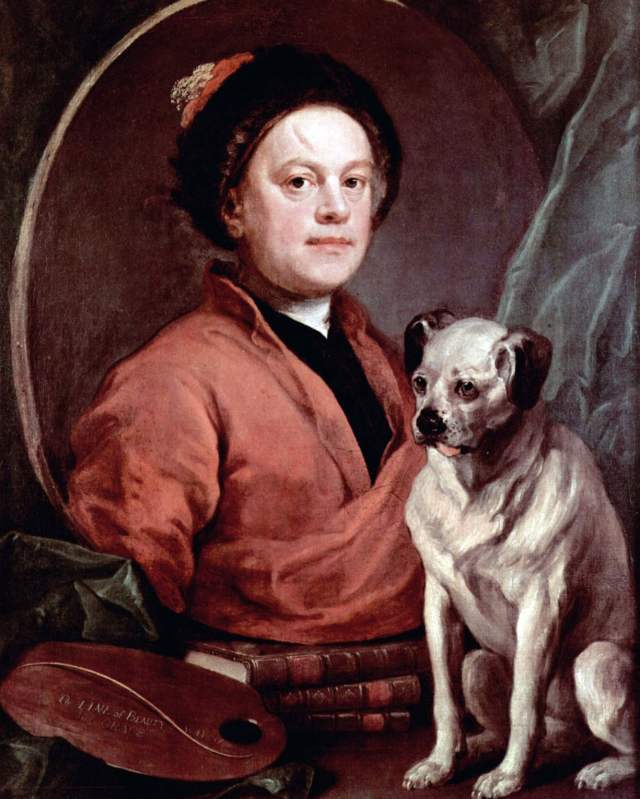
Painter and his Pug, 1745, is a self-portrait by William Hogarth. Photograph: Universal Images Group/Getty.

[“Sir John Soane’s Museum [London] will announce this week that it is to stage Hogarth: Place and Progress, an exhibition of 50 or so works in which Hogarth observed the morals of contemporary life, conveying the comedy and tragedy of all human frailty.”]

“[Hogarth] was a social critic but he wasn’t against the establishment or in any way politically radical,” [David Bindman, Hogarth scholar] said. “The paintings are often seen as an attack on pretension and the aristocracy. It’s not actually the case. He had a lot of friends who were aristocrats. He simply picked up on contemporary literary ideas that the aristocracy and the merchant class had a number of people who didn’t live up to their ideals.”

Dalya Alberge, “Gin, syphilis, lunacy: Hogarth’s grotesques united in new show,” The Guardian, 3-2-19)

(c) 2019 JMN.

Posted in Anthology, Quotations | Tagged | Leave a comment

The Screaming “Caravaggio”

caravaggio judith and holofernes

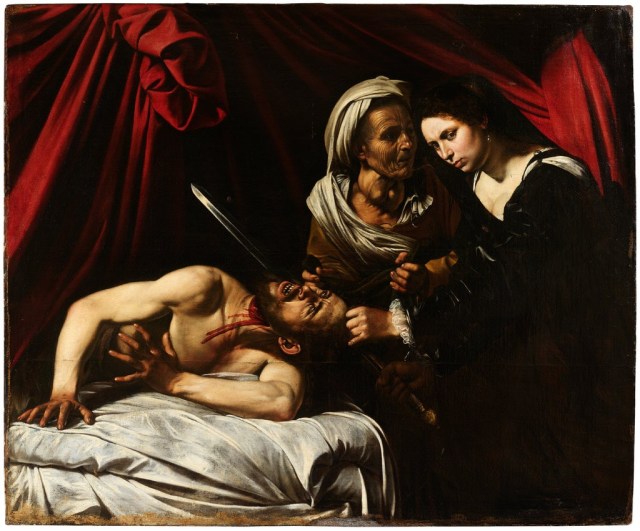
“Judith and Holofernes” which was found in an attic in Toulouse, France 2014, will be auctioned in June. Credit Cabinet Turquin.

Eric Turquin, art dealer: “Look at the execution of the lips, the way the chin and eyelids are painted… It belongs to Caravaggio. How could it be by anyone else?”
Keith Christiansen, MOMA-NY: [Contains details too crude to be by Caravaggio, including the] “concentric wrinkles of the old servant’s face.”
Gianni Papi, University of Florence: [The head of Holofernes is] “too loaded, with those animal teeth” [to be by Caravaggio].
James Bradburne, Pinacoteca de Brera, Milan: “The touch of the brush screamed out Caravaggio,” [referring to the delicacy with which Judith’s left cuff is painted].
(Quotations are from Scott Reyburn, “Is That a Real Caravaggio? It’s All in the Detail,” NYTimes, 2-28-19)

I have limited interest in fights over attribution of art works to old masters. However, the tumescent rhetoric swirling around the disturbing painting in question attracted notice. The discussion doesn’t live up to my expectations in the matter of scholarly debate. It rings shrill and opportunistic. Consider that Marc Labarbe, an auctioneer, found the “spectacularly well-preserved 17th-century canvas” in an attic in 2014. Mr. Labarbe will auction the painting “in collaboration with” Mr. Turquin, the art dealer quoted above saying, “How could it be by anyone else?” They hope it will sell for between $115 and $170 million. The auctioneer and art dealer (and perhaps someone they represent) have money
riding on the attribution of this pristine canvas to Michelangelo Merisi (1571-1610), the brawling murderer known as Caravaggio, who also painted well. And money screams.

(c) 2019 JMN.

Posted in Commentary | Tagged , | Leave a comment

The “Immortals” Budge

feminine firefighters

Women firefighters are already often called sapeuses-pompières.

Decades after other French-speaking countries adopted feminine names for professions, the official guardians of the language in France have also backed the change.

The Académie française, whose members are known as “immortals”, has said it has no obstacle in principle to such a “natural evolution” of French.

In its report it said “the academy considers that all developments aiming at recognising in language the place of women in today’s society can be foreseen, as long as they do not contravene the elementary and fundamental rules of language”…

(“Feminine job titles get go-ahead in France,” BBC.com, 3-1-19)

Examples — Masculine/Feminine:

professeur/professeure
auteur/auteure-autoresse-autrice
préfet/préfète (prefect)
député/députée (MP)
avocat/avocate (lawyer)
procureur/procureure (prosecutor)
le juge/la juge
le ministre/la ministre
le médecin/la médecin (doctor) [“médecine” would be confused with “medicine”]
chef/cheffe
écrivain/écrivaine (writer)
ingénieur/ingénieure (engineer)
sapeur-pompier/sapeuse-pompière (firefighter)

(c) 2019 JMN.

Posted in Anthology, Quotations | Tagged , | 2 Comments

Haircut Comment of the Day

rob auton

Grizzly… Rob Auton. Photograph: Julian Ward .

Rob Auton: ‘My haircut got comments like – Doth thou playeth the lute, sire?’

The polymath standup, writer and painter on the things that make him laugh the most…

(Harriet Gibsone, The Guardian, 3-1-19)

(c) 2019 JMN.

Posted in Quotations | Tagged | 2 Comments

Correct Me If I’m Wrong

exclamation-mark

People often say that our problem in America today is incivility or intolerance. This is incorrect… You might be tempted to say we need to find ways to disagree less, but that is incorrect… This might sound like a call for magnanimity, but it is just as much an appeal to self-interest… Finally, we should see the contempt around us as what it truly is: an opportunity, not a threat… It is easy to feel helpless in the current political environment, but I believe that is unwarranted.

(Arthur C. Brooks, “Our Culture of Contempt,” NYTimes, 3-2-19)

Mr. Brooks’s rhetoric is interesting. The snippets quoted above, taken out of context, might lead one to think he’s being provokingly disputatious in his essay, bent on contradicting the reader’s “incorrect” assumptions. That would be a misreading, however; Brooks in fact has some affirming things to say and states them persuasively. As basis for his discussion he cites the Proceedings of the National Academy of Sciences on “motive
attribution asymmetry.” This, he says, is “the assumption that your ideology is based in love, while your opponent’s is based in hate.”

This blog skirts ideology for the most part, so I leave it there, having noted a style trait used to good effect in my view.

(c) 2019 JMN.

Posted in Anthology, Quotations | Tagged , | Leave a comment