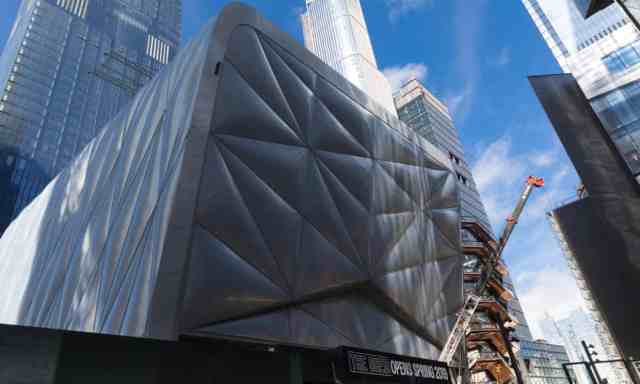
The Shed will keep back 10% of the seats in every row for low-income visitors, who will be able to buy $10 tickets. Photograph: Christopher Lane.
[This April the Shed will be “the largest new art space to have opened in New York since the Lincoln Center in 1962.” Originally, it was to be called the Culture Shed.]
“I didn’t like the sound of [the name],” [Alex Poots, its director] says. “Culture Shed – it sounded a bit preachy.” He called a friend, one of the creative directors at Framestore, the company responsible for the CGI sequences in the Alfonso Cuarón film, Gravity. “And he said, ‘Why would you call it Culture Shed? It’s like a soap opera putting on a laugh track to tell your dumb audience when to laugh.’” Then he called Marina Abramovic, who … said: “Why call it that? When they made Apple, they didn’t call it the Apple Computer.” Finally, Poots went back to the board and suggested dropping “culture” from the title and just calling it the Shed. “I liked the idea of the Shed because it’s where you make things,” he said. Plus, “it would’ve been shortened anyway, like the Met, so you may as well save on rebranding costs in three years’ time.”
(Emma Brockes, “Alex Poots: The Scottish impresario opening NYC’s largest new art space,” The Guardian, 3-3-19)
(c) 2019 JMN.





 EthicalDative
How Rembrandt Worked
“Portrait of a Young Gentleman,” discovered by Jan Six XI in a Christie’s catalog as a likely Rembrandt. Credit René Gerritsen/Jan Six Fine Art.
I liked the detail quoted below of how Rembrandt painted lace — the “hieroglyphic jumble” that coheres from afar– as well as the notion that a painted copy of a repetitive pattern actually looks artificial. This is helpful to a striving painter.
(Russell Shorto, “Rembrandt in the Blood: An Obsessive Aristocrat, Rediscovered Paintings and an Art-World Feud,” NYTimes, 2-27-19)
(c) 2019 JMN.