
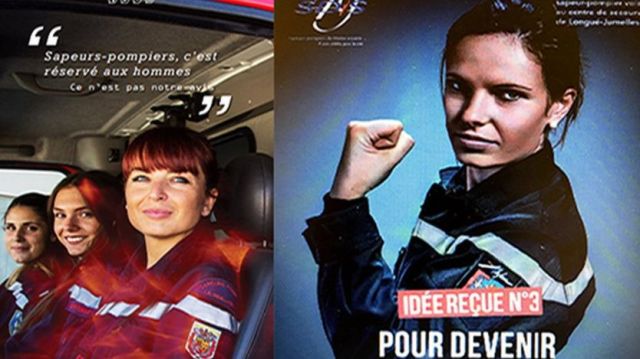
Women firefighters are already often called sapeuses-pompières.
Decades after other French-speaking countries adopted feminine names for professions, the official guardians of the language in France have also backed the change.
The Académie française, whose members are known as “immortals”, has said it has no obstacle in principle to such a “natural evolution” of French.
In its report it said “the academy considers that all developments aiming at recognising in language the place of women in today’s society can be foreseen, as long as they do not contravene the elementary and fundamental rules of language”…
(“Feminine job titles get go-ahead in France,” BBC.com, 3-1-19)
Examples — Masculine/Feminine:
professeur/professeure
auteur/auteure-autoresse-autrice
préfet/préfète (prefect)
député/députée (MP)
avocat/avocate (lawyer)
procureur/procureure (prosecutor)
le juge/la juge
le ministre/la ministre
le médecin/la médecin (doctor) [“médecine” would be confused with “medicine”]
chef/cheffe
écrivain/écrivaine (writer)
ingénieur/ingénieure (engineer)
sapeur-pompier/sapeuse-pompière (firefighter)
(c) 2019 JMN.






 EthicalDative
How Rembrandt Worked
“Portrait of a Young Gentleman,” discovered by Jan Six XI in a Christie’s catalog as a likely Rembrandt. Credit René Gerritsen/Jan Six Fine Art.
I liked the detail quoted below of how Rembrandt painted lace — the “hieroglyphic jumble” that coheres from afar– as well as the notion that a painted copy of a repetitive pattern actually looks artificial. This is helpful to a striving painter.
(Russell Shorto, “Rembrandt in the Blood: An Obsessive Aristocrat, Rediscovered Paintings and an Art-World Feud,” NYTimes, 2-27-19)
(c) 2019 JMN.